

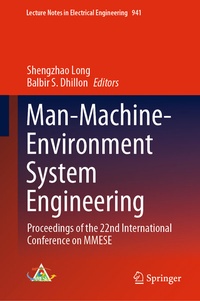
Man-Machine-Environment System Engineering
Proceedings of the 22nd International Conference on MMESE
1st Edition
Published on 20. August 2022
XXII, 730 pages
978-981-19-4786-5 (ISBN)
Description

Man-Machine-Environment System Engineering: Proceedings of the 22nd Conference on MMESE are an academic showcase of the best papers selected from more than 500 submissions, introducing readers to the top research topics and the latest developmental trends in the theory and application of MMESE. This proceedings are interdisciplinary studies on the concepts and methods of physiology, psychology, system engineering, computer science, environment science, management, education, and other related disciplines. Researchers and professionals who study an interdisciplinary subject crossing above disciplines or researchers on MMESE subject will be mainly benefited from this proceedings
MMESE primarily focuses on the relationship between Man, Machine and Environment, studying the optimum combination of man-machine-environment systems. In this system, "Man" refers to working people as the subject in the workplace (e.g. operators, decision-makers); "Machine" is the general namefor any object controlled by Man (including tools, machinery, computers, systems and technologies), and "Environment" describes the specific working conditions under which Man and Machine interact (e.g. temperature, noise, vibration, hazardous gases etc.). The three goals of optimization of the man-machine-environment systems are to ensure safety, efficiency and economy.
The integrated and advanced science research topic Man-Machine-Environment System Engineering (MMESE) was first established in China by Professor Shengzhao Long in 1981, with direct support from one of the greatest modern Chinese scientists, Xuesen Qian. In a letter to Shengzhao Long from October 22nd, 1993, Xuesen Qian wrote: "You have created a very important modern science and technology in China!"
MMESE primarily focuses on the relationship between Man, Machine and Environment, studying the optimum combination of man-machine-environment systems. In this system, "Man" refers to working people as the subject in the workplace (e.g. operators, decision-makers); "Machine" is the general namefor any object controlled by Man (including tools, machinery, computers, systems and technologies), and "Environment" describes the specific working conditions under which Man and Machine interact (e.g. temperature, noise, vibration, hazardous gases etc.). The three goals of optimization of the man-machine-environment systems are to ensure safety, efficiency and economy.
The integrated and advanced science research topic Man-Machine-Environment System Engineering (MMESE) was first established in China by Professor Shengzhao Long in 1981, with direct support from one of the greatest modern Chinese scientists, Xuesen Qian. In a letter to Shengzhao Long from October 22nd, 1993, Xuesen Qian wrote: "You have created a very important modern science and technology in China!"
More details
Series
Language
English
Place of publication
Singapore
Singapore
Publishing group
Springer Singapore
Target group
Professional and scholarly
Product notice
Reflowable
Illustrations
XXII, 730 p. 305 illus., 206 illus. in color.
File size
71,56 MB
ISBN-13
978-981-19-4786-5 (9789811947865)
DOI
10.1007/978-981-19-4786-5
Schweitzer Classification
Other editions
Additional editions
Shengzhao Long | Balbir S. Dhillon
Man-Machine-Environment System Engineering
Proceedings of the 22nd International Conference on MMESE
Book
08/2022
Springer
€374.49
Shipment within 3-4 weeks
Persons
Professor Shengzhao LongProfessor Shengzhao Long is the founder of the Man-Machine-Environment System Engineering (MMESE),the Chairman of the Man-Machine-Environment System Engineering (MMESE) Committee of China, the Chairman of the Beijing Kecui Man-Machine Environment System Engineering Technology Research Institute and the Former Director of Ergonomics Lab of Astronaut Centre of China. In October 1992, he's honored by the Chinese Government National Specific Allowance.Professor Shengzhao Long graduated from the Shanghai Science and Technology University in 1965, China. In 1981, supported by the famous modern scientist Qian Xuesen, he founded MMESE theory. In 1982, he proposed and developed Human Fuzzy Control Model using fuzzy mathematics. From August 1986 to August 1987, he conducted research in Man-Machine System as a visiting scholar at Tufts University, Massachusetts, U.S.A. In 1993, he established Man-Machine-Environment System Engineering (MMESE) Committee of China. He published "Foundation of theory and application of Man-Machine-Environment System Engineering"(2004) and "Man-Machine-Environment System Engineering"(1987). He's the chief editor from the 1st to the 20th conference proceeding on Man-Machine-Environment System Engineering from 1993 to 2020.
Professor Balbir S. DhillonProfessor Dhillon is a professor of Engineering Management in the Department of Mechanical Engineering at the University of Ottawa, Canada. He has served as a Chairman/Director of Mechanical Engineering Department/Engineering Management Program for over 10 years at the same institution. He has published over 345 (i.e., 201 journal + 144 conference proceedings) articles on reliability, safety, engineering management, etc. He has been on the editorial boards of 9 international scientific journals. In addition, Dr. Dhillon has written 34 books on various aspects of reliability, design, safety, quality, and engineering management published by Wiley (1981), Van Nostrand (1982), Butterworth (1983), Marcel Dekker (1984), Pergamon (1986), etc. His books are being used in over 85 countries and many of them are translated into languages such as German, Russian and Chinese. He has served as General Chairman of two international conferences on reliability and quality control held in Los Angeles and Paris in 1987.Professor Dhillon has served as a consultant to various organizations and bodies and has many years of experience in the industrial sector. At the University of Ottawa, he has been teaching reliability, quality, engineering management, design, and related areas for over 29 years and he has also lectured in over 50 countries, including keynote addresses at various international scientific conferences held in North America, Europe, Asia, and Africa. In March 2004, Dr. Dhillon was a distinguished speaker at the Conf./Workshop on Surgical Errors (sponsored by White House Health and Safety Committee and Pentagon), held at the Capitol Hill (One Constitution Avenue, Washington, D.C.). Professor Dhillon attended the University of Wales where he received a BS in electrical and electronic engineering and an MS in mechanical engineering. He received a Ph.D. in industrial engineering from the University of Windsor.
Professor Balbir S. DhillonProfessor Dhillon is a professor of Engineering Management in the Department of Mechanical Engineering at the University of Ottawa, Canada. He has served as a Chairman/Director of Mechanical Engineering Department/Engineering Management Program for over 10 years at the same institution. He has published over 345 (i.e., 201 journal + 144 conference proceedings) articles on reliability, safety, engineering management, etc. He has been on the editorial boards of 9 international scientific journals. In addition, Dr. Dhillon has written 34 books on various aspects of reliability, design, safety, quality, and engineering management published by Wiley (1981), Van Nostrand (1982), Butterworth (1983), Marcel Dekker (1984), Pergamon (1986), etc. His books are being used in over 85 countries and many of them are translated into languages such as German, Russian and Chinese. He has served as General Chairman of two international conferences on reliability and quality control held in Los Angeles and Paris in 1987.Professor Dhillon has served as a consultant to various organizations and bodies and has many years of experience in the industrial sector. At the University of Ottawa, he has been teaching reliability, quality, engineering management, design, and related areas for over 29 years and he has also lectured in over 50 countries, including keynote addresses at various international scientific conferences held in North America, Europe, Asia, and Africa. In March 2004, Dr. Dhillon was a distinguished speaker at the Conf./Workshop on Surgical Errors (sponsored by White House Health and Safety Committee and Pentagon), held at the Capitol Hill (One Constitution Avenue, Washington, D.C.). Professor Dhillon attended the University of Wales where he received a BS in electrical and electronic engineering and an MS in mechanical engineering. He received a Ph.D. in industrial engineering from the University of Windsor.
Content
Part1 Research on the Man Character.- Part2 Research on the Machine Character.- Part3 Research on the Environment Character.- Part4 Research on the Man-Machine Relationship.- Part5 Research on the Man-Environment Relationship.- Part6 Research on the Machine-Environment Relationship.- Part7 Research on the Overall Performance of Man-Machine-Environment System.- Part8 Theory & Application Research of the MMESE.
