

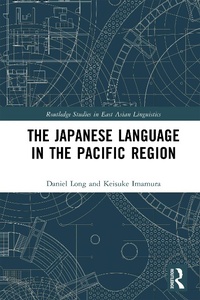
The Japanese Language in the Pacific Region
1st Edition
Published on 16. August 2024
240 pages
978-1-040-09703-8 (ISBN)
Description

Long and Imamura examine language contact phenomena in the Asia Pacific region in the context of early 20th-century colonial history, focusing on the effects the Japanese language continues to have over island societies in the Pacific.
Beginning in the early 20th century when these islands were taken over by the Japanese Empire and continuing into the 21st century, the book examines 5,150 Japanese-origin loanwords used in 14 different languages. It delves into semantic, phonological, and grammatical changes in these loanwords that form a fundamental part of the lexicons of the Pacific Island languages, even now in the 21st century. The authors examine the usage of Japanese kana for writing some of the local languages and the pidginoid phenomena of Angaur Island. Readers will gain a unique understanding of the Japanese language's usage in the region from colonial times through the post-war period and well into the current century.
Researchers, students, and practitioners in the fields of sociolinguistics, language policy, and Japanese studies will find this book particularly useful for the empirical evidence it provides regarding language contact situations and the various Japanese language influences in the Asia Pacific region. The authors also offer accompanying e-resources that help to further illustrate the examples found in the book.
Beginning in the early 20th century when these islands were taken over by the Japanese Empire and continuing into the 21st century, the book examines 5,150 Japanese-origin loanwords used in 14 different languages. It delves into semantic, phonological, and grammatical changes in these loanwords that form a fundamental part of the lexicons of the Pacific Island languages, even now in the 21st century. The authors examine the usage of Japanese kana for writing some of the local languages and the pidginoid phenomena of Angaur Island. Readers will gain a unique understanding of the Japanese language's usage in the region from colonial times through the post-war period and well into the current century.
Researchers, students, and practitioners in the fields of sociolinguistics, language policy, and Japanese studies will find this book particularly useful for the empirical evidence it provides regarding language contact situations and the various Japanese language influences in the Asia Pacific region. The authors also offer accompanying e-resources that help to further illustrate the examples found in the book.
More details
Series
Edition
1. Auflage
Language
English
Place of publication
London
United Kingdom
Publishing group
Taylor & Francis Ltd
Target group
College/higher education
Professional and scholarly
Illustrations
97 Tables, black and white; 8 Line drawings, black and white; 28 Halftones, black and white; 36 Illustrations, black and white
ISBN-13
978-1-040-09703-8 (9781040097038)
Copyright in bibliographic data and cover images is held by Nielsen Book Services Limited or by the publishers or by their respective licensors: all rights reserved.
Schweitzer Classification
Other editions
Additional editions
Daniel Long | Keisuke Imamura
The Japanese Language in the Pacific Region
Book
approx. 12/2025
1st Edition
Routledge
€68.80
Not yet published
Daniel Long | Keisuke Imamura
The Japanese Language in the Pacific Region
Book
08/2024
1st Edition
Routledge
€193.80
Shipment within 10-20 days
Persons
Daniel Long is Professor of Japanese Linguistics at Tokyo Metropolitan University, Japan.
Keisuke Imamura is Associate Professor of Japanese Language and Linguistics at Tokyo University of Marine Science and Technology, Japan.
Keisuke Imamura is Associate Professor of Japanese Language and Linguistics at Tokyo University of Marine Science and Technology, Japan.
Content
1. Introduction 2. The Historical Background of Japanese Usage in Palau 3. Place Names of Japanese Origin in Nan'yo 4. People's Names of Japanese Origin in Palau 5. Linguistic Landscapes and Japanese Loanwords 6. Quantitative Research into Japanese Loanwords 7. Phonological Adaptations in Japanese Loanwords 8. Semantic Changes in Japanese Loanwords 9. Grammatical Changes in Japanese Loanwords 10. Socio-historical Analysis of Japanese Loanwords 11. Retention Rates of Japanese Loanwords 12. Phonological Changes across Generations in Japanese Loanwords 13. Language Policy and Spelling Reforms in Japanese Loanwords 14. Katakana Usage in Nan'yo and Other Japanese Colonies 15. Pidginoid Japanese in Angaur 16. Official Language Status of Japanese in Angaur 17. Welfare Linguistics and the Japanese Loanword Dictionary
