

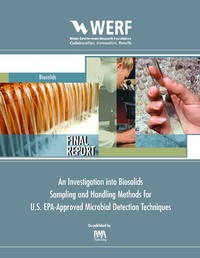
An Investigation into Biosolids Sampling and Handling Methods for U.S. EPA-Approved Microbial Detection Techniques
WERF Report 04-HHE-7
Published on 30. June 2009
186 pages
978-1-78040-359-5 (ISBN)
Description

The objective of this research was to develop guidance for collecting samples of biosolids for microbial analysis to ensure representative samples are tested. The types of biosolids products studied included liquid, cake and compost. To accomplish the research objective, three phases of research and development of a suite of communications documents were undertaken.
The first Phase involved information gathering and establishing the status of sampling guidance and practices for biosolids. Phase II involved conducting sampling and microbial analysis of biosolids products from four target facilities utilizing different biosolids treatment technologies to determine which of a series of sample collection and handling parameters most affects sample integrity and representativeness. Phase III of the project involved field testing at nine utilities. Microbial monitoring results were compared and utility protocols were examined to determine the suitability of their sampling approach. Finally, a series of communications documents were prepared.
These communications tools were designed to convey the importance of sampling and handling details at multiple stakeholder levels. This research demonstrated that analysis of multiple, discrete, grab samples provides insight into product variability. In addition, proper handling and adherence to sample size and storage protocols provides a reliable measurement of biosolids microbial content from the biosolids production process being sampled.
The first Phase involved information gathering and establishing the status of sampling guidance and practices for biosolids. Phase II involved conducting sampling and microbial analysis of biosolids products from four target facilities utilizing different biosolids treatment technologies to determine which of a series of sample collection and handling parameters most affects sample integrity and representativeness. Phase III of the project involved field testing at nine utilities. Microbial monitoring results were compared and utility protocols were examined to determine the suitability of their sampling approach. Finally, a series of communications documents were prepared.
These communications tools were designed to convey the importance of sampling and handling details at multiple stakeholder levels. This research demonstrated that analysis of multiple, discrete, grab samples provides insight into product variability. In addition, proper handling and adherence to sample size and storage protocols provides a reliable measurement of biosolids microbial content from the biosolids production process being sampled.
More details
Series
Language
English
Place of publication
London
United Kingdom
Target group
College/higher education
Professional and scholarly
File size
2,68 MB
ISBN-13
978-1-78040-359-5 (9781780403595)
Copyright in bibliographic data and cover images is held by Nielsen Book Services Limited or by the publishers or by their respective licensors: all rights reserved.
Schweitzer Classification
Other editions
Additional editions
Sharon C. Long
An Investigation into Biosolids Sampling and Handling Methods for U.S. EPA-Approved Microbial Detection Techniques
Book
06/2009
IWA Publishing
€166.38
Shipment within 3-4 weeks
Content
- Cover
- Copyright
- Acknowledgments
- Abstract and Benefits
- Table of Contents
- List of Tables
- List of Figures
- List of Acronyms
- Executive Summary
- Chapter 1.0: Introduction and Objectives
- 1.1 Introduction
- 1.2 Objectives and Research Approach
- Chapter 2.0: State of Biosolids Sampling Practice
- 2.1 Literature Review
- 2.1.1 Background
- 2.1.2 Microbial Testing of Biosolids
- 2.1.3 Biosolids Sampling and Handling
- 2.1.4 Sampling Information from Other Disciplines
- 2.1.5 Research Questions
- 2.2 Utility Survey
- 2.2.1 Synopsis of Utilities Survey Results
- 2.2.2 Additional Synthesis of Survey Results
- 2.2.3 Overview of Project Guidance Gained from the Utility Survey
- 2.3 WEFTEC Workshop
- 2.4 Summary of Phase I Information Gathering
- Chapter 3.0: Experimental Work
- 3.1 Study Site Selection
- 3.1.1 Facility #1
- 3.1.2 Facility #2
- 3.1.3 Facility #3
- 3.1.4 Facility #4
- 3.2 Sample Collection and Handling Experimental Approach
- 3.2.1 Research Question 1
- 3.2.2 Research Question 2
- 3.2.3 Research Question 3
- 3.2.4 Research Question 4
- 3.2.5 Research Question 5
- 3.2.6 Research Question 6
- 3.2.7 Research Question 7
- 3.2.8 Research Question 8
- 3.2.9 Research Question 9
- 3.2.10 Statistical Analysis
- 3.3 Experimental Results
- 3.3.1 Pipe Purging for Liquid Samples
- 3.3.2 Effects of Discrete Sample Size
- 3.3.3 Composite Sampling for Liquid Biosolids
- 3.3.4 Numbers of Samples and Production of Composite Samples
- 3.3.5 Effects of Sample Holding Times
- 3.3.6 Cooling Regimes
- 3.3.7 Field Sterilization
- 3.3.8 Compost and Particle Size Effects
- 3.3.9 Multiple Microbial Measures
- Chapter 4.0: Field Studies
- 4.1 Field Study Results
- 4.1.1 SE Utility 1 - Class B Liquid
- 4.1.2 SE Utility 2 - Class A and Class B Liquid
- 4.1.3 MW Utility 1 - Class B Liquid
- 4.1.4 MW Utility 2 - Class A Cake
- 4.1.5 MW Utility 3 - Class B Cake
- 4.1.6 NW Utility 1 - Class B Cake
- 4.1.7 SE Utility 3 - Class A Compost
- 4.1.8 SE Utility 4 - Class A Compost
- 4.1.9 NE Utility 1 - Class A Compost
- 4.2 Brief Study Site Results
- 4.2.1 SW Utility 1 - Class A Liquid
- 4.2.2 NW Utility 2 - Class B Cake
- 4.3 Key Phase III Findings
- Chapter 5.0: Communications
- 5.1 The Communications Approach
- 5.2 Purpose of the Communications Strategy
- 5.3 Other Potential Communication Efforts
- 5.4 Communications Beta-test Results Summary
- 5.4.1 General Comments and Feedback of Note
- 5.4.2 Comments Specific to Content
- 5.4.3 Formats
- 5.4.4 Notable Communication Needs
- 5.4.5 Final Note
- Chapter 6.0: Recommendations and Future Research Needs
- 6.1 Recommendations
- 6.2 Future Research Needs
- Chapter 7.0: Key Research Activities and Findings
- Appendix A: Utility Surveys
- Appendix B: Communications
- Appendix C: Communications ß-Test
- References
