

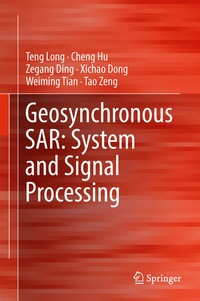
Geosynchronous SAR: System and Signal Processing
Description

This book chiefly addresses the analysis and design of geosynchronous synthetic aperture radar (GEO SAR) systems, focusing on the algorithms, analysis, methods used to compensate for ionospheric influences, and validation experiments for Global Navigation Satellite Systems (GNSS). Further, it investigates special problems in the GEO SAR context, such as curved trajectories, the Earth's rotation, the 'non-stop-and-go' model, high-order Doppler parameters, temporal-variant ionospheric errors etc. These studies can also be extended to SAR with very high resolution and long integration time. Given the breadth and depth of its coverage, scientists and engineers in SAR and advanced graduate students in related areas will greatly benefit from this book.
More details
Other editions
Additional editions
Persons
Cheng Hu is a full professor at theSIE, BIT, Beijing, China. He is an IET Fellow and IEEE senior member and senior member of CIE. His research interests include geosynchronous synthetic aperture radar (GEO SAR), bistatic SAR, ground-based SAR, and forward scattering radar. He has published more than 120 refereed journal and conference papers, and holds 30 national invention patents in China. He was a recipient of the best paper awards of the IET International Radar Conference 2013 and the IEEE International Radar Conference 2011, and the best poster awards in Land Remote Sensing of DRAGON 3 Program in 2012.
Zegang Ding is a professor at the SIE, BIT, Beijing, China. His main research interests are in the system design and image formation for spaceborne SAR, as well as information processing for airborne SAR. He has published more than 30 refereed journal and conference papers, and holds 20 national invention patents in China.
Xichao Dong is an assistant professor at theSIE, BIT, Beijing, China. His chief research interests are in GEO SAR and microwave remote sensing. He has published more than 40 refereed journal and conference papers. He was a recipient of the IEEE CIE International Radar Conference Excellent Paper Award in 2011 and the Chinese Institute of Electronics Youth Conference Poster Award in 2014.
Weiming Tian is a lecturer at the SIE, BIT, Beijing, China. His research interests include high-resolution SAR systems and signal processing technology, as well as ground differential interferometry SAR. He has published more than 20 academic papers.
Tao Zeng is a full professor at the SIE, BIT, Beijing, China. An IET Fellow, his work primarily focuses on bistatic and multistatic radar. He has published more than 100 refereed journal and conference papers, and holds 70 national invention patents in China. He has received 1 Second Prize of National Technology Invention Award and the Distinguished Young Scholar Fund of the NNSF.
