

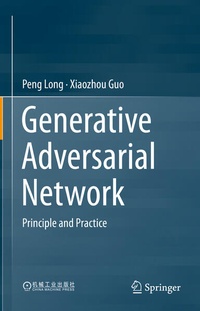
Generative Adversarial Network
Description

This book comprehensively and systematically introduces the theory of generative adversarial networks and its applications in image and voice processing. This book consists of 12 chapters, of which the first four chapters present basic knowledge, including the principle of GAN, optimization objectives, training methods and evaluation indicators. The last eight chapters introduce the applications of GAN in various vertical fields, covering image generation, video generation, image translation, face image editing, image quality improvement, general image editing, anti-attack, voice signal processing and other fields. Through reading this book, readers will thoroughly understand the principles of GAN, various GAN model designs, and learn to apply GAN for most vision and voice tasks. This book is suitable for the junior researchers, students or industrial practitioners in related areas.
More details
Other editions
Additional editions
Persons
Long Peng, an expert and senior author in the field of deep learning. He is currently the CEO of Beijing YouSan Educational Technology Co., Ltd.. He is the Most Valuable Professional of Alibaba Cloud and HUAWEI Cloud, Publicity Chair in HDIS 2022. He has published four books alone and one book with others in recent 5 years and is one of the leaders in book creation in the field of deep learning and computer vision in China.
Xiaozhou Guo, China Electronics Technology Group Corporation No. 54 Research Institute.His main research directions include artificial intelligence and communication intelligence. He has co-authored 1 monograph in the past five years.
Content
"Chapter 1 Generative Model".- "Chapter 2 Objective Function Optimization".- "Chapter 3 Training Techniques".- "Chapter 4 Evaluation Methods and Visualization".- "Chapter 5 Image Generation".- "Chapter 6 Image Translation".- "Chapter 7 Face Image Editing".- "Chapter 8 Image Quality Enhancement".- "Chapter 9 Generation of 3D pictures and videos".- "Chapter 10 General Image Editing".- "Chapter 11 Adversarial Attack".- "Chapter 12 Speech Signal Processing".
