

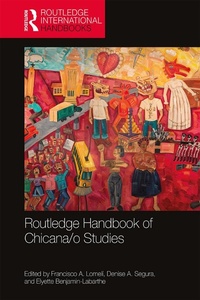
Routledge Handbook of Chicana/o Studies
Published on 6. August 2018
516 pages
978-1-317-53670-3 (ISBN)
Description

The Routledge Handbook of Chicana/o Studies is a unique interdisciplinary resource for students, libraries, and researchers interested in the largest and most rapidly growing racial-ethnic community in the United States and elsewhere which can either be identified as Chicano, Latino, Hispanic, or Mexican-American. Structured around seven comprehensive themes, the volume is for students of American studies, the Social Sciences, and the Humanities. The volume is organized around seven critical domains in Chicana/o Studies:
Chicana/o History and Social Movements
Borderlands, Global Migrations, Employment, and Citizenship
Cultural Production in Global and Local Settings
Chicana/o Identities
Schooling, Language, and Literacy
Violence, Resistance, and Empowerment
International Perspectives
The Handbook will stress the importance of the historical origins of the Chicana/o Studies field. Starting from myth of origins, Aztlan, alleged cradle of the Chicana/o people lately substantiated by the findings of archaeology and anthropology, over Spanish/Indigenous relations until the present time. Essays will explore cultural and linguistic hybridism and showcase artistic practices (visual arts, music, and dance) through popular (folklore) or high culture achievements (museums, installations) highlighting the growth of a critical perspective grounded on key theoretical formulations including borderlands theories, intersectionalities, critical race theory, and cultural analysis.
Chicana/o History and Social Movements
Borderlands, Global Migrations, Employment, and Citizenship
Cultural Production in Global and Local Settings
Chicana/o Identities
Schooling, Language, and Literacy
Violence, Resistance, and Empowerment
International Perspectives
The Handbook will stress the importance of the historical origins of the Chicana/o Studies field. Starting from myth of origins, Aztlan, alleged cradle of the Chicana/o people lately substantiated by the findings of archaeology and anthropology, over Spanish/Indigenous relations until the present time. Essays will explore cultural and linguistic hybridism and showcase artistic practices (visual arts, music, and dance) through popular (folklore) or high culture achievements (museums, installations) highlighting the growth of a critical perspective grounded on key theoretical formulations including borderlands theories, intersectionalities, critical race theory, and cultural analysis.
More details
Series
Language
English
Place of publication
London
United Kingdom
Publishing group
Taylor & Francis Ltd
Target group
College/higher education
Illustrations
2 Line drawings, black and white; 1 Halftones, color; 7 Halftones, black and white; 1 Illustrations, color; 9 Illustrations, black and white
File size
4,81 MB
ISBN-13
978-1-317-53670-3 (9781317536703)
Copyright in bibliographic data and cover images is held by Nielsen Book Services Limited or by the publishers or by their respective licensors: all rights reserved.
Schweitzer Classification
Other editions
Additional editions
Francisco A. Lomeli | Denise A. Segura | Elyette Benjamin-Labarthe
Routledge Handbook of Chicana/o Studies
Book
09/2020
1st Edition
Routledge
€66.00
Shipment within 15-20 days
Francisco A. Lomeli | Denise A. Segura | Elyette Benjamin-Labarthe
Routledge Handbook of Chicana/o Studies
Book
08/2018
1st Edition
Routledge
€280.50
Shipment within 10-20 days
Persons
Francisco A. Lomeli is Distinguished Professor at the University of California, Santa Barbara, in the Spanish and Portuguese and Chicana/o Studies Departments. His areas of interest and expertise include Chicana/o literature and culture, Southwest literary history, Latin American literature (the novels and certain regions like Central America, Mexico, parts of South America), Spanglish, and literary theory pertaining to Chicana/o Studies.
Denise A. Segura is Professor of Sociology and Affiliated Professor in the respective departments of Chicana/o Studies and Feminist Studies at the University of California, Santa Barbara. Recipient of the Lifetime Distinguished Contributions to Research, Teaching and Service from the Latina/o Sociology Section of the American Sociological Association, she publishes widely in Chicana feminist studies borderlands studies, and Chicana/Mexicana employment. She co-edited with Patricia Zavella, Women and Migration in the U.S.-Mexico Borderlands, Duke University Press, 2007.
Elyette Benjamin-Labarthe is Honorary Professor of American Studies at Michel de Montaigne University, France, affiliated with the CLIMAS Bordeaux research center, and has published extensively on Chicano poetry, literature, culture, arts, drama, cinema, on the literature of immigration, and transcultural phenomena. Her main contributions to the field, as author, co-author, editor, or co-editor are Vous Avez Dit Chicano, Ecritures Hispaniques aux Etats-Unis: Memoire et Mutations, Cinema americain: aux marches du Paradis, Cinema metis: le cinema de la frontiere Mexique/Etats-Unis, Confrontations et Metissages. She has been conferred the distinction of Knight of the Legion of Honor for services rendered to French research and that of Commander of Academic Palms for her educational activities.
Denise A. Segura is Professor of Sociology and Affiliated Professor in the respective departments of Chicana/o Studies and Feminist Studies at the University of California, Santa Barbara. Recipient of the Lifetime Distinguished Contributions to Research, Teaching and Service from the Latina/o Sociology Section of the American Sociological Association, she publishes widely in Chicana feminist studies borderlands studies, and Chicana/Mexicana employment. She co-edited with Patricia Zavella, Women and Migration in the U.S.-Mexico Borderlands, Duke University Press, 2007.
Elyette Benjamin-Labarthe is Honorary Professor of American Studies at Michel de Montaigne University, France, affiliated with the CLIMAS Bordeaux research center, and has published extensively on Chicano poetry, literature, culture, arts, drama, cinema, on the literature of immigration, and transcultural phenomena. Her main contributions to the field, as author, co-author, editor, or co-editor are Vous Avez Dit Chicano, Ecritures Hispaniques aux Etats-Unis: Memoire et Mutations, Cinema americain: aux marches du Paradis, Cinema metis: le cinema de la frontiere Mexique/Etats-Unis, Confrontations et Metissages. She has been conferred the distinction of Knight of the Legion of Honor for services rendered to French research and that of Commander of Academic Palms for her educational activities.
Content
Introduction: Handbook of Chicana/o Studies, Francisco A. Lomeli, Denise A. Segura and Elyette Benjamin-Labarthe
Part I. Chicana/o History and Social Movements
Introduction to Chicana/o History and Social Movements
1. What is Aztlan?: Homeland, Quest, Female Place, David Carrasco
2. Chicano History- A General Approach, Mario T. Garcia
3. Recent Chicana/o Historiography: Advances, Shortcoming, and Challenges, Alex M. Saragoza
4. The Chicano Movement, Ramon A. Gutierrez
5. A Genealogy of Chicana History, the Chicana Movement, and Chicana Studies, Miroslava Chavez-Garcia
6. Bilingual Education: History, Policy, and Insights from Critical Race Theory, Grace P. McField
Part II. Borderlands: Contested (Im)migrations, Culture and Citizenship
Introduction to Borderlands: Contested (Im)migrations, Culture and Citizenship
7. Mexico y lo Mexicano in Aztlan: Transborder Economic, Cultural and Political Links, David R. Maciel and Maria Rosa Garcia-Acevedo
8. Immigration, Latinos, and the Media, Leo R. Chavez
9. Mobilizing for Life: Illegality, Organ Transplants, and Migrant Biosociality, Jonathan Xavier Inda
10. Discourses of Violence and Peace: About and On the U.S.-Mexico Border, Maria-Socorro Tabuenca
11. Reconstructing Home in the Borderlands, Patricia Zavella
Part III. Cultural Production in Local and Global Settings
Introduction to Cultural Production in Local and Global Settings
12. Colonial, De-colonial, and Transnational Choreographies in Ritual Danzas and Popular Bailes of Greater Mexico, Enrique R. Lamadrid
13. The Challenge of Chicana/o Music, Steven Loza
14. Chicana/o Literature's Multi-Spatiotemporal Projections & Impacts; or Back to the Future, Frederick Luis Aldama
15. From Don Juan to Dolores Huerta: Foundational Chicana/o Films, Catherine Leen
16. Origins and Evolution of Homies as Hip Rasquache Cultural Artifacts: Taking the Homies Out of the Barrio or the Barrio Out of the Homies, Francisco A. Lomeli
Part IV. Indigeneity, Mestizaje, Postnationalism, and Transnationalism: Overarching Phenomena of Interdisciplinarity
Introduction to Indigeneity, Mestizaje, Postnationalism, and Transnationalism: Overarching Phenomena of Interdisciplinarity
17. The Embodied Epistemology of Chicano Mestizaje, Rafael Perez-Torres
18. New Tribalism and Chicana/o Indigeneity in the Work of Gloria Anzaldua, Domino Renee Perez
19. "Aztlan es una fabula": Navigating Postnational Spaces in Chicana/o Culture, Marc Priewe
20. Regional Singularity and Decolonial Chicana/o Studies, Lene M. Johannessen
21. Transnationalism Chicana/o Style, Karin Ikas
Part V. Chicana/o Identities and Political Expressions
Introduction to Chicana/o Identities and Political Expressions
22. Narrative Identity and the Dialectics of Selfhood in Chicana/o Writing, Sophia Emmanouilidou
23. The Challenge of Colorism in the Chicana/o Community, Margaret Hunter
24. Bilingualism and Biculturalism: Spanish, English, Spanglish?, Cecilia Montes-Alcala
25. The Landscapes and Languaging of Chicana Feminisms, Aida Hurtado
26. The Aesthetics of Healing and Love: An Epistemic Geneaology of Jota/o Aesthetic Traditions, William A. Calvo-Quiros
Part VI. Violence, Resistance and Empowerment
Introduction to Violence, Resistance and Empowerment
27. The Art of Disruption: Chicana/o Art's Politicized Strategies for Aesthetic Innovation, Guisela Latorre
28. Resisting the Dominant Anglo-American Discourse: Political Activism and the Art of Protest, Astrid M. Fellner and Claire M. Massey
29. Spanish Language Media: From Politics of Resistance to Politics of Pan-ethnicity, Xavier Medina Vidal and Federico Subervi-Velez
30. Transnational Incest: Sexual Violence and Migration in Mexican Families, Gloria Gonzalez-Lopez
Part VII. International Perspectives on Chicana/o Studies: From Aztlan to Shores Abroad
Introduction to International Perspectives on Chicana/o Studies: From Aztlan to Shores Abroad
31. Chicana/o Studies in France: Emergence and Development, Elyette Benjamin-Labarthe
32. Chicano Studies and Inter-American Studies in Germany, Gabriele Pisarz-Ramirez
33. Reception of Chicano Literature and Culture in Italy: A Survey, Erminio Corti
34. A Trans-Atlantic Look at Chicano Culture and Literature from a Spanish Perspective, Jose Antonio Gurpegui
Part I. Chicana/o History and Social Movements
Introduction to Chicana/o History and Social Movements
1. What is Aztlan?: Homeland, Quest, Female Place, David Carrasco
2. Chicano History- A General Approach, Mario T. Garcia
3. Recent Chicana/o Historiography: Advances, Shortcoming, and Challenges, Alex M. Saragoza
4. The Chicano Movement, Ramon A. Gutierrez
5. A Genealogy of Chicana History, the Chicana Movement, and Chicana Studies, Miroslava Chavez-Garcia
6. Bilingual Education: History, Policy, and Insights from Critical Race Theory, Grace P. McField
Part II. Borderlands: Contested (Im)migrations, Culture and Citizenship
Introduction to Borderlands: Contested (Im)migrations, Culture and Citizenship
7. Mexico y lo Mexicano in Aztlan: Transborder Economic, Cultural and Political Links, David R. Maciel and Maria Rosa Garcia-Acevedo
8. Immigration, Latinos, and the Media, Leo R. Chavez
9. Mobilizing for Life: Illegality, Organ Transplants, and Migrant Biosociality, Jonathan Xavier Inda
10. Discourses of Violence and Peace: About and On the U.S.-Mexico Border, Maria-Socorro Tabuenca
11. Reconstructing Home in the Borderlands, Patricia Zavella
Part III. Cultural Production in Local and Global Settings
Introduction to Cultural Production in Local and Global Settings
12. Colonial, De-colonial, and Transnational Choreographies in Ritual Danzas and Popular Bailes of Greater Mexico, Enrique R. Lamadrid
13. The Challenge of Chicana/o Music, Steven Loza
14. Chicana/o Literature's Multi-Spatiotemporal Projections & Impacts; or Back to the Future, Frederick Luis Aldama
15. From Don Juan to Dolores Huerta: Foundational Chicana/o Films, Catherine Leen
16. Origins and Evolution of Homies as Hip Rasquache Cultural Artifacts: Taking the Homies Out of the Barrio or the Barrio Out of the Homies, Francisco A. Lomeli
Part IV. Indigeneity, Mestizaje, Postnationalism, and Transnationalism: Overarching Phenomena of Interdisciplinarity
Introduction to Indigeneity, Mestizaje, Postnationalism, and Transnationalism: Overarching Phenomena of Interdisciplinarity
17. The Embodied Epistemology of Chicano Mestizaje, Rafael Perez-Torres
18. New Tribalism and Chicana/o Indigeneity in the Work of Gloria Anzaldua, Domino Renee Perez
19. "Aztlan es una fabula": Navigating Postnational Spaces in Chicana/o Culture, Marc Priewe
20. Regional Singularity and Decolonial Chicana/o Studies, Lene M. Johannessen
21. Transnationalism Chicana/o Style, Karin Ikas
Part V. Chicana/o Identities and Political Expressions
Introduction to Chicana/o Identities and Political Expressions
22. Narrative Identity and the Dialectics of Selfhood in Chicana/o Writing, Sophia Emmanouilidou
23. The Challenge of Colorism in the Chicana/o Community, Margaret Hunter
24. Bilingualism and Biculturalism: Spanish, English, Spanglish?, Cecilia Montes-Alcala
25. The Landscapes and Languaging of Chicana Feminisms, Aida Hurtado
26. The Aesthetics of Healing and Love: An Epistemic Geneaology of Jota/o Aesthetic Traditions, William A. Calvo-Quiros
Part VI. Violence, Resistance and Empowerment
Introduction to Violence, Resistance and Empowerment
27. The Art of Disruption: Chicana/o Art's Politicized Strategies for Aesthetic Innovation, Guisela Latorre
28. Resisting the Dominant Anglo-American Discourse: Political Activism and the Art of Protest, Astrid M. Fellner and Claire M. Massey
29. Spanish Language Media: From Politics of Resistance to Politics of Pan-ethnicity, Xavier Medina Vidal and Federico Subervi-Velez
30. Transnational Incest: Sexual Violence and Migration in Mexican Families, Gloria Gonzalez-Lopez
Part VII. International Perspectives on Chicana/o Studies: From Aztlan to Shores Abroad
Introduction to International Perspectives on Chicana/o Studies: From Aztlan to Shores Abroad
31. Chicana/o Studies in France: Emergence and Development, Elyette Benjamin-Labarthe
32. Chicano Studies and Inter-American Studies in Germany, Gabriele Pisarz-Ramirez
33. Reception of Chicano Literature and Culture in Italy: A Survey, Erminio Corti
34. A Trans-Atlantic Look at Chicano Culture and Literature from a Spanish Perspective, Jose Antonio Gurpegui
