

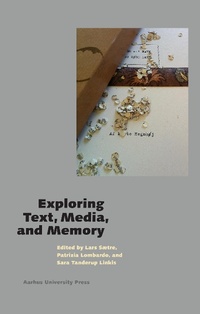
Exploring Text, Media, and Memory
Published on 31. December 2018
560 pages
978-87-7184-582-2 (ISBN)
Description

Exploring Text, Media and Memory investigates the link between memory and media by asking a series of questions pertinent to our time: How do individual and collective memories blend? How do traumatic experiences from past events and catastrophic projections of the future reveal the human condition in the epoch of frenetic technological reproduction of works of art? How is the human body tied to narrations - and why? A group of international scholars tackle questions like these across art forms, media, and cultural history. In nineteen essays they argue that modern and contemporary literary texts and visual arts show how photography, film, tape recording, television, and internet are not just means of storing memory and information, but objects that we interact with every day - challenging static visions of places and the linear notions of past, present and future.
More details
Other editions
Additional editions
Lars Saetre | Patrizia Lombardo | Sara Tanderup Linkis
Exploring Text, Media, and Memory
Book
07/2018
Aarhus Universitetsforlag
€73.28
Article exhausted; check different version
Content
- Cover
- Title Page
- Colophon
- Contents
- Text, Media, and Memory
- Lars Sætre, Patrizia Lombardo, Sara Tanderup Linkis
- Literature and memory
- Mediation and memory
- Freezing the moment
- Acknowledgements
- Suggested Readings
- Part I: Mediation
- Bits of Books in Boxes: Remembering the Book in Anne Carson's Nox and Mette Hegnhøj's Ella is my name do you want to buy it?
- Sara Tanderup Linkis
- Material memory matters
- The book as an epitaph
- The books of the dead
- Performing memory in the digital age
- Works Cited
- Memory and the Tape Recorder: Krapp's Last Tape
- Ragnhild Evang Reinton
- The lost past
- The burden of the past
- Krapp - a failed Proust
- Krapp - a failed Beckett?
- Playing with the past
- Works Cited
- John Akomfrah's The Nine Muses and the Ethics of Memory
- Asbjørn Grønstad
- Karlin, Akomfrah, and the sites of memory
- Reappropriation
- Transtextuality
- Opacity
- Conclusion
- Works Cited
- Negotiating Cinematic Staging of Colonial Past in the Blogosphere: Abdellatif Kechiche's Vénus noire
- Jorunn S. Gjerden
- Repentance and reparation
- The Hottentot Venus and the archive :Medial superimpositions
- From cinematic silence to the verbal reality of blogs
- Polarised online discussion dynamics: Don't feed the trolls
- Memory and ambiguity
- Concluding remarks
- Works Cited
- Body and Narrative: Mediated Memory
- Svend Erik Larsen
- Emergence of memory: In the veld
- Construction of memory: Co-existing fragments
- Communication of memory: Negotiating memories
- Memory beyond place
- Works Cited
- "Memory is a seamstress": Media of Memory in Virginia Woolf's Orlando
- Anders Kristian Strand
- "A thousand odd, disconnected fragments": Distractive media of memory
- "Memory is a seamstress": Memory and the seams of winding identity
- Storing the past at home: The medium of the house
- Conclusion
- Works Cited
- Media, Memory, and Meaning in Narrative Art: Trauma in Renate Dorrestein's Novel A Heart of Stone
- Lars Sætre
- Traumatic core
- Building a story line
- The imaging power of rupture
- The talking cure
- In conclusion
- Works Cited
- "The past still has possibilities": The Art of Memory in Daniel Eisenberg's Postwar Films
- Henrik Gustafsson
- The postwar trilogy
- Displaced Person
- Cooperation of Parts
- Persistence
- Coda
- Works Cited
- Films by Daniel Eisenberg
- "Magnificent desolation": The Memory of Welfare and the Archeology of Shame in the Novels of Johan Harstad
- Pieter Vermeulen
- Harstad's capitalist realism
- Generation star wars (Hässelby)
- "The great story of the parentheses" (Buzz Aldrin)
- Back to the future (172 Hours on the Moon)
- First as horror, then as farce: Space and social security
- Works Cited
- Traumatic Memory, Shame, and the Artistic Representation of the Shoah
- Susana Onega
- Psychic trauma and memory malfunctioning
- The function of the performing arts during and after the Shoah
- The representation of the Shoah in Enzo Cormann's Storm Still
- The representation of the Shoah in Roberto Benigni's Life is Beautiful
- Conclusion
- Works Cited
- Part II: Remembrance
- Testimony, Documentary, Fiction: The Remediation of Stolen Children
- Hans Lauge Hansen
- Mala gente que camina (2006)
- The "mediated action" on memory of the abducted children
- Concluding remarks
- Works Cited
- Remembering Ceylon: Leonard Woolf's Colony in the Age of Extremism
- Randi Koppen
- The Village in the Jungle: The colony and the trope of the hybrid
- Totalitarianism and colonialism: Multidirectional memory
- The tom-toms in the present: The transpositions of memory
- Works Cited
- Textual Memory: Preservation and Loss in To the Lighthouse
- Thomas Hill
- Rethinking memory
- Reaching R
- Painting a problem
- Narrating a problem
- Material memory loss
- "Time Passes": Textually generated memory
- Memory as a mode of thought
- Works Cited
- "Murdered and so discreetly bound in linens": Djuna Barnes' Ryder and the (W)hole in Weaving Memory
- Helle Håkonsen
- Bound in linen - stitched in time: Creation and preservation
- Problems of weaving memory
- Homophony and discursive polyphony: Towards glissement
- Shattered surfaces: Memorial objects
- Conclusion: The (im)possibility of a future
- Works Cited
- Virginia Woolf and the Perception of Things
- Tone Selboe
- "Solid Objects"
- Things or objects?
- Objects of the past: "Haworth, November 1904"
- Works Cited
- Memory as Resurrection in Roland Barthes
- Patrizia Lombardo
- Away with nostalgia
- Barthes and Proust
- Resurrection in Michelet
- Pathos
- The great chain of memory
- Hallucination
- Works Cited
- Will and Indolence: Proust, Reader of Baudelaire
- Julien Zanetta
- Involuntary?
- Procrastination
- Indolence as a tech nique
- "Head of Hair"
- Works Cited
- Cleansing the Soul of Images: Overcoming Forgetfulness in Mattis Øybø's Alle ting skinner
- Anders M. Gullestad
- On becoming more free than ever before
- Otto and forgetfulness
- The evanescence of the recaptured aura
- Works Cited
- Posthuman Memory
- Mads Rosendahl Thomsen
- Memory, imperfection, and the posthuman
- The blank slate and self-development
- Societal control
- New tech nologies and unlimited memory
- Conclusion
- Works Cited
- Contributors
- Index
