

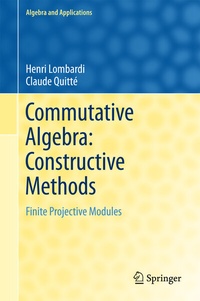
Commutative Algebra: Constructive Methods
Description

Translated from the popular French edition, this book offers a detailed introduction to various basic concepts, methods, principles, and results of commutative algebra. It takes a constructive viewpoint in commutative algebra and studies algorithmic approaches alongside several abstract classical theories. Indeed, it revisits these traditional topics with a new and simplifying manner, making the subject both accessible and innovative.
The algorithmic aspects of such naturally abstract topics as Galois theory, Dedekind rings, Prüfer rings, finitely generated projective modules, dimension theory of commutative rings, and others in the current treatise, are all analysed in the spirit of the great developers of constructive algebra in the nineteenth century.
This updated and revised edition contains over 350 well-arranged exercises, together with their helpful hints for solution. A basic knowledge of linear algebra, group theory, elementary number theory as well as the fundamentals of ring and module theory is required. Commutative Algebra: Constructive Methods will be useful for graduate students, and also researchers, instructors and theoretical computer scientists.
Reviews / Votes
"The book treats many of the standard topics from commutative algebra and projective modules in great detail, all using constructive methods. . The exhaustive bibliography draws both from classical and constructive mathematics. . This will be a great addition to the bookshelves of the community of constructive mathematicians." (N. Mohan Kumar, Mathematical Reviews, October, 2016)
"The book has over 350 well-arranged exercises, together with helpful hints for solution. . Many methods, like lazy evaluation and dynamic evaluation, are discussed in great detail. . There is a detailed flow chart on chapter dependencies and the order in which chapters should be read. . The book will be useful for graduate students, as well as researchers, instructors, and theoretical computer scientists." (Naga Narayanaswamy, Computing Reviews, February, 2016)
"The book under review is the faithful English translation of the original French edition published in 2011 under the same title. . No doubt, the English edition . will certainly increase both its international significance and its wider popularity among graduate students, researchers, instructors, and interested scientists in general." (Werner Kleinert, zbMATH 1327.13001, 2016)
More details
Other editions
Additional editions
Persons
Henri Lombardi is a researcher in constructive mathematics, real algebra and algorithmic complexity. Since 2003, with Marie-Françoise Roy and Thierry Coquand, he has developed the international group MAP (Mathematics, Algorithms, Proofs). He has published E´piste´mologie mathe´matique , (Ellipse, 2011), and Me´thodes matricielles. Introduction a' la complexite´ alge´brique , (Springer, 2003, in collaboration with Jounai¨di Abdeljaoued).
Claude Quitté is a researcher in effective commutative algebra, computer algebra and computer science. He has published Algorithmique alge´brique , (Masson, 1991) in collaboration with Patrice Naudin.
Henri Lombardi and Claude Quitté also published together with Maria-Gema Díaz-Toca the book Modules sur les anneaux commutatifs (Calvage & Mounet, 2014).
