

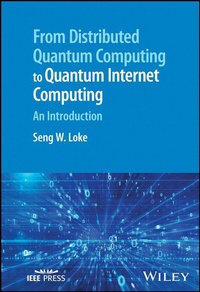
From Distributed Quantum Computing to Quantum Internet Computing
Description

Understand the future of the internet with this accessible guide
Quantum computing, which draws upon the principles of quantum mechanics to perform computing functions unrestricted by the binary language of ordinary computing, has developed with extraordinary speed in recent years. Progress in quantum computing and its related technological subfields, including quantum internet, has been rapid enough to suggest that we are living in a "new Quantum Age." To understand the future of the internet, it's now essential to understand the present and future of quantum computing and quantum internet computing.
This book provides a groundbreaking overview of this field of technology and its latest developments. It provides readers with a working knowledge of the key topics required to connect quantum computing to the future of distributed computing and the internet, including important issues like quantum protocols, distributed quantum computations, fundamental computations in the quantum internet architecture, and more. The result is an accessible and essential reference for any reader looking to better understand quantum technologies.
From Distributed Quantum Computing to Quantum Internet Computing readers will also find:
* Detailed discussion of topics including qubit states, entanglement, quantum gates, and more.
* Mathematical background for underlying key concepts.
* Worked out examples that aim to initiate readers into the emerging area of quantum internet computing.
This book is ideal for researchers and graduate students in quantum computing, quantum internet, quantum communications, and related fields, as well as Computer Scientists and Information Technology students and researchers who want an introductory overview to quantum internet computing.
More details
Other editions
Additional editions
Person
Seng W. Loke, PhD, is a Professor in Computer Science for the School of Information Technology, Deakin University, Australia, as well as Director of the Centre for Software, Systems and Society (CS3) and Co-Director of the Internet of Things Platforms and Applications Lab in the Centre for Internet of Things Ecosystem Research and Experimentation (CITECORE). He has published extensively on Internet of Things, context-aware computing, mobile and pervasive computing, and related subjects.
Content
About the Author x
Preface xi
Acknowledgments xiv
1 Introduction 1
1.1 The New Quantum Age and the Second Quantum Revolution 1
1.2 Distributed Quantum Computing and the Rise of Quantum Internet Computing 4
1.2.1 Distributed Quantum Computing 5
1.2.2 Quantum Internet Computing 8
1.3 Aim and Scope of the Book 9
1.4 Outline of this Book 10
1.5 Related Books and Resources 11
2 Preliminaries 17
2.1 Qubit and Qubit States 17
2.2 Quantum Gates and Quantum Circuits 23
2.2.1 Single Qubit Gates 24
2.2.2 Measurement Operators 26
2.2.2.1 Measurement Postulate (General Measurement) 27
2.2.2.2 POVM 27
2.2.2.3 Projective Measurements 28
2.2.3 Multiple Qubit Gates 29
2.2.4 Quantum Circuits 29
2.2.5 Universal Quantum Computer and Gate Sets 32
2.3 Entanglement 33
2.4 Teleportation and Superdense Coding 39
2.5 Summary 42
2.6 Further Reading and Resources on Quantum Computing 42
3 Distributed Quantum Computing-Classical and Quantum 45
3.1 The Power of Entanglement for Distributed Computing 46
3.1.1 Enabling Distributed Computations with Fewer Bits of Communication 46
3.1.1.1 The Distributed Three-Party Product Problem 47
3.1.1.2 The Distributed Deutsch-Jozsa Promise Problem 49
3.1.1.3 The Distributed Intersection Problem 52
3.1.1.4 Discussion 56
3.1.2 Enabling Distributed Computations Not Possible Classically 56
3.1.2.1 Greenberger-Horne-Zeilinger and Mermin (GHZ&M) Game 56
3.1.2.2 Clauser-Horne-Shimony-Holt (CHSH) 60
3.1.2.3 Discussion 67
3.2 Other Quantum Protocols 67
3.2.1 Quantum Coin Flipping 67
3.2.1.1 Classical Coin Flipping 67
3.2.1.2 Quantum Coin Flipping 74
3.2.2 Quantum Leader Election 77
3.2.3 Quantum Key Distribution (QKD) 79
3.2.4 Quantum Anonymous Broadcasting 90
3.2.5 Quantum Voting 97
3.2.6 Quantum Byzantine Generals Solution 99
3.2.7 Quantum Secret Sharing 104
3.2.8 Quantum Oblivious Transfer (OT) 105
3.2.9 Discussion 107
3.3 Summary 107
4 Distributed Quantum Computing - Distributed Control of Quantum Gates 113
4.1 Performing a Distributed CNOT 113
4.1.1 Using Teleportation 113
4.1.2 A More Efficient MethodWith Cat-Like States 114
4.2 Beyond the Distributed CNOT 118
4.2.1 Same Control Qubit for Multiple Target Qubits on Different Machines 118
4.2.2 Multiple Control Qubits for the Same Target Qubit on a Different Machine 123
4.2.3 Cat-Entangler and Cat-Disentangler Modules 126
4.3 Distributing Quantum Circuits and Compilation for Distributed Quantum Programs 127
4.4 Control and Scheduling for Distributed Quantum Computers 129
4.5 Distributed Quantum Computing Without Internode Entanglement 132
4.6 Summary 133
5 Delegating Quantum Computations 137
5.1 Delegating Private Quantum Computations 137
5.2 How to Verify Delegated Private Quantum Computations 149
5.2.1 X Gate Gadget 150
5.2.2 Z Gate Gadget 151
5.2.3 CNOT Gate Gadget 151
5.2.4 R Gate Gadget 151
5.2.5 H Gate Gadget 155
5.3 Quantum Computing-as-a-Service 158
5.4 Summary 158
6 The Quantum Internet 161
6.1 Entanglement Over Longer Distances 161
6.1.1 Bell States and Bell State Measurement 162
6.1.2 Entanglement Swapping 163
6.1.3 Transmission of Qubits Using Tree-Cluster States 165
6.2 Entanglement with Higher Fidelity 172
6.2.1 Fidelity 172
6.2.2 Twirling Map 174
6.2.3 Quality of Distributed Entanglement and Entanglement Purification 177
6.3 Distributed Quantum Computation Over the Quantum Internet - Challenges 183
6.4 Summary 187
References 187
7 Conclusion 191
References 192
Index 193
1
Introduction
For the Stoics, living in accordance with nature required a knowledge of nature and its operations. One reason for this was that the study of nature was thought to offer the best way of establishing what lay within one's own power, and what in the power of nature.
- Peter Harrison, The Territories of Science and Religion
1.1 The New Quantum Age and the Second Quantum Revolution
Andrew Whitaker's book The New Quantum Age: From Bell's Theorem to Quantum Computation and Teleportation speaks of the First Quantum Age marked by the pioneers of quantum theory (or quantum mechanics), such as the physicists Max Planck, Albert Einstein, Niels Bohr, and others, in the first quarter of the 20th century, and the New Quantum Age ushered in by the work of the physicist John Stewart Bell in the 1960s and others, some later winning the Nobel Prize in Physics, in the area of quantum information science (a term we will come back to later).
The 2022 Nobel Prize in Physics went to three outstanding physicists, Alain Aspect, John F. Clauser, and Anton Zeilinger, for "experiments with entangled photons, establishing the violation of Bell inequalities and pioneering quantum information science."1 Some readers might already be familiar with the many ideas and concepts mentioned in that one sentence, but some not so - we will in this book unpack some of the above concepts such as "entanglement," "quantum information," and "Bell inequalities" (and the associated concepts of "Bell pairs" and "Bell states," named after John Bell mentioned above). Some of the experiments conducted by the Nobel prize winners investigated and demonstrated a key concept in quantum mechanics called entanglement, a term due to physicist Erwin Schrödinger in 19352 - informally, a type of "quantum link."3 One could also think of such entanglement between particles (e.g. photons of light) as a type of "resource" that will enable the transfer of quantum information over geographical distances (a phenomenon called quantum teleportation). We will see that such a resource is central to distributed quantum computing and is a key concept in quantum networks.
As mentioned in the document on the scientific contributions of the 2022 Nobel Prize in Physics:
This year's Nobel prize is for experimental work. Apart from the disparities in philosophical interpretation, the early Bell experiments drove the development of what is often referred to as the 'Second Quantum Revolution'. Two of this year's laureates, John Clauser and Alain Aspect, are honoured for work that initiated a new era, opening the eyes of the physics community to the importance of entanglement, and providing techniques for creating, processing and measuring Bell pairs in ever more complex and mind-boggling scenarios. The experimental work of the third Laureate, Anton Zeilinger, stands out for its innovative use of entanglement and Bell pairs, both in curiosity driven fundamental research and in applications such as quantum cryptography. [https://www.nobelprize.org/uploads/2022/10/advanced-physicsprize2022.pdf, p. 15, accessed: 7/10/2022]
The Nobel Prize also recognized Anton Zeilinger's work on entanglement swapping and multipartite entanglement, concepts which we will discuss later in the book.
Since the early experimental work by the Nobel prize winners dating back to the early 1970s and 1980s, much has happened in the areas of experimental demonstrations of quantum entanglement (over larger geographical scales) and quantum teleportation, quantum cryptographic protocols, quantum communications, quantum networking, quantum computing, quantum distributed computing, as well as quantum information theory. For example, in 1984, Charles Bennett and Gilles Brassard came up with the first quantum key distribution (QKD) protocol, a secure way to share keys used for encryption and decryption, called BB84,4 which was later demonstrated experimentally in 1989 [Bennett et al., [1992]]. A brief history of quantum cryptography is given by Brassard [[2005]]. In 1991, Artur Ekert came up with the E91 protocol for QKD [Ekert, [1991]]. We will come back to the topic of QKD later in the book. Further experimental demonstrations were then conducted over the years. In the early 2000s, ID Quantique5 became one of the first companies to bring a QKD product to the commercial market. Going beyond just two nodes, the world's first quantum network became operational between 2004 and 2007, demonstrating QKD, i.e. the DARPA Quantum Network.6 Today, a Quantum Network architecture standard is being developed with the creation of the Quantum Internet Research Group (an Internet Research Task Force [IRTF]).7 Recent work has continued to conceptualize and develop architectures and applications of the quantum Internet, as reviewed in Gyongyosi and Imre [[2022]], Illiano et al. [[2022]], Wehner et al. [[2018]], and Rohde [[2021]]. Quantum-enabled 6G wireless networking has been discussed in Wang and Rahman [[2022]]. We discuss quantum networking and the quantum Internet further in Chapter 6.
At the same time, developments in quantum computing have progressed with (i) important work in the 1980s and 1990s, e.g. with the foundational thinking of Deutsch [[1985]] and the invention of quantum algorithms for factoring numbers by Shor [[1994], [1999]] and for quantum search by Grover [[1996]] and (ii) many other developments in the more recent decades, including in the areas of quantum computing applications such as quantum simulation [Smith et al., [2019]] and quantum machine learning [Biamonte et al., [2017]; Ramezani et al., [2020]; Schuld and Petruccione, [2021]]. Several companies (big tech and startups)8 and a number of universities have built quantum computers or are experimenting with quantum hardware concepts,9 research continues into building even larger scale quantum computers, and developing tools and software for programming quantum computers toward full quantum computer systems [Ding and Chong, [2020]] for at least, what John Preskill has called, Noisy Intermediate-Scale Quantum (NISQ) computers [Preskill, [2018]].10 Also emerged is what has been called quantum software engineering [Piattini and Murillo, [2022]; De Stefano et al., [2022]; Ali et al., [2022]], concerned with processes, tools, and methodologies for developing software that runs on quantum computer systems. A number of companies are also providing access to quantum computers via a cloud service model.11 Government investments into quantum computing and networking have increased in many countries.12
Hence, one can see the increasing developments at the intersection of Information and Communication Technologies (ICT) and quantum theory, yielding quantum information science, which can be described as
an emerging field with the potential to cause revolutionary advances in fields of science and engineering involving computation, communication, precision measurement, and fundamental quantum science. [https://www.nsf.gov/pubs/2000/nsf00101/nsf00101.htm, accessed: 8/10/2022]
And more recently, research into quantum software development, from the information technology or computing perspective.
1.2 Distributed Quantum Computing and the Rise of Quantum Internet Computing
We have been in the Internet or Web Age for some decades now since the early days of the Web in the 1990s and the invention of email even earlier. With networked computers (wired or wireless) around the world, and computers being pervasive, we then have the field of distributed computing, looking into computations (and communication protocols) over distributed networked or connected nodes, and the Internet of Things, which is concerned with all sorts of things (including everyday objects with embedded computers), people and places, becoming connected to the Internet. Distributed computing might be over computers (or nodes) within the same room, or the same geographical area, or might utilize nodes geographically far apart but connected over the Internet. The latter involves a number of issues perhaps not as apparent or on the same scale as when the nodes are local, such as increased latency in communications, fault tolerance, heterogeneity, and scalability. Distributed computing can go beyond geographically local nodes and involve nodes distributed over vast geographical (Internet size) scales (perhaps even interplanetary in the future!), and hence, the often used term Internet computing in such cases.
1.2.1 Distributed Quantum Computing
While work on distributed computing (including mobile and pervasive computing) in the recent decades have been mostly on classical (one might call traditional) distributed computing, there has been a lot of thinking since the 1990s about how quantum mechanics might have an impact on distributed computing.
Lov Grover proposed the idea of computations with distributed quantum processors [Grover, [1997]], which he called quantum telecomputation, with respect to the problem of finding the average of real numbers to a...
