

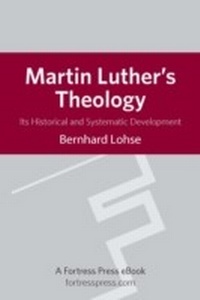
Martin Luther's Theology
It''s Historical and Systematic Development
1st Edition
Published on 18. November 1999
412 pages
978-1-4514-0422-7 (ISBN)
Description

This definitive analysis of the theology of Martin Luther surveys its development during the crises of Luther's life, then offers a systematic survey by topics. Containing a wealth of quotations from less-known writings by Luther and written in a way that will interest both scholar and novice, Lohse's magisterial volume is the first to evaluate Luther's theology in both ways. Lohse's historical analysis takes up Luther's early exegetical works and then his debates with traditions important to him in the context of the various controversies leading up to his dispute with the Antinomians. The systematic treatment shows how the meaning of ancient Christian doctrines took their place within the central teaching of justification by faith.
More details
Other editions
Additional editions
Book
03/2011
Fortress Press,U.S.
€34.00
Shipment within 10-20 days
Person
By Bernhard Lohse
Content
- MARTIN LUTHER'S THEOLOGY
- CONTENTS
- Foreword
- Translator-Editor's Note
- Part One Introduction: Preliminary Considerations and Presuppositions Relative to a Description of Luther's Theology
- 1. Criteria for Describing Luther's Theology
- Survey of Previous Descriptions
- The Alternative: Historical-Genetic or Systematic Description
- The Attempt at a Connection of the Historical-Genetic and Systematic Presentation
- 2. The Situation in the Church around 1500
- Decline and Reform
- Scholasticism and Humanism
- Wyclif and Hus
- New Formulations of the Question and Impulses
- 3. The Theological Situation around 1500, Especially in Erfurt and Wittenberg
- Occamism at Erfurt
- Humanism at Erfurt and Wittenberg
- The Traditions of Significance for Luther
- 4. Luther's Personal Development
- The Parental Home
- Schooling at Magdeburg and Eisenach
- Luther as Student
- Entry into the Cloister
- 5. The Uniqueness of Luther's Theology
- A Theology That Gets at the Meat of the Nut
- Theologia cruris
- Knowledge of God and Man
- Part Two Luther's Theology in Its Historical Development
- Basic Theological Ideas in Luther's Marginal Notes on Augustine and Peter Lombard (1509/1510)
- The Traditional and the New: The View of Sin
- Faith and Discipleship
- Criticism of Theology and Church
- Early Reformation Theology in the First Psalms Lecture (1513-1515)
- The New Hermeneutic
- The Concept of Sin
- The Concept of Grace
- The Sacraments
- Faith
- Holy and Blessed in spe/in re
- The Church
- Criticism of the Church
- The Structure of Reformation Theology in the Period of Pauline Exegesis (1515-1518)
- Setting the Goal for the Lectures on Romans (1515/1516), Galatians (1516/1517), and Hebrews (1517/1518)
- The Concept of Sin
- The Concept of Grace
- God's Righteousness and Our Justification
- The Sacraments
- The Church
- Criticism of the Church
- The Reformation Discovery
- The Problem
- On the State of Research
- Luther's Inner Conflicts (Anfechtungeri)
- Luther's Own Testimony (1545)
- Documentation in the Early Lectures
- Luther's Reformation Understanding in Light of the Tradition
- Luther's Attack on Indulgences (1517/1518)
- Luther's Path toward the Public
- Luther's Ninety-five Theses on Indulgences: Occasion and Purpose
- Penance, Forgiveness, Church, and Office in the Ninety-five Theses
- Explanations of the Ninety-five Theses (1518)
- The Heidelberg Disputation (1518)
- The Dialogus de potestate papae of Silvester Prierias (1518)
- Luther's Dispute with Cajetan over Justification, Faith, and Church Authority
- The Sharpening of the Conflict between Luther and Rome
- Cajetan
- Luther's Hearing before Cajetan
- Luther's Appeal to Pope and Council
- Luther's Debate with Eck on the Authority of Pope and Council (1519)
- Preparation for the Leipzig Disputation
- The Leipzig Disputation
- The Effect of the Leipzig Disputation
- Luther's Dispute with the Sacramental Teaching of His Time (1519/1520)
- The Sermons on the Sacrament from 1519
- The Treatise on the New Testament (1520)
- The Babylonian Captivity of the Church (1520)
- Luther's Dispute with the Monastic Ideal (1520/1521)
- The Urgency of the Question Concerning Monastic Vows in 1520/1521
- Luther's Themata de votis (1521)
- The Judgment (iudicium) of Luther on Monastic Vows (1521)
- Luther's Dispute with the Wittenberg Reformers
- The Wittenberg Reforms and the Question of Scriptural Authority
- Luther's Attitude toward the Wittenberg Reforms
- Luther's Further Development of His Doctrine of Holy Scripture, Law, and Gospel, and His View of the Temporal Authorities
- Luther's Dispute with Radical Tendencies to "Right" and "Left": The Distinction between the Two Kingdoms and the Two Governments
- The Shift in Fronts
- Luther's Treatise on Temporal Authority, to What Extent It Should Be Obeyed (1523)
- The Distinction between the Two Kingdoms and the Two Governments
- Luther's Attitude toward the Rebellious Peasants
- Luther's Dispute with Erasmus
- Erasmus's Diatribe de libero arbitrio (1524)
- Luther's Response in The Bondage of the Will (1525)
- Central Themes in De servo arbitrio
- Luther's Dispute with Zwingli: The Lord's Supper Controversy
- The Emergence of Intra-Evangelical Differences
- The Further Development of Luther's Position during the Lord's Supper Controversy
- The Marburg Colloquy (1529)
- Luther's Dispute with the Antinomians
- The Question of Repentance in Reformation Theology
- The Conflict over Law and Gospel
- Luther's Doctrine of Law and Gospel in the Antinomian Controversy
- Part Three Luther's Theology in Its Systematic Context
- Sola scriptura
- The Authority of Scripture
- Christ as Midpoint of Scripture: Word and Spirit
- Old and New Testament: Law and Gospel
- The Clarity of Scripture
- Reason and Faith
- Reason
- Faith
- The Task of Theological Knowledge
- The View of God
- Luther's Attitude toward Traditional Dogma
- The Godhead of God
- Deus absconditus and Deus revelatus
- Christology
- Luther's Attitude toward Traditional Dogma
- The Work of Christ
- Luther's Further Formation of Ancient Church Christology
- Spiritus Creator
- Luther's Attitude toward Traditional Dogma
- The Work of the Holy Spirit
- Humanity as Creature of God
- The Creation of the World
- Humanity in the World
- Sin
- The Knowledge of Sin
- The Nature of Sin
- Inherited Sin
- The Devil
- The Bound Will
- Justification
- Justificational Function of the Doctrine of Justification
- The Imputation of "Alien Righteousness
- Justification and the New Existence
- Faith and Works
- Law and Gospel
- The Distinction between Law and Gospel
- Duplex usus legis (The Twofold Use of the Law)
- Natural Law and Mosaic Law
- Tertius usus legis (The Third Use of the Law)
- The Church
- The Nature of the Church
- The True and False Church
- The notae ecclesiae
- Office and Ordination
- The Starting Point of Luther's View of Office
- The Universal Priesthood
- The Ministerial Office
- The Episcopal Office
- Baptism
- The Starting Point of Luther's Theology of Baptism
- The Institution and Nature of Baptism
- The Baptism of Infants
- The Lord's Supper
- The Words of Institution and the Real Presence
- The unio sacramentalis, "Spiritual" and "Bodily" Eating
- The Lord's Supper as Crystallization Point of Christology and Faith
- The Doctrine of the Two Kingdoms
- On the Historical and Theological Place of the Distinction between the Two Kingdoms or the Two Governments
- The History of the Tradition of the Two Kingdoms Doctrine
- The New Impulse in Luther's Distinction between the Two Kingdoms and the Two Governments
- The Impulse toward Ethics
- The Distinction between the Three Estates
- Eschatology
- Death and the Last Judgment
- Death in the Light of Law and Gospel
- The Goal of History
- Excursus: Luther's Attitude toward the Jews
- Jews in the West around 1500
- Luther's Early Attitude toward the Jews
- Luther's Later Attitude toward the Jews
- Bibliography
- Index of Names
- Index of Subjects
