


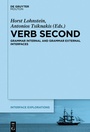
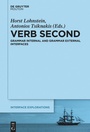
Verb Second
Grammar Internal and Grammar External Interfaces
1st Edition
Published on 9. March 2020
VIII, 451 pages
978-1-5015-0814-1 (ISBN)
Description

This book addresses a general phenomenon in the European languages: verb second. The articles provide a comprehensive survey of synchronic vs. diachronic developments in the Germanic and Romance languages.
New theoretical insights into the interaction of the properties of verbal mood and syntactic structure building lead to hypotheses about the mutual influence of these systems. The diachronic change in the syntax together with changes in the inflectional system show the interdependence between the syntactic and the inflectional component.
The fact that the subjunctive can license verb second in dependent clauses reveals further dependencies between these subsystems of grammar. "Fronting finiteness" furthermore constitutes an instance of a main clause phenomenon. Whether "assertion" or "at-issueness" are encoded through this grammatical process will be a matter in the debates discussed in the book. Moreover, information structure appears to be directly related to the fronting of other constituents in front of the finite verb. Questions concerning the interrelations between these various subcomponents of the grammatical system are investigated.
New theoretical insights into the interaction of the properties of verbal mood and syntactic structure building lead to hypotheses about the mutual influence of these systems. The diachronic change in the syntax together with changes in the inflectional system show the interdependence between the syntactic and the inflectional component.
The fact that the subjunctive can license verb second in dependent clauses reveals further dependencies between these subsystems of grammar. "Fronting finiteness" furthermore constitutes an instance of a main clause phenomenon. Whether "assertion" or "at-issueness" are encoded through this grammatical process will be a matter in the debates discussed in the book. Moreover, information structure appears to be directly related to the fronting of other constituents in front of the finite verb. Questions concerning the interrelations between these various subcomponents of the grammatical system are investigated.
More details
Other editions
Additional editions
E-Book
03/2020
1st Edition
De Gruyter Mouton
€149.95
Available for download
Book
03/2020
1st Edition
De Gruyter Mouton
€149.95
Article not available at the moment
Persons
Horst Lohnstein , Antonios Tsiknakis , University of Wuppertal, Germany
Content
- Intro
- Preface
- Contents
- Form and function of verb second - an overview
- A grammar competition analysis of V2 phenomena in second language acquisition
- How much verb moves to second position?
- Notes on the left periphery of V2 complement clauses in German: Complementiser drop and complementiser doubling
- Assertive potential, speaker evidence and embedded V2
- What kind of main clause phenomenon is V2 in German?
- The left periphery as interface - On verb second and finiteness interaction
- Variation and change in the licensing of dependent V2 in German
- On the licensing of null subjects in Old Venetian
- Verb third as Cluster movement in German
- On the role of the left periphery in the interpretation of causal Wo-VE-clauses
- Parentheticals, root phenomena, and V2 in German
- Verb movement and topicalization in German
- Addresses
- Index
