

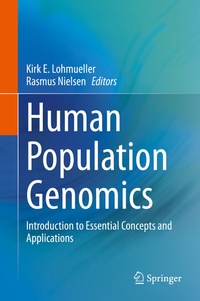
Human Population Genomics
Description

This textbook provides a concise introduction and useful overview of the field of human population genomics, making the highly technical and contemporary aspects more accessible to students and researchers from various fields.
Over the past decade, there has been a deluge of genetic variation data from the entire genome of individuals from many populations. These data have allowed an unprecedented look at human history and how natural selection has impacted humans during this journey. Simultaneously, there have been increased efforts to determine how genetic variation affects complex traits in humans. Due to technological and methodological advances, progress has been made at determining the architecture of complex traits.
Split in three parts, the book starts with the basics, followed by more advanced and current research. The first part provides an introduction to essential concepts in population genetics, which are relevant for any organism. The second part covers the genetics of complex traits in humans. The third part focuses on applying these techniques and concepts to genetic variation data to learn about demographic history and natural selection in humans.This new textbook aims to serve as a gateway to modern human population genetics research for those new to the field. It provides an indispensable resource for students, researchers and practitioners from disparate areas of expertise.
Reviews / Votes
"This book is likely to be most useful to PhD students in the early stages of their graduate degree . . By reading this edited volume, researchers will feel empowered and be able to interpret complex human genomic datasets. . Human Population Genomics: Introduction to Essential Concepts and Applications would be a valuable addition to the bookshelf of any research group that studies this topic." (Joseph Lachance, The Quarterly Review of Biology, Vol. 97 (3), September, 2022)More details
Other editions
Additional editions
Persons
Rasmus Nielsen is a Professor of computational biology in the Department of Integrative Biology and the Department of Statistics at the UC Berkeley, a position he has held since 2008. He obtained his PhD from UC Berkeley in 1998, did a two-year postdoc at Harvard University 1998-2000, was an Assistant Professor at Cornell University 2000-2004 and has also been a Professor at University of Copenhagen since 2004. His work focuses on statistical and computational methods in genetics, including methods for elucidating human history using genomic data. He has received multiple fellowships and awards for his work including a Fulbright fellowship, a Sloan Research Fellowship, the AAAS Newcomb Clevealand Price, and the Villum Kann Rasmussen Annual Award. He has published more than 300 peer reviewed publications which have been cited by other researchers more than 75,000 times.
