

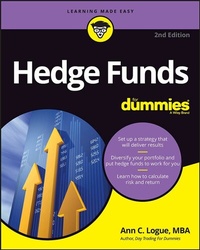
Hedge Funds For Dummies
Description

Hedge Funds For Dummies is your introduction to the popular investing strategy that can help you gain positive returns, no matter what direction the market takes. Hedge funds use pooled funds to focus on high-risk, high-return investments, often with a focus on shorting--so you can earn profit even when stocks fall. But there's a whole lot more to it than that. This book teaches you about the diversity of hedge funds, their pros and cons, and their potentially lucrative role as a part of your portfolio. We also give you tips on finding a broker that is right for you and the investment you wish to make. Let Dummies be your investment advisor as you set up a strategy that will deliver results.
* Understand the ins and outs of hedge funds and how they fit in your portfolio
* Choose the funds that make the most sense for your unique situation
* Build a hedge fund strategy based on tested techniques and the latest market data
* Avoid common mistakes and identify solid funds to ensure success
This Dummies guide is for traders and investors looking to learn more about hedge funds and how they can become lucrative investments in a down market.
More details
Other editions
Additional editions
Person
Ann C. Logue, MBA, worked for twelve years as an investment analyst and earned the Chartered Financial Analyst designation along the way. She also taught business administration at the University of Illinois. Now, she's a finance writer with dozens of publications under her belt, including Day Trading For Dummies.
Content
Part 1: What Is a Hedge Fund, Anyway? 7
Chapter 1: Hedge Funds: Alternative Assets and Alternative Strategies 9
Chapter 2: Not Just a Sleeping Aid: Analyzing SEC Registration 25
Chapter 3: How to Buy into a Hedge Fund 39
Chapter 4: Using Hedge-Fund Strategies without the Hedge Funds 51
Chapter 5: Hedging through Research and Asset Selection 71
Part 2: Looking at Alternative Strategies 93
Chapter 6: Calculating Investment Risk and Return 95
Chapter 7: Buying Low, Selling High: Using Arbitrage in Hedge Funds 123
Chapter 8: Short-Selling, Leveraging, and Other Equity Strategies 139
Chapter 9: Observing How Hedge Funds Profit from the Corporate Life Cycle 159
Chapter 10: Macro Funds: Looking for Global Trends 173
Part 3: Determining Whether Alternative Investments Are Right for You 189
Chapter 11: Fitting Alternatives into a Portfolio 191
Chapter 12: Examining How Hedge Funds Are Structured 205
Chapter 13: But Will You Make Money? Evaluating Hedge Fund Performance 223
Chapter 14: You Want Your Money When? Balancing Time and Liquidity 245
Chapter 15: Taxes, Responsibilities, Transparency, and Other Investment Considerations 257
Part 4: Special Considerations Regarding Hedge Funds 273
Chapter 16: Hooking onto Other Types of Hedge Funds 275
Chapter 17: Hiring a Consultant to Help You with Hedge Funds 289
Chapter 18: Doing Due Diligence on a Hedge Fund 301
Part 5: The Part of Tens 317
Chapter 19: Ten (Plus One) Big Myths about Hedge Funds 319
Chapter 20: Ten Good Reasons to Invest in a Hedge Fund 325
Index 333
Introduction
You've seen the headlines in the financial press. You've heard the rumors about mythical investment funds that make money no matter what happens in the market. And you want a part of that action.
I have to be upfront: Hedge funds aren't newfangled mutual funds, and they aren't for everyone. They're private partnerships that pursue high finance. If you don't mind a little risk, you can net some high returns for your portfolio. However, you have to meet strict limits put in place by the Securities and Exchange Commission - namely that you have a net worth of at least $1 million or an annual income of $200,000. Most hedge-fund investors are institutions, like pensions, foundations, and endowments; if you work for an institution, you definitely need to know about hedge funds. I also have to let you in on a little secret: Not all hedge fund mangers are performing financial alchemy. Many of the techniques they use are available to any investor who wants to increase return relative to the amount of risk taken.
Hedge Funds For Dummies tells you what you need to know, whether you want to research an investment in hedge funds for yourself or for a pension, an endowment, or a foundation. I also give you information about investment theories and practices that apply to other types of investments so you can expand your portfolio. Even if you decide that hedge funds aren't for you, you can increase the return and reduce the risk in your portfolio by using some of the same techniques that hedge fund managers use. After all, not everything fund managers do requires a PhD in applied finance, and not everything in the world of investing is expensive, difficult, and inaccessible.
About This Book
First, let me tell you what this book is not: It is not a textbook, and it is not a guide for professional investors. You can find several of those books on the market already, and they are fabulous in their own right. But they can be dry, and they assume that readers have plenty of underlying knowledge.
This book is designed to be simple. It assumes that you don't know much about hedge funds, but that you're a smart person who needs or wants to know about them. I require no calculus or statistics prerequisite; I just give you straightforward explanations of what you need to know to understand how hedge funds are structured, the different investment styles that hedge fund managers use, and how you can check out a fund before you invest.
And if you still want to read the textbooks, I list a few in the Appendix.
Conventions Used in This Book
I'll start with the basics. I put important words that I define in italic font. I often bold the key words of bulleted or numbered lists to bring the important ideas to your attention. And I place all Web addresses in monofont for easy access.
I've thrown some investment theory into this book. You don't need to know this information to invest in hedge funds, but I think it's helpful to know what people are thinking when they set up a portfolio. I also make an effort to introduce you to some technical terms that will come up in the investment world. I don't want you to be caught short in a meeting where a fund manager talks about generating alpha through a multifactorial arbitrage model that includes behavioral parameters. Many hedge fund managers are MBAs or even PhDs, and two notorious ones have Nobel Prizes. Folks in the business really do talk this way! (To alert you to these topics, I often place them under Technical Stuff icons; see the section "Icons Used in This Book.")
During printing of this book, some of the Web addresses may have broken across two lines of text. If you come across such an address, rest assured that I haven't put in any extra characters (such as hyphens) to indicate the break. When using a broken Web address, type in exactly what you see on the page, pretending as though the line break doesn't exist.
What You're Not to Read
I include sidebars in the book that you don't need to read in order to follow the chapter text. With that stated, though, I do encourage you to go back and read through the material when you have the time. Many of the sidebars contain practice examples that help you get a better idea of how some of the investment concepts work.
You can also skip the text marked with a Technical Stuff icon, but see the previous section for an explanation of why you may not want to skim over this material.
Foolish Assumptions
The format of this masterpiece requires me to make some assumptions about you, the reader. I assume that you're someone who needs to know a lot about hedge funds in a short period of time. You may be a staff member or director at a large pension, foundation, or endowment fund, and you may need to invest in hedge funds in order to do your job well, even if you aren't a financial person. I assume that you're someone who has plenty of money to invest (whether it's yours or not) and who could benefit from the risk-reduction strategies that many hedge funds use. Maybe you've inherited your money, earned it as an athlete or performer, gained it when you sold a company, or otherwise came into a nice portfolio without a strong investment background.
I also assume that you have some understanding of the basics of investing - that you know what mutual funds and brokerage accounts are, for example. If you don't feel comfortable with the basic information, you should check out Investing For Dummies or Mutual Funds For Dummies, both by Eric Tyson. (Calculus and statistics may not be prerequisites, but that doesn't mean I don't have any!)
No matter your situation or motives, my goal is to give you information so that you can ask smart questions, do careful research, and handle your money in order to meet your goals.
And if you don't have a lot of money, I want you to discover plenty of information from this book so that you'll have it at the ready someday. For now, you can structure your portfolio to minimize risk and maximize return with the tools that I provide in this book. You can find more strategies than you may know.
How This Book Is Organized
Hedge Funds For Dummies is sorted into parts so that you can find what you need to know quickly. The following sections break down the structure of this book.
Part 1: What Is a Hedge Fund, Anyway?
The first part describes what hedge funds are, explains how managers structure them, and gives you a little history on their development. It also covers the nuts and bolts of SEC regulation and the process of buying into a hedge fund. Go here for the basics.
Part 2: Looking at Alternative Investment Strategies
In this part, I cover the ways that hedge funds invest and cover the ways that ordinary investors can work some of these strategies into their portfolios. Over the years, exchange traded funds and mutual funds have emerged to make many hedge fund strategies accessible. Other strategies can be copied on your own, if you know what to do.
Part 3: Determining Whether Alternative Investments Are Right For You
Part 3 is an overview of the investment process, including information about risk, return, and cash flow. This information can help you evaluate hedge funds, other alternative investments, and maybe even the traditional mutual funds offered in your employer's retirement plan.
This part also covers ways you can evaluate a hedge fund's risk-adjusted performance. You've probably heard of a handful of headline-grabbing hedge-fund scams, and you can find plenty of investors who have learned the hard way just how much risk their hedge funds had.
Part 4: Special Considerations Regarding Hedge Funds
Part 4 covers some additional information that you need to know such as how to get help with your investment and how to check out the background of the fund and fund manager before you invest. My goal is to help you do the right thing with your money, and this section helps you make the decisions that will achieve this goal.
Part 5: The Part of Tens
In this For Dummies-only part, you get to enjoy some top 10 lists. I present 10 reasons to invest in hedge funds, 10 reasons to avoid them, and 10 myths about the hedge-fund business. I also include an Appendix full of references so that you can get more information if you desire.
Icons Used in This Book
You'll see five icons scattered around the margins of the text. Each icon points to information you should know or may find interesting about hedge funds. They go as follows:
This icon notes something you should keep in mind about hedge-fund investing. It may refer to something I've already covered in the book, or it may highlight something you need to know for future investing decisions.
Tip information tells you how to invest a little better, a little smarter, a little more efficiently. The information can help you ask better questions of your hedge fund manager or make smarter moves with your money.
I've included nothing in this book that can cause death or bodily harm, as far as I can figure out, but plenty of things in the world of hedge funds can cause you to make expensive mistakes. These points help...
