

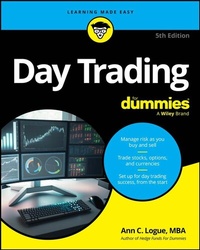
Day Trading For Dummies
Description

Conquer the markets and become a successful day trader
Day trading is a fast-paced, sometimes risky form of investment. Day Trading For Dummies gives you the information you need to get started with this quick-action form of trading for income and maintain your assets. Learn how the market works, how to read and predict price movements, and how to minimize your loss potential, so you can manage your money strategically and create your day trading plan. Expert author Ann Logue will set you on the path to success, showing you the techniques successful day traders use to profit. This new edition covers crypto, AI, meme stocks, new trading options, and the latest strategies. By following market indicators and doing the essential research, you can avoid making critical mistakes and instead make smart trades that earn money.
- Learn the basics of how the stock market works and master the concepts specific to day trading
- Understand the risks involved in fast-paced day trading and maximize your profit potential without going broke
- Discover new methods and ideas, including cryptocurrency trading and FOMO risk
- Earn income and get tips for minimizing your tax bill at the end of the year
Day Trading For Dummies will teach you a lot about day trading in only a little time. Beginning to intermediate investors will love this jargon-free guide to deciding if day trading is for you and making the best money you can.
More details
Other editions
Additional editions
Person
Ann Logue, MBA, CFA, is a writer specializing in business and finance. She has written for Barron's, Entrepreneur, and InvestHedge, among other publications. She is the author of Hedge Funds For Dummies and Socially Responsible Investing For Dummies.
Content
Introduction 1
Part 1: Getting Started with Day Trading 5
Chapter 1: Doing Day Trading Right 7
Chapter 2: Introducing the Financial Markets 19
Chapter 3: Assets 101: Stocks, Bonds, and Commodities 39
Chapter 4: Assets 102: ETFs, Options, and Derivatives 57
Chapter 5: Assets 103: Currencies and Crypto 71
Chapter 6: Increasing Risk and Potential Return with Short Selling and Leverage 85
Chapter 7: Managing Your Money and Positions 101
Chapter 8: Planning Your Trades and Trading Your Plans 117
Part 2: Developing Your Trading Strategy 135
Chapter 9: Picture This: Technical Analysis 137
Chapter 10: Following Market Indicators and Tried-and-True Day Trading Strategies 159
Chapter 11: AI or DIY: Eliminating Emotion with Program Trading 179
Chapter 12: Day Trading for Investors 201
Chapter 13: Researching Research Services 213
Chapter 14: Determining Your Profit and Your Profit Potential 231
Part 3: Taking Your Trading Beyond a Hobby 253
Chapter 15: Setting Up Day Trading Like a Business 255
Chapter 16: Regulation Right Now 281
Chapter 17: Taxes for Day Traders 299
Part 4: The Part of Tens 319
Chapter 18: Ten Good Reasons to Day Trade 321
Chapter 19: Ten (or So) Good Reasons to Avoid Day Trading 327
Chapter 20: Ten Common Day Trading Mistakes 333
Chapter 21: Ten Tested Money-Management Techniques 339
Appendix: Additional Resources for Day Traders 345
Index 351
Chapter 1
Doing Day Trading Right
IN THIS CHAPTER
Figuring out just what day traders do
Setting up a trading business
Knowing what being a successful trader takes
Dispelling a few day trading myths
Looking to conquer the markets from the comforts of home? Some people can. But day trading is a crazy business. Traders work in front of their computer screens, reacting to blips, each of which represents real dollars. They make quick decisions because their ability to bring in profits depends on successfully executing a large number of trades that generate small profits. They close out their positions in the stocks, options, and futures contracts they own at the end of the day, which limits some of the risks. A lot can happen in a year when you're a day trader, increasing the likelihood that your trade idea will work out, but in a day? You have to be patient and work fast. Some days offer nothing good to buy. Other days, every trade seems to lose money.
The individual human day trader is up against a tough opponent: high-frequency algorithms programmed and operated by brokerage firms and hedge funds that have no emotion and can make trades in less time than it takes to blink your eye. Artificial intelligence has the potential to level the playing field, but the market will still crush unprepared players all the time.
In this chapter, I cover what day traders do, share the advantages and disadvantages of day trading, list the personality traits of successful day traders, and give you information on your likelihood of success if you choose to be a day trader. The more you know before you make the decision to trade, the greater your chance of being successful. If you decide that day trading isn't right for you, you can apply strategies and techniques that day traders use to improve the performance of your investment portfolio.
Defining Day Trading: It's All in a Day's Work
The definition of day trading is that day traders hold their securities for only one day. They close out their positions at the end of every day and then start all over again the next day. By contrast, swing traders hold securities for days and sometimes even months; investors sometimes hold for years. The short-term nature of day trading reduces some risks, because nothing that happens overnight will cause losses. Meanwhile, many other types of investors go to bed thinking their position is in great shape only to wake up the next morning to find that the company has announced terrible earnings or that its CEO is being indicted on fraud charges.
Ah, but there are two - or more - sides to every story: The day trader's choice of securities and positions has to work out in a day or it's gone. Tomorrow doesn't exist for any specific position. Meanwhile, the swing trader and the investor have the luxury of time, because it sometimes takes a while for a position to work out the way your research shows it should. In the long run, markets are efficient, and prices reflect all information about a security. Unfortunately, a few days of short runs may need to occur for this efficiency to kick in.
Day traders are speculators working in zero-sum markets one day at a time. That makes the dynamics different from other types of financial activities you may have been involved in. When you take up day trading, the rules that may have helped you pick good stocks or find great mutual funds over the years no longer apply. Day trading is a different game with different rules.
Speculating, not hedging
Professional traders fall into two categories: speculators and hedgers. Speculators look to make a profit from price changes. Hedgers look to protect against a price change. They make their buy and sell choices as insurance, not as a way to make a profit, so they choose positions that offset their exposure in another market.
As an example of hedging, consider a food-processing company and the farmer who raises or grows the ingredients the company needs. The company may look to hedge against the risks of price increases of key ingredients - like corn, cooking oil, or meat - by buying futures contracts on those ingredients. That way, if prices do go up, the company's profits on the contracts help fund the higher prices it has to pay for those ingredients. If the prices stay the same or go down, the company loses only the price of the contract, which may be a fair tradeoff to the company. The farmer raising corn, soybeans, or cattle, on the other hand, benefits if prices go up and suffers if they go down. To protect against a price decline, the farmer sells futures on those commodities. Their futures position makes money if the price goes down, offsetting the decline on their products. And if the prices goes up, they lose money on the contracts, but that loss would be offset by their gain on their harvest.
The commodity markets were intended to help agricultural producers manage risk and find buyers for their products. The stock and bond markets were intended to create an incentive for investors to finance companies. Speculation emerged in all of these markets almost immediately, but it was not their primary purpose.
Day traders are all speculators. They look to make money from the market as they see it now. They manage their risks by carefully allocating their money, using stop and limit orders (which close out positions as soon as predetermined price levels are reached), and closing out at the end of the night. Day traders don't manage risk with offsetting positions the way a hedger does. They use other techniques to limit losses, like careful money management and stop and limit orders (which you can read about in Chapter 2).
Markets have both hedgers and speculators in them. Knowing that different participants have different profit and loss expectations can help you navigate the turmoil of each day's trading. And that's important, because to make money in a zero-sum market, you only make money if someone else loses.
Understanding zero-sum markets
A zero-sum game, discussed in Chapter 2, has exactly as many winners as losers. And options and futures markets, which are popular with day traders, are zero-sum markets. If the person who holds an option makes a profit, then the person who wrote (which is option-speak for sold) that option loses the same amount. There's no net gain or net loss in the market as a whole.
Now some of those people buying and selling in zero-sum markets are hedgers who are content to take small losses in order to prevent big ones. Speculators may have the profit advantage in certain market conditions, but they can't count on having that advantage all the time.
So who wins and who loses in a zero-sum market? Some days, whether you win or lose all depends on luck, but over the long run, the winners are the people who are the most disciplined: They have a trading plan, set limits and stick to them, and can trade based on the data on the screen rather than on emotions like hope, fear, and greed.
Unlike the options and futures markets, the stock market is not a zero-sum game. As long as the economy grows, company profits grow, which in turn leads to growing stock prices. The stock market really has more winners than losers over the long run. That doesn't mean that any given day will have more winners than losers, however. In the short run, the stock market should be treated like a zero-sum market.
If you understand how profits are divided in the markets that you choose to trade, you have a better awareness of the risks that you face as well as the risks that the other participants are taking. People do make money in zero-sum markets, but you don't want those winners to be making a profit off you.
Some traders make money - lots of money - doing what they like. Trading is all about risk and reward. The traders who are rewarded risked the 90 percent washout rate. Knowing that, do you want to take the plunge? If so, read on and check out Chapter 6 where I discuss risk and reward in greater detail. And if not, read on anyway, because you may get some ideas that can help you manage your other investments.
Being disciplined: Closing out each night
Day traders start each day fresh and finish each day with a clean slate. This daily regimen reduces some of the risk, and it forces discipline. You can't keep your losers longer than a day, and you have to take your profits at the end of the day before those winning positions turn into losers.
That discipline is important for day traders. When you day trade, you face a market that doesn't know and doesn't care who you are, what you're doing, or what your personal or financial goals are. There's no kindly boss who may cut you a little slack today, no friendly coworker to help you through a jam, no great client dropping you a little hint about their spending plans for the next fiscal year. Unless you have rules in place to guide your trading decisions, you'll fall prey to hope, fear, doubt, and greed - the Four Horsemen of trading ruin.
So how do you start? First you develop a business plan and a trading plan that reflect your goals and your personality. Then you set your working days and hours, and you accept that you'll close out every night.
In other words, you prepare and have a plan. That's a basic strategy for...
