

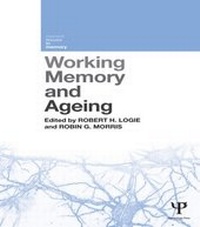
Working Memory and Ageing
1st Edition
Published on 20. June 2014
176 pages
978-1-134-75189-1 (ISBN)
Description

The rapid growth in the numbers of older people worldwide has led to an equally rapid growth in research on the changes across age in cognitive function, including the processes of moment to moment cognition known as working memory. This book brings together international research leaders who address major questions about how age affects working memory:
Why is working memory function much better preserved in some people than others?
In all healthy adults, which aspects of working memory are retained in later years and which aspects start declining in early adulthood?
Can cognitive training help slow cognitive decline with age?
How are changes in brain structures, connectivity and activation patterns related to important changes in working memory function?
Impairments of cognition, and particularly of working memory, can be major barriers to independent living. The chapters of this book dispel some popular myths about cognitive ageing, while presenting the state of the science on how and why working memory functions as it does throughout the adult lifespan.
Working Memory and Aging is the first volume to provide an overview of the burgeoning literature on changes in working memory function across healthy and pathological ageing, and it will be of great interest to advanced undergraduates, postgraduates and researchers in psychology and related subject areas concerned with the effects of human ageing, including several areas of medicine.
Why is working memory function much better preserved in some people than others?
In all healthy adults, which aspects of working memory are retained in later years and which aspects start declining in early adulthood?
Can cognitive training help slow cognitive decline with age?
How are changes in brain structures, connectivity and activation patterns related to important changes in working memory function?
Impairments of cognition, and particularly of working memory, can be major barriers to independent living. The chapters of this book dispel some popular myths about cognitive ageing, while presenting the state of the science on how and why working memory functions as it does throughout the adult lifespan.
Working Memory and Aging is the first volume to provide an overview of the burgeoning literature on changes in working memory function across healthy and pathological ageing, and it will be of great interest to advanced undergraduates, postgraduates and researchers in psychology and related subject areas concerned with the effects of human ageing, including several areas of medicine.
Reviews / Votes
'Working memory has become one of the cornerstones of modern psychology and is a core principle in theories of thought, emotion, and behavior. Logie and Morris, two splendid scholars, have assembled a group of other splendid scholars to discuss how working memory changes over the latter portion of the life span. This great volume belongs on the shelf of anyone interested in how and why we are likely to change as we age and what can be done to make those changes more positive.' - Randall W. Engle, School of Psychology, Georgia Institute of Technology, USA'This is a well-edited book with excellent contributions from very competent scientists on working memory and aging.' - Lars-Goeran Nilsson, Aging Research Center, Karolinska Institutet, Stockholm and Umea Center for Functional Brain Imaging, Umea University
More details
Series
Language
English
Place of publication
London
United Kingdom
Publishing group
Taylor & Francis Ltd
Target group
College/higher education
Illustrations
32 s/w Abbildungen, 7 s/w Tabellen
7 Tables, black and white; 32 Illustrations, black and white
File size
3,80 MB
ISBN-13
978-1-134-75189-1 (9781134751891)
Copyright in bibliographic data and cover images is held by Nielsen Book Services Limited or by the publishers or by their respective licensors: all rights reserved.
Schweitzer Classification
Other editions
Additional editions
Robert H. Logie | Robin G. Morris
Working Memory and Ageing
Book
07/2014
1st Edition
Psychology Press Ltd
€205.90
Shipment within 3-4 weeks
Robert H. Logie | Robin G. Morris
Working Memory and Ageing
Book
07/2014
1st Edition
Psychology Press Ltd
€83.60
Shipment within 3-4 weeks
Persons
Robert H. Logie is Professor of Human Cognitive Neuroscience, and Research Director for the School of Philosophy, Psychology and Language Sciences at the University of Edinburgh, UK. He is also Group Leader for Human Cognitive Ageing within the cross-council-funded Centre for Cognitive Ageing and Cognitive Epidemiology. His research and teaching interests lie in the cognition of human memory in the healthy, ageing and damaged brain, focused on experimental behavioural studies of working memory. He has published over 170 peer reviewed papers, 50 book chapters and 12 books.
Robin G. Morris is Professor of Neuropsychology at King's College London, UK, and Consultant Clinical Neuropsychologist at King's College Hospital, where he is Head of the Clinical Neuropsychology Department. He is also Head of Neuropsychology in the King's Health Partners Neurosciences Academic Group. His main interests are in the neuropsychology of memory and also of executive functioning, and he has conducted research on a range of patients with neuropsychological disorders, including those with focal brain damage, schizophrenia, cerebrovascular disease and Alzheimer's disease. He has published over 220 peer reviewed papers and 40 book chapters, and recently received the British Psychological Society Barbara Wilson Neuropsychology Award.
Robin G. Morris is Professor of Neuropsychology at King's College London, UK, and Consultant Clinical Neuropsychologist at King's College Hospital, where he is Head of the Clinical Neuropsychology Department. He is also Head of Neuropsychology in the King's Health Partners Neurosciences Academic Group. His main interests are in the neuropsychology of memory and also of executive functioning, and he has conducted research on a range of patients with neuropsychological disorders, including those with focal brain damage, schizophrenia, cerebrovascular disease and Alzheimer's disease. He has published over 220 peer reviewed papers and 40 book chapters, and recently received the British Psychological Society Barbara Wilson Neuropsychology Award.
Content
Logie & Morris, Introduction Angela Kilb & Moshe Naveh-Benjamin, The effects of divided attention on long-term memory in younger and older adults Anna Stigsdotter Neely & Lars Nyberg, Working Memory Training in Late Adulthood:A Behavioral and Brain Perspective, Irene E. Nagel and Ulman Lindenberger Functional neuroimaging investigations of age-related working memory decline Timothy A. Salthouse, Individual Differences in Working Memory and Aging Rebecca Charlton & Robin Morris, Structural correlates of age-related working memory decline Robert Logie & Mark Horne, What is and what is not affected by age in working memory Randall Engle, Commentary.
