

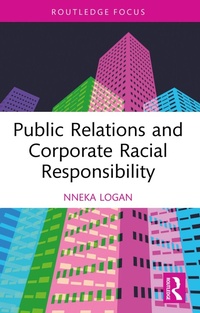
Public Relations and Corporate Racial Responsibility
1st Edition
Published on 13. February 2026
160 pages
978-1-040-69336-0 (ISBN)
Description

Public Relations and the Corporate Racial Responsibility introduces corporate racial responsibility (CRR) theory. CRR responds to the ongoing crisis of racism by showing how communication from corporations can advance racial justice, support racial equality and foster inclusivity, even in polarizing times.
Many people may wonder why corporations have racial responsibilities. The author lays out several examples that describe precisely why corporations have earned racial responsibilities - from the days of chattel slavery to today's AI era. The book describes how corporations have directly or indirectly participated in and benefitted from racial oppression as well as how they can use communication to help right historical wrongs. Communications and campaigns from Ben & Jerry's, Dove, Nike, P&G, Pepsi, Starbucks and others are discussed and demonstrate how corporations have sought to communicate about matters of race, justice and equality. CRR theory emerges from the nexus of corporate social responsibility thinking in public relations to offer scholars a new theoretical avenue they can use to identify, understand, contextualize, theorize, and analyze corporate discourse about race and its societal implications. It also provides practitioners guidance on how their organizations can approach communicating about race.
As the book advances the development of CRR theory, it provides readers with a fresh and dynamic take on the corporation and the societal import of its communications. Scholars and practitioners in public relations, corporate communication, corporate social responsibility, corporate social advocacy, business ethics, advertising, branding, marketing, race and social justice will find this book of interest.
Many people may wonder why corporations have racial responsibilities. The author lays out several examples that describe precisely why corporations have earned racial responsibilities - from the days of chattel slavery to today's AI era. The book describes how corporations have directly or indirectly participated in and benefitted from racial oppression as well as how they can use communication to help right historical wrongs. Communications and campaigns from Ben & Jerry's, Dove, Nike, P&G, Pepsi, Starbucks and others are discussed and demonstrate how corporations have sought to communicate about matters of race, justice and equality. CRR theory emerges from the nexus of corporate social responsibility thinking in public relations to offer scholars a new theoretical avenue they can use to identify, understand, contextualize, theorize, and analyze corporate discourse about race and its societal implications. It also provides practitioners guidance on how their organizations can approach communicating about race.
As the book advances the development of CRR theory, it provides readers with a fresh and dynamic take on the corporation and the societal import of its communications. Scholars and practitioners in public relations, corporate communication, corporate social responsibility, corporate social advocacy, business ethics, advertising, branding, marketing, race and social justice will find this book of interest.
More details
Series
Edition
1. Auflage
Language
English
Place of publication
London
United Kingdom
Publishing group
Taylor & Francis Ltd
Target group
College/higher education
Professional and scholarly
Product notice
Reflowable
File size
0,55 MB
ISBN-13
978-1-040-69336-0 (9781040693360)
Copyright in bibliographic data and cover images is held by Nielsen Book Services Limited or by the publishers or by their respective licensors: all rights reserved.
Schweitzer Classification
Other editions
Additional editions
Book
approx. 02/2026
1st Edition
Routledge
€69.50
Not yet published
Person
Nneka Logan is Professor in the School of Communication at Virginia Tech, USA.
Content
Introduction
1. Big Business and Slavery: Establishing the Corporate Responsibility to Race
2. Corporate Personhood and the Appropriation of a Racialized Discourse
3. Corporate Discourse and the Ideological Construction of Race
4. Corporate Racial Responsibility Theory
5. Analyzing Dove's CROWN Act Campaign with CRR
6. The Corporate Responsibility to Race Continues: The AI Era
Conclusion
Index
1. Big Business and Slavery: Establishing the Corporate Responsibility to Race
2. Corporate Personhood and the Appropriation of a Racialized Discourse
3. Corporate Discourse and the Ideological Construction of Race
4. Corporate Racial Responsibility Theory
5. Analyzing Dove's CROWN Act Campaign with CRR
6. The Corporate Responsibility to Race Continues: The AI Era
Conclusion
Index
