

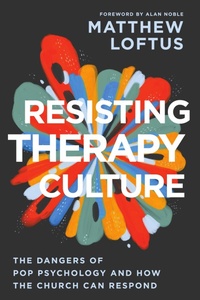
Resisting Therapy Culture
Description

Let Churches Be Churches and Therapists Be Therapists
We live in an age where "therapy culture" dominates our cultural milieu. Everywhere we look, therapeutic language and psychological concepts are popularized, misapplied,and lose their medical significance. Therapy and psychiatry are good practices, but when people begin to filter everything in life through a therapeutic lens, it becomes harmful rather than helpful.
The church is not immune to this phenomenon. Increasingly, people's expectations of the church and its leaders are viewed through the lens of psychological health and wellness.
In this book, Matthew Loftus unpacks how this kind of "therapy culture" can distort the Christian life. He argues that the church cannot do for people what therapy and psychiatry are designed to do. While church should be a place of healing and love for people who are suffering from mental illness, churches and their leaders should focus on what they are called to do: bringing people together to worship God.
What you'll get with Resisting Therapy Culture:
- An understanding of the role of the church in supporting people through mental health struggles
- A deeper appreciation for the expertise and value of mental health professionals
- Insight into how both therapy and the church can be good for Christians' spiritual and mental health in their own intended ways
- Encouragement for church leaders to renew their focus on leading people in worship
This book is an invitation for church leaders to focus on what the church does best. As Loftus explains, "People will live healthier lives when churches and therapists are working well, but the two do not have the same mission, methods, mandates, or measures of success. . . . Both should do the very best that they can in the sphere of work that God has assigned."
More details
Other editions
Additional editions
Person
Matthew Loftus teaches and practices family medicine at a mission hospital in Kenya. His work has appeared in The New York Times, The Atlantic, Christianity Today, First Things, Comment, and Mere Orthodoxy. He is the 2025 recipient of Trinity Forum's Michael J. Gerson Prize for Excellence in Writing on Faith and Public Life.
O. Alan Noble (PhD, Baylor) is associate professor of English at Oklahoma Baptist University, a fellow at the Keller Center for Cultural Apologetics, and author of On Getting Out of Bed, You Are Not Your Own, and Disruptive Witness. Noble has published articles at The Atlantic, The Gospel Coalition, First Things, and Christianity Today. He lives with his wife and three children in Oklahoma City.
Content
Foreword by Alan Noble
Introduction: What Is Therapy Culture?
1. What's Gone Wrong? Church and Therapy Culture
2. Medicalization and Iatrogenesis: The Means and Ends of Therapy Culture
3. Mental Health and Moral Choices: Defining the Indistinguishable
4. Diagnoses and Treatments: Lines in the Sand and Hammers for Pointy Objects
5. Christianity and Psychology: History and Rivalry
6. Suffering and Mental Illness: Finding a Purpose In, Through, or Despite Pain
7. Stress and Self-Care: Cycles of Rest and Choosing to Suffer Well
8. Attachment and Parenting: What We Inherit and What We Learn
9. Trauma: Wounded and Healing
10. Addiction: Desire and Disease
Conclusion: The Good Enough Church
Acknowledgments
Notes
