

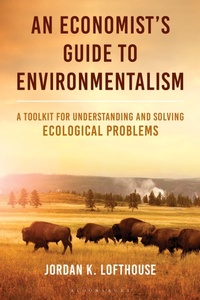
An Economist's Guide to Environmentalism
A Toolkit for Understanding and Solving Ecological Problems
1st Edition
Published on 16. October 2025
248 pages
978-1-5381-8986-3 (ISBN)
Description

Explains how economics can be used to solve an array of environmental issues from endangered species to global warming.
Many species are threatened with extinction and landscapes are being destroyed. Water is becoming increasingly scarce, harming ecological systems and human societies. Perhaps the most pressing environmental problem is human-caused climate change. What causes these problems, and what can we do about them?
In An Economist's Guide to Environmentalism, Jordan K. Lofthouse demonstrates how the field of economics can explain the rise of environmental problems and offers a framework to evaluate the vast array of potential solutions. Lofthouse assembles a "toolkit" of easy-to-understand economic concepts and then applies those tools to a variety of environmental problems. These tools include incentives, constraints, trade-offs, unintended consequences, institutional analysis, and more. The examples in this book highlight how environmental issues often stem from poorly defined or poorly enforced property rights.
Lofthouse argues for novel solutions such as assigning property rights to wildlife on the verge of extinction, private approaches to land conservation, and the implementation of water markets. Addressing global-scale problems like climate change requires the innovative and entrepreneurial discoveries of many different people in governments, markets, and civil society. Readers of this book will discover new opportunities and a refreshing, practical approach to protecting the planet through the insights of economics.
Many species are threatened with extinction and landscapes are being destroyed. Water is becoming increasingly scarce, harming ecological systems and human societies. Perhaps the most pressing environmental problem is human-caused climate change. What causes these problems, and what can we do about them?
In An Economist's Guide to Environmentalism, Jordan K. Lofthouse demonstrates how the field of economics can explain the rise of environmental problems and offers a framework to evaluate the vast array of potential solutions. Lofthouse assembles a "toolkit" of easy-to-understand economic concepts and then applies those tools to a variety of environmental problems. These tools include incentives, constraints, trade-offs, unintended consequences, institutional analysis, and more. The examples in this book highlight how environmental issues often stem from poorly defined or poorly enforced property rights.
Lofthouse argues for novel solutions such as assigning property rights to wildlife on the verge of extinction, private approaches to land conservation, and the implementation of water markets. Addressing global-scale problems like climate change requires the innovative and entrepreneurial discoveries of many different people in governments, markets, and civil society. Readers of this book will discover new opportunities and a refreshing, practical approach to protecting the planet through the insights of economics.
More details
Edition
1. Auflage
Language
English
Place of publication
United States
Publishing group
Bloomsbury Publishing Plc
Illustrations
8 bw illus
ISBN-13
978-1-5381-8986-3 (9781538189863)
Copyright in bibliographic data and cover images is held by Nielsen Book Services Limited or by the publishers or by their respective licensors: all rights reserved.
Schweitzer Classification
Other editions
Additional editions
Jordan K. Lofthouse
An Economist's Guide to Environmentalism
A Toolkit for Understanding and Solving Ecological Problems
Book
10/2025
Rowman & Littlefield
€36.50
Shipment within 3-4 weeks
Person
Jordan K. Lofthouse is a senior fellow with the FA Hayek Program for Advanced Study in Philosophy, Politics, and Economics at the Mercatus Center at George Mason University. He is the coauthor of The Reality of American Energy: The Hidden Costs of Electricity Policy. He was born and raised in Rexburg, Idaho, and he currently lives in Falls Church, Virginia.
Content
Acknowledgements
Introduction: Economics and Environmentalism
Part I: An Economic Toolbox
Chapter 1: Rational Choice Theory
Chapter 2: Tradeoffs and Opportunity Costs
Chapter 3: Marginalism
Chapter 4: Institutions
Chapter 5: Property Rights
Chapter 6: The Entrepreneurial Market Process
Chapter 7: Supply and Demand
Chapter 8: Unintended Consequences
Chapter 9: Public Choice Theory
Chapter 10: Polycentric Governance
Part II: Applying Economic Tools to Environmental Problems
Chapter 11: Positive-Sum Versus Negative-Sum Environmentalism
Chapter 12: Species Conservation
Chapter 13: Land Conservations
Chapter 14: Water Scarcity and Water Markets
Chapter 15: Climate Change
Conclusion
Notes
Select Bibliography
Index
About the Author
Introduction: Economics and Environmentalism
Part I: An Economic Toolbox
Chapter 1: Rational Choice Theory
Chapter 2: Tradeoffs and Opportunity Costs
Chapter 3: Marginalism
Chapter 4: Institutions
Chapter 5: Property Rights
Chapter 6: The Entrepreneurial Market Process
Chapter 7: Supply and Demand
Chapter 8: Unintended Consequences
Chapter 9: Public Choice Theory
Chapter 10: Polycentric Governance
Part II: Applying Economic Tools to Environmental Problems
Chapter 11: Positive-Sum Versus Negative-Sum Environmentalism
Chapter 12: Species Conservation
Chapter 13: Land Conservations
Chapter 14: Water Scarcity and Water Markets
Chapter 15: Climate Change
Conclusion
Notes
Select Bibliography
Index
About the Author
