

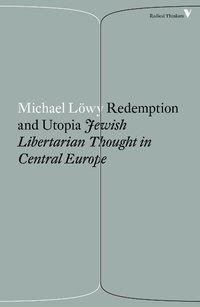
Redemption and Utopia
Jewish Libertarian Thought in Central Europe
Published on 28. March 2017
288 pages
978-1-78663-086-5 (ISBN)
Description

Towards the end of the nineteenth century, there appeared in Central Europe a generation of Jewish intellectuals whose work was to transform modern culture. Drawing at once on the traditions of German Romanticism and Jewish messianism, their thought was organized around the cabalistic idea of the "tikkoun": redemption. Redemption and Utopia uses the concept of "elective affinity" to explain the surprising community of spirit that existed between redemptive messianic religious thought and the wide variety of radical secular utopian beliefs held by this important group of intellectuals. The author outlines the circumstances that produced this unusual combination of religious and non-religious thought and illuminates the common assumptions that united such seemingly disparate figures as Martin Buber, Franz Kafka, Walter Benjamin and Georg Luk¿cs.
More details
Series
Edition
Ebook UK & RoW
Language
English
Place of publication
London
United Kingdom
Target group
College/higher education
Professional and scholarly
Product notice
Reflowable
ISBN-13
978-1-78663-086-5 (9781786630865)
Copyright in bibliographic data and cover images is held by Nielsen Book Services Limited or by the publishers or by their respective licensors: all rights reserved.
Schweitzer Classification
Other editions
Additional editions

Book
03/2017
Verso Books
€33.50
Shipment within 3-4 weeks
Persons
Michael L¿wy is Research Director of Sociology at the Centre National de la Recherche Scientifique, Paris. He is the author of numerous books, including George Luk¿cs: From Romanticism to Bolshevism, The Politics of Combined and Uneven Development: The Theory of Permanent Revolution, Marxism in Latin America, The War of the Gods: Religion and Politics in Latin America and Fire Alarm: Reading Walter Benjamin's 'On the Concept of History'.
Content
- Intro
- Halftitle Page
- Title Page
- Copyright Page
- Contents
- Introduction: The Defeated of History
- 1. On the Concept of Elective Affinity
- 2. Jewish Messianism and Libertarian Utopia: From 'Correspondences' to 'Attractio Electiva'
- 3. Pariahs, Rebels and Romantics: A Sociological Analysis of the Central European Jewish Intelligentsia
- 4. Religious Jews Tending to Anarchism: Martin Buber, Franz Rosenzweig, Gershom Scholem, Leo Löwenthal
- 5. 'Theologia negativa' and 'Utopia negativa': Franz Kafka
- 6. Outside all Currents, at the Crossing of the Ways: Walter Benjamin
- 7. The Religious-Atheist and Libertarian Assimilated Jews: Gustav Landauer, Ernst Bloch, Georg Lukács, Erich Fromm
- 8. Crossroads, Circles and Figures: A Few Examples
- 9. A French Exception: Bernard Lazare
- Conclusion: 'Historical Messianism': A Romantic/Messianic Conception of History
- Notes
- Bibliography
- Index
