

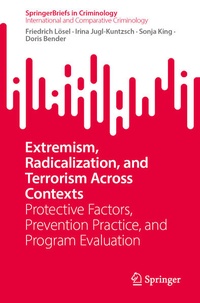
Extremism, Radicalization, and Terrorism Across Contexts
Description

This brief addresses the urgent global challenge of politically, religiously, ethnically, and other ideologically motivated extremism and violent radicalization. It critically examines the effectiveness of existing psychosocial prevention strategies and provides insights into resilience against extremism. Drawing on research from 31 countries and the evaluation of l prevention programs, the book offers a comprehensive look at how psychosocial programs can reduce radicalization. The volume delves into key concepts, theoretical explanations, methodological challenges, and developmental risks Its own empirical research includes a unique survey of practical prevention projects and a systematic review and meta-analysis of outcome evaluations. The volume highlights positive outcomes, especially in primary prevention for youth and tertiary interventions for exiting radical trajectories. However, it also underscores the need for more methodologically sound, controlled evaluations of long-term behavioral changes. By offering empirical evidence on diverse approaches, this book provides a robust foundation for a more informed and less divisive societal discussion on extremism. It is an essential resource for policymakers, practitioners, and researchers engaged in counter-extremism, social work, and criminology.
More details
Other editions
Additional editions
Persons
Friedrich Lösel is Emeritus Professor and past Director of the Institute of Psychology, Friedrich-Alexander University Erlangen-Nuremberg, and the Institute of Criminology, Cambridge University. For his broad range of research and activities he received five awards from the American Society of Criminology, and the Joan McCord Award, German Psychology Prize, Beccaria Gold Medal, and Stockholm Prize in Criminology.
Irina Jugl received her Ph.D. in Psychology from the Friedrich-Alexander-University Erlangen-Nuremberg (FAU). She was a research assistant at FAU and published on prevention programs against extremism, left-wing and female extremism. Currently, she works as researcher specializing in extremism prevention at the State Criminal Police Office of Baden-Württemberg, Germany.
Sonja King received her Ph.D. in Psychology from the Friedrich-Alexander-University Erlangen-Nuremberg (FAU). She was a research assistant in projects on extremism and radicalization at FAU and published on extremism prevention and related topics. Currently, she is a scientific officer at the Research Center on Terrorism/Extremism of the German Federal Police Office.
Doris Bender was senior lecturer at the Institute of Psychology, Friedrich-Alexander-University Erlangen-Nuremberg (FAU). She worked at various research projects and published on resilience in childhood, biosocial origins of delinquency, developmental prevention, offender treatment, school bullying, and extremism. Currently, she is Co-PI of the FAU-project EFFEKT which focuses on child and family-oriented prevention.
Content
Chapter 1: Summary.- Chapter 2: Conceptual and theoretical Foundations.- Chapter 3: Risk factors and risk assessment instruments.- Chapter 4: Our research on protective factors against extremism and radicalization.- Chapter 5: International survey of psychosocial prevention programs against extremism, radicalization and terrorism.- Chapter 6: Systematic review and meta-analysis on the evaluation of psychosocial prevention programs against extremism and radicalization.- Chapter 7: Résumé and perspectives.
