

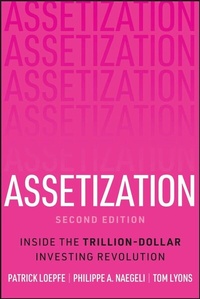
Assetization
Description

A bold new look inside the trillion-dollar investing revolution currently reshaping how financial products are made and who gets to invest.
Most investors and financial advisors believe the market offers endless opportunity. Yet in reality, standard investment products capture only a narrow slice of the real economy. Trillions in value remain locked away-out of reach for all but the ultra-wealthy and major institutions.
The good news is that this is changing. Driven by advances in technology and financial engineering, pioneers the world over are transforming how financial products are made, what can be invested in, and who can access these opportunities.
In Assetization: Inside the Trillion-Dollar Investing Revolution, a team of veteran fintech innovators-including the founders of the award-winning Swiss fintech GenTwo-provide an insider's view of this collective movement to democratize investing and bring the creator economy to finance.
Inside, you'll discover:
- Why large parts of the global economy-and the investment opportunities they represent-are not accessible using today's standard financial products.
- How the barriers that have previously hindered investors and financial product creators in accessing these opportunities are coming down.
- What the emerging creator economy in finance looks like, and what this means for those prepared to make use of it.
- Where innovation is already happening-through detailed research, use cases, and case studies from the cutting edge of this investment revolution.
- Why this transformation is accelerating now, and what you can do to be part of it.
As the authors show, markets around the world are shifting from a product-pushed system to a demand-driven one. Investors can now act on their convictions, and advisors and institutions can reinvent how they deliver value. Those who understand this moment will define - and reap the rewards of - the future of investing.
Who should read this book?
- Investors eager to move beyond standard products and tap into the full spectrum of opportunities the real economy has to offer.
- Wealth and investment advisors ready to shift from curators to creators in their client offering.
- Financial professionals and institutions looking to future-proof their business models.
- Entrepreneurs, students, and policymakers wanting to understand the new infrastructure transforming the investment industry.
Don't just imagine more open, accessible markets-see how it's happening and learn how to act. The treasure is out there. The pioneers are staking their claims. Will you join them?
More details
Other editions
Additional editions
Persons
PATRICK LOEPFE is the Founder and Chairman of GenTwo. A seasoned expert in structured products and investment banking with over 25 years of experience, he revolutionized financial processes throughout his career, including development of Vontobel's groundbreaking Deritrade platform. Patrick founded d-struct AG in 2015 and is recognized as a key figure in Switzerland's fintech industry.
PHILIPPE A. NAEGELI is the Co-Founder and CEO of GenTwo. He brings over 30 years of international experience in trading, investment and merchant banking, corporate governance, and entrepreneurship. Philippe founded PAN Asset Management in 2007, establishing an international network of financial institutions and investment funds, and served as CEO and Managing Partner of Forstmann & Co. USA.
TOM LYONS is responsible for communications and thought leadership at GenTwo. Originally from New York and educated at Columbia University, he moved to Zurich in 1994, where he worked in communications and marketing at Clariden Bank, Credit Suisse and UBS. He founded Lyons Communications in 2014, specializing in technology storytelling with an emphasis on fintech, blockchain, and emerging technologies.
Content
FOREWORD BY JIM WIANDT, FOUNDER OF ETF.COM xv
The ETF Revolution Was Only the Beginning xvi
Containerization: The Turning Point xvii
From Prompt to Product: Wave 3 and the Unimaginable Future xviii
The Future Is Wider Than We Think xix
PREFACE xxi
How to Read This Book xxiv
What You Will Find Inside xxiv
Part I: The Assetization Revolution xxv
Part II: Asset Rush-Tales from the Assetization Frontier xxvii
ABOUT THE AUTHORS xxix
PART I THE ASSETIZATION REVOLUTION 1
CHAPTER 1 IT WILL NEVER WORK! 3
CHAPTER 2 THE BUY SIDE AND ITS DISCONTENTS 15
CHAPTER 3 WAVE 1-THE DEMOCRATIZATION OF ACCESS 37
CHAPTER 4 WAVE 2-THE CONTAINERIZATION OF FINANCE 59
CHAPTER 5 WAVE 3-RADICAL AUTOMATION 81
CHAPTER 6 FROM CURATOR TO CREATOR 97
CHAPTER 7 UNTAPPED ASSETS: THE TRILLION-DOLLAR OPPORTUNITY OF ASSETIZATION 115
CHAPTER 8 ASSETIZATION AND THE HISTORY OF FINANCE 131
CHAPTER 9 INVEST IN YOUR BELIEFS 143
PART II ASSET RUSH-TALES FROM THE ASSETIZATION FRONTIER 151
THE CHANGING FACE OF ASSET MANAGEMENT: MYRIAM OUALHA DEBLANC 155
FINTECH EXISTS TO MAKE THINGS EASIER FOR PEOPLE: PETE CASELLA 161
MAKING CARBON CREDITS INVESTIBLE: PROFESSOR LISA WILSON 167
BRINGING DIGITAL ASSETS INTO THE FINANCIAL MAINSTREAM: NISHA SURENDRAN 175
ETHEREUM AND THE TREASURY REVOLUTION: JOE LUBIN AND JOSEPH CHALOM 181
IT'S THE (BANKING) NETWORK, STUPID: LUCAS ERETH 187
THE ASSETIZATION OF PROFESSIONAL ATHLETES: PROFESSOR PIER-LUC NAPPERT 195
THE ACADEMIC STUDY OF ASSETIZATION: PROFESSOR KEAN BIRCH 201
HOW GENTWO DIGITAL SOLVES INSTITUTIONAL CRYPTO'S ACCESS PROBLEM: MARK ARASARATNAM 207
URANIUM, AMCS, AND THE GREEN METALS INVESTMENT OPPORTUNITY: PATRICK MICHAELS 213
THE WORLD'S LARGEST LEGAL INSIDER MARKET: PASCAL SCHNEIDINGER 219
INDEX 225
PREFACE
There is a revolution happening in the investment industry. We call it assetization, and it will reshape how people invest and how financial products get made. In our opinion, it also represents a once-in-a-generation opportunity for investors, independent financial advisors, and institutional wealth managers. If you fall into one of these three categories, this book is for you.
For generations, investing has meant public markets. Most investors have been confined to listed securities-stocks, bonds, mutual funds, ETFs-and have had to settle for whatever products the industry chose to put on the shelf. Advisors and wealth managers, meanwhile, have been stuck with a narrow toolset, unable to build truly custom solutions even when they could see exactly what their clients needed. This is no longer good enough.
Public markets are vast, but they are also limited. They represent a relatively narrow slice of the real economy, and that slice is shrinking as fewer companies go public. At the same time, traditional products ignore enormous categories of assets: private equity and venture capital, infrastructure, real estate, private credit, digital assets, and "passion" and frontier assets such as art, collectibles, and tokenized data. The majority of the world's wealth sits outside the universe most portfolios can reach.
It is no surprise that investors and their advisors want more-more asset choices, more control, and solutions that reflect what people actually believe and care about rather than what happens to be available.
The good news is that this is changing.
Over the past 10 years, we have seen the barriers to private markets and other alternative investments begin to come down. New marketplaces are making it easier for people to access investments that were previously out of reach. New types of assets, from cryptocurrencies to collectibles, are going mainstream. New platforms and products are providing hands-on investors with the tools to create their own portfolios.
We see this democratization of access as the first wave of assetization. As the investment industry works to bring previously inaccessible assets into the investment universe, the old "seller's market" of investment products, controlled by large institutions that decide what products get made, is shifting into a "buyer's market," characterized by low costs and greater choice.
But this is only the beginning. The tip of the iceberg.
The upcoming democratization of financial product creation will be far more interesting and potentially transformative. Thanks to new technologies, innovative approaches, and the ongoing disaggregation of the financial product value chain, it is becoming easier than ever to create and issue financial products across all types of assets. This process shifts control away from large financial institutions with their massive product factories and into the hands of independent financial advisors, wealth managers, multi-family offices, and others who are closer to investors and better attuned to their needs. This will benefit their clients significantly. By breaking the quasi-monopoly on financial product creation, this wave of assetization will also level the playing field in the industry. Smaller or independent players who leverage these tools effectively will be able to enhance their offerings, differentiate themselves from competitors, and stand their ground against the dominant incumbents currently shaping the landscape.
As importantly, this wave will unlock trillions of dollars of value by opening up assets that barely touch today's public markets. Hundreds of trillions of dollars in real estate, investible private companies, and infrastructure projects; trillions in art and collectibles; not to mention unknown quantities of new frontier assets like tokenized data or future cash flows, are all assetizable. Even a small fraction of that would represent a generation-defining opportunity for investors to access, shape, and share in value that was previously out of reach.
But it doesn't end there. We believe that the process of assetization will ultimately lead to the complete automation of the product creation value chain. Everything-from generating an idea for a product to researching, structuring, issuing it, and managing its lifecycle-will be automated and accessible through a platform or even an app. The entire marketing and distribution process will also be automated, brought together in digital marketplaces that connect sellers with investors worldwide.
For investors, the message of this book is clear: you no longer have to settle for portfolios built only from what happens to be on the shelf. Over time, assetization will allow you to invest in your beliefs-to express what you actually think, know, and care about through the assets you hold and the products you choose. For advisors and wealth managers, it offers a path to move from curator to creator, using new tools and structures to design solutions that truly fit your clients instead of forcing clients into pre-packaged molds. For institutions and wealth management firms, it is an invitation to embrace these capabilities, bring them inside the organization, and use them to strengthen client relationships and hold on to assets.
This book is written from a practitioner's standpoint. We are not market analysts. We are not academics. We are builders. Our company, GenTwo, is dedicated to expanding the investment universe by building tools to democratize how financial products get made. This is an important part of the puzzle, but it is far from the only one. Assetization is unfolding on many levels and across many institutions at once. Our goal in these pages is simply to give that transformation a name, to sketch its main contours as clearly as we can, and to invite you to think about what it will mean for your own investing decisions, your clients, and your business.
This is a completely new world. The world of assetization.
HOW TO READ THIS BOOK
This book is addressed to investors and those who advise them. While it may seem like these are two clearly distinct groups-investors who buy financial products, advisors and wealth managers who sell them-in reality both groups are "consumers" of financial products. Investors use the products, their advisors, broadly stated, help them to find the right ones.
That said, assetization has different implications depending on which side you are on (though as a professional advisor you will likely be an investor too). To help, in Chapter 2 we introduce three personas: Ada the investor, Barbara the independent advisor, and Clark the institutional wealth manager. Throughout the book these characters reappear as proxies for you the reader in whichever role you feel applies to you. It is our intention that when Ada appears, she should stand for you as an investor. When Barbara or Clark do, they stand for you as a financial professional. In this way we hope to make the relevance of our arguments to you as clear as we can.
WHAT YOU WILL FIND INSIDE
This book is divided into two parts.
PART I: THE ASSETIZATION REVOLUTION
Chapter 1: It Will Never Work! We begin with our personal journey, launching GenTwo in a Zurich nightclub to a skeptical audience who told us "it will never work." We introduce the fundamental problem that motivated us: the friction inherent in traditional securitization that keeps vast amounts of global value locked away. This chapter lays the groundwork for the concept of "assetization"-not just as a technical fix for banking infrastructure, but as a broader movement to democratize the creation of financial products and radically expand the investment universe.
Chapter 2: The Buy Side and Its Discontents Here we introduce Ada, Barbara, and Clark-the three personas mentioned above that represent the modern investor, the independent advisor, and the institutional wealth manager. Through their eyes, we explore the "buy side's" growing discontent with the status quo: shrinking public markets, rising asset correlation, and a generic product shelf that no longer meets the needs of a younger, digital-native generation. We argue that the pressure from these dissatisfied stakeholders is the primary force driving the industry toward assetization.
Chapter 3: Wave 1-The Democratization of Access This chapter defines the first wave of assetization: the democratization of access. We trace the industry's shift from a "seller's market," where institutions dictate the menu, to a "buyer's market" defined by unprecedented choice. We look at how public and private markets are converging, and how new platforms and DIY tools are empowering investors to build their own playlists of assets. However, we note a critical limitation: while investors can now buy more products, they still rely on large institutions to create them.
Chapter 4: Wave 2-The Containerization of Finance We explore the second wave: the democratization of creation. Drawing on the history of the shipping container, we show how the infrastructure of finance is being standardized and modularized. Starting with securitization and tokenization as efficient "containers" for value, we demonstrate how the complex machinery of product creation is being disaggregated....
