

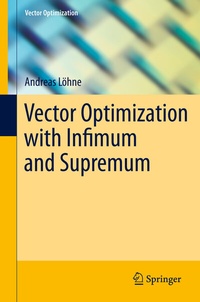
Vector Optimization with Infimum and Supremum
1st Edition
Published on 25. May 2011
X, 206 pages
978-3-642-18351-5 (ISBN)
Description

The theory of Vector Optimization is developed by a systematic usage of infimum and supremum. In order to get existence and appropriate properties of the infimum, the image space of the vector optimization problem is embedded into a larger space, which is a subset of the power set, in fact, the space of self-infimal sets. Based on this idea we establish solution concepts, existence and duality results and algorithms for the linear case. The main advantage of this approach is the high degree of analogy to corresponding results of Scalar Optimization. The concepts and results are used to explain and to improve practically relevant algorithms for linear vector optimization problems.
More details
Other editions
Additional editions
Andreas Löhne
Vector Optimization with Infimum and Supremum
Book
07/2013
Springer
€117.69
Shipment within 7-9 days
Andreas Löhne
Vector Optimization with Infimum and Supremum
Book
05/2011
1st Edition
Springer
€117.69
Shipment within 7-9 days
Content
- Intro
- Vector Optimization with Infimum and Supremum
- Preface
- Contents
- Introduction
- Part I General and Convex Problems
- Chapter 1 A complete lattice for vector optimization
- 1.1 Partially ordered sets and complete lattices
- 1.2 Conlinear spaces
- 1.3 Topological vector spaces
- 1.4 Infimal and supremal sets
- 1.5 Hyperspaces of upper closed sets and self-infimal sets
- 1.6 Subspaces of convex elements
- 1.7 Scalarization methods
- 1.8 A topology on the space of self-infimal sets
- 1.9 Notes on the literature
- Chapter 2 Solution concepts
- 2.1 A solution concept for lattice-valued problems
- 2.2 A solution concept for vector optimization
- 2.3 Semicontinuity concepts
- 2.4 A vectorial Weierstrass theorem
- 2.5 Mild solutions
- 2.6 Maximization problems and saddle points
- 2.7 Notes on the literature
- Chapter 3 Duality
- 3.1 A general duality concept applied to vector optimization
- 3.2 Conjugate duality
- 3.2.1 Conjugate duality of type I
- 3.2.2 Duality result of type II and dual attainment
- 3.2.3 The finite dimensional and the polyhedral case
- 3.3 Lagrange duality
- 3.3.1 The scalar case
- 3.3.2 Lagrange duality of type I
- 3.3.3 Lagrange duality of type II
- 3.4 Existence of saddle points
- 3.5 Connections to classic results
- 3.6 Notes on the literature
- Part II Linear Problems
- Chapter 4 Solution concepts and duality
- 4.1 Scalarization
- 4.1.1 Basic methods
- 4.1.2 Solutions of scalarized problems
- 4.2 Solution concept for the primal problem
- 4.3 Set-valued duality
- 4.4 Lattice theoretical interpretation of duality
- 4.5 Geometric duality
- 4.6 Homogeneous problems
- 4.7 Identifying faces of minimal vectors
- 4.8 Notes on the literature
- Chapter 5 Algorithms
- 5.1 Benson's algorithm
- 5.2 A dual variant of Benson's algorithm
- 5.3 Solving bounded problems
- 5.4 Solving the homogeneous problem
- 5.5 Computing an interior point of the lower image
- 5.6 Degeneracy
- 5.7 Notes on the literature
- References
- Index
