

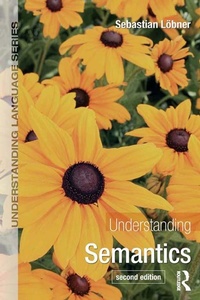
Understanding Semantics
2nd Edition
Published on 26. June 2013
392 pages
978-1-134-05271-4 (ISBN)
Description

Understanding Semantics, Second Edition, provides an engaging and accessible introduction to linguistic semantics. The first part takes the reader through a step-by-step guide to the main phenomena and notions of semantics, covering levels and dimensions of meaning, ambiguity, meaning and context, logical relations and meaning relations, the basics of noun semantics, verb semantics and sentence semantics. The second part provides a critical introduction to the basic notions of the three major theoretical approaches to meaning: structuralism, cognitive semantics and formal semantics.
Key features include:
A consistent mentalist perspective on meaning
Broad coverage of lexical and sentence semantics, including three new chapters discussing deixis, NP semantics, presuppositions, verb semantics and frames
Examples from a wider range of languages that include German, Japanese, Spanish and Russian.
Practical exercises on linguistic data
Companion website including all figures and tables from the book, an online dictionary, answers to the exercises and useful links at routledge.com/cw/loebner
This book is an essential resource for all undergraduate students studying semantics.
Sebastian Loebner is a Professor of Linguistics at the Institute for Language and Information at the University of Duesseldorf, Germany
Key features include:
A consistent mentalist perspective on meaning
Broad coverage of lexical and sentence semantics, including three new chapters discussing deixis, NP semantics, presuppositions, verb semantics and frames
Examples from a wider range of languages that include German, Japanese, Spanish and Russian.
Practical exercises on linguistic data
Companion website including all figures and tables from the book, an online dictionary, answers to the exercises and useful links at routledge.com/cw/loebner
This book is an essential resource for all undergraduate students studying semantics.
Sebastian Loebner is a Professor of Linguistics at the Institute for Language and Information at the University of Duesseldorf, Germany
Reviews / Votes
Praise for the first edition"Understanding Semantics is an original and innovative resource for introductory courses on linguistic semantics, excelling in particular in conciseness and accessibility of presentation."
Linguistics 43-2
"Loebner's book is strongly recommended and is best seen as a starting point in one's inquiry into what semantics comprises."
Luna Filipovic Kleiner, Journal of Pragmatics
Praise for the second edition
"Sebastian Loebner deserves great credit for producing an introduction to linguistic meaning that is both accessible and thorough."
Chris Lucas, School of Oriental and African Studies, University of London, UK
"This excellent and well-written introductory textbook provides students with easy access to the fascinating world of semantics."
Klaus von Heusinger, University of Cologne, Germany
"Sebastian Loebner's Understanding Semantics is a rare treat for both seasoned researchers in semantics and novices to the field, and I believe this book should be on every semantics curriculum as it has been on mine since it first appeared."
Luna Filipovic, University of East Anglia, UK
"Without stinting on presenting core areas of sentential logic, predication, and lexical relations, the new edition of this comprehensive survey of semantics is enhanced by three new chapters. Students will benefit from the exercises that cover the intersection of semantic and pragmatics at the lexical, sentential and cognitive levels and require seeking evidence from their own as well as typologically diverse languages."
Laurel Smith Stvan, University of Texas at Arlington, USA
More details
Series
Edition
2nd edition
Language
English
Place of publication
London
United Kingdom
Publishing group
Taylor & Francis Ltd
Target group
College/higher education
Edition type
Revised edition
Illustrations
85 s/w Tabellen
85 Tables, black and white
File size
2,66 MB
ISBN-13
978-1-134-05271-4 (9781134052714)
Copyright in bibliographic data and cover images is held by Nielsen Book Services Limited or by the publishers or by their respective licensors: all rights reserved.
Schweitzer Classification
Other editions
Additional editions

Sebastian Loebner
Understanding Semantics
Book
06/2013
2nd Edition
Routledge
€73.40
Shipment within 10-20 days
Sebastian Loebner
Understanding Semantics
Book
06/2013
2nd Edition
Routledge
€232.80
Shipment within 15-20 days
Person
Sebastian Loebner is Professor for general linguistics at the University of Duesseldorf, Germany. His main research interests are linguistic semantics and cognitive linguistics.
Content
1. Meaning and semantics
2. Dimensions of meaning
3. Ambiguity
4. Meaning and context
5. Predication
6. Verbs
7. Meaning and logic
8. Meaning relations
9. Meaning components
10. Meaning and language comparison
11. Meaning and cognition
12. Frames
13. Formal semantics
2. Dimensions of meaning
3. Ambiguity
4. Meaning and context
5. Predication
6. Verbs
7. Meaning and logic
8. Meaning relations
9. Meaning components
10. Meaning and language comparison
11. Meaning and cognition
12. Frames
13. Formal semantics
