

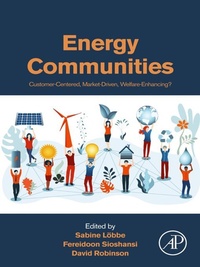
Energy Communities
Customer-Centered, Market-Driven, Welfare-Enhancing?
Published on 1. July 2022
514 pages
978-0-323-91139-9 (ISBN)
Description

Energy Communities explores core potential systemic benefits and costs in engaging consumers into communities, particularly relating to energy transition. The book evaluates the conditions under which energy communities might be regarded as customer-centered, market-driven and welfare-enhancing. The book also reviews the issue of prevalence and sustainability of energy communities and whether these features are likely to change as opportunities for distributed energy grow. Sections cover the identification of welfare considerations for citizens and for society on a local and national level, and from social, economic and ecological perspectives, while also considering different community designs and evolving business models.
- Defines and conceptualizes the energy community for the current generation of researchers and practitioners facing the energy transition
- Explores the main benefits and challenges in forming energy communities and to what extent they are welfare-enhancing
- Examines under what terms, conditions, regulations or policies energy communities can be beneficially and successfully organized and why
- Reviews the combination of business models and forms of organization which are conducive to economic feasibility and the commercial success of energy communities
More details
Other editions
Additional editions
Sabine Loebbe | Fereidoon Sioshansi | David Robinson
Energy Communities
Customer-Centered, Market-Driven, Welfare-Enhancing?
Book
07/2022
Academic Press
€157.50
Shipment within 15-20 days
Content
Part 1: The Concept of Energy Communities and Their Regulatory Framework1. A taxonomy of energy communities in liberalized energy systems2. The EU policy framework for energy communities3. Energy communities: A US regulatory perspective4. Developing a legal framework for energy communities beyond energy law5. Alignment of energy community incentives with electricity system benefits in Spain6. The "virtual model for collective self-consumption in Italy7. Energy Communities: A North American Perspective8. Energy Communities: Challenges for Regulators and Policymakers
Part 2: The Appeal of Energy Communities to Customers and Citizens9. What motivates private households to participate in energy communities? A literature review and German case study10. Community energy initiatives as a space for emerging new imaginaries?11. The construction of a citizen-centered ecosystem for renewable energies in France12. Energy communities' social role in a just energy transition
Part 3: Enabling Technologies, Community Design, and Business Models13. The path to energy communities via local energy management and digital customer care14. Governing energy communities: The role of actors and expertise in business model innovation15. Grid-friendly clean energy communities and induced intra-community cash flows through peer-to-peer trading16. Italian Energy Communities from a DSO's Perspective17. Community energy design models in Brazil: From niches to mainstream18. Institutional and policy context of energy communities in France and Italy: How to increase the welfare-enhancing capacity of the sector19. The digitalization of peer-to-peer electricity trading in energy communities
Part 4: Case Studies and Implementation20. Enabling Business Models and Grid Stability: Case Studies from Germany21. Energy communities in Europe: A review of the Danish and German experiences22. Platform-based energy communities in Germany and their benefits and challenges23. A community-based biomethane heat network:Case study from Trier24. Establishing Energy Communities in Post-Communist States:The Case of Bulgaria25. Sustainable island energy systems: A case study of Tilos island, Greece
