

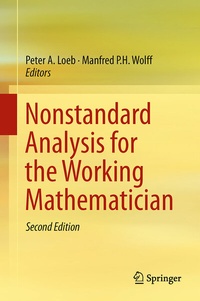
Nonstandard Analysis for the Working Mathematician
Description

Starting with a simple formulation accessible to all mathematicians, this second edition is designed to provide a thorough introduction to nonstandard analysis. Nonstandard analysis is now a well-developed, powerful instrument for solving open problems in almost all disciplines of mathematics; it is often used as a 'secret weapon' by those who know the technique.
This book illuminates the subject with some of the most striking applications in analysis, topology, functional analysis, probability and stochastic analysis, as well as applications in economics and combinatorial number theory. The first chapter is designed to facilitate the beginner in learning this technique by starting with calculus and basic real analysis. The second chapter provides the reader with the most important tools of nonstandard analysis: the transfer principle, Keisler's internal definition principle, the spill-over principle, and saturation. The remaining chapters of the book study different fields for applications; each begins with a gentle introduction before then exploring solutions to open problems.
All chapters within this second edition have been reworked and updated, with several completely new chapters on compactifications and number theory. Nonstandard Analysis for the Working Mathematician will be accessible to both experts and non-experts, and will ultimately provide many new and helpful insights into the enterprise of mathematics.
More details
Other editions
Additional editions
Content
Simple Nonstandard Analysis and Applications.- An Introduction to General Nonstandard Analysis.- Topology and Measure Theory.- Banach Spaces and Linear Operators.- General and End Compactifications.- Measure theory and integration.- Stochastic Analysis.- New Understanding of Stochastic Independence.- Nonstandard Analysis in Mathematical Economics.- Density Problems and Freiman's Inverse Problem.- Hypernatural numbers as ultrafilters.
