

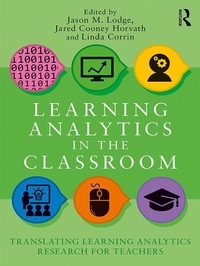
Learning Analytics in the Classroom
Translating Learning Analytics Research for Teachers
1st Edition
Published on 3. October 2018
314 pages
978-1-351-11302-1 (ISBN)
Description

Learning Analytics in the Classroom presents a coherent framework for the effective translation of learning analytics research for educational practice to its practical application in different education domains. Highlighting the real potential of learning analytics as a way to better understand and enhance student learning and with each chapter including specific discussion about what the research means in the classroom, this book provides educators and researchers alike with the tools and frameworks to effectively make sense of and use data and analytics in their everyday practice.
This volume is split into five sections, all of which relate to the key themes in understanding learning analytics through the lens of the classroom:
broad theoretical perspectives
understanding learning through analytics
the relationship between learning design and learning analytics
analytics in the classroom and the impact it can and will have on education
implementing analytics and the challenges involved.
Bridging the gap between research, theory and practice, Learning Analytics in the Classroom is both a practical tool and an instructive guide for educators, and a valuable addition to researchers' bookshelves. A team of world-leading researchers and expert editors have compiled a state-of-the-art compendium on this fascinating subject and this will be a critical resource for the evolution of this field into the future.
This volume is split into five sections, all of which relate to the key themes in understanding learning analytics through the lens of the classroom:
broad theoretical perspectives
understanding learning through analytics
the relationship between learning design and learning analytics
analytics in the classroom and the impact it can and will have on education
implementing analytics and the challenges involved.
Bridging the gap between research, theory and practice, Learning Analytics in the Classroom is both a practical tool and an instructive guide for educators, and a valuable addition to researchers' bookshelves. A team of world-leading researchers and expert editors have compiled a state-of-the-art compendium on this fascinating subject and this will be a critical resource for the evolution of this field into the future.
More details
Edition
1. Auflage
Language
English
Place of publication
London
United Kingdom
Publishing group
Taylor & Francis Ltd
Target group
Professional and scholarly
Illustrations
17 Tables, black and white; 26 Line drawings, black and white; 5 Halftones, black and white
File size
7,14 MB
ISBN-13
978-1-351-11302-1 (9781351113021)
Copyright in bibliographic data and cover images is held by Nielsen Book Services Limited or by the publishers or by their respective licensors: all rights reserved.
Schweitzer Classification
Other editions
Additional editions
Jason Lodge | Jared Horvath | Linda Corrin
Learning Analytics in the Classroom
Translating Learning Analytics Research for Teachers
Book
10/2018
1st Edition
Routledge
€60.80
Shipment within 15-20 days
Jason Lodge | Jared Horvath | Linda Corrin
Learning Analytics in the Classroom
Translating Learning Analytics Research for Teachers
Book
10/2018
1st Edition
Routledge
€205.10
Shipment within 15-20 days
Persons
Jason M. Lodge is Associate Professor of Educational Psychology in the School of Education and Institute for Teaching and Learning Innovation at the University of Queensland, Australia. He is affiliated with the National Australian Research Council funded Science of Learning Research Centre. Jason's research focusses on the cognitive and emotional aspects of learning, particularly in digital learning environments.
Jared Cooney Horvath is a research fellow at St Vincent's Hospital in Melbourne and the co-founder of the Science of Learning Group - a team dedicated to bringing the latest in educationally relevant brain and behavioural research to students and educators at all levels. Currently he teaches at the University of Melbourne, prior to this he spent a number of years working as a teacher and curriculum developer for several institutions around Los Angeles, Seattle and Boston.
Linda Corrin is Senior Lecturer in Higher Education in the Williams Centre for Learning Advancement in the Faculty of Business and Economics, University of Melbourne. Linda's research interests include students' engagement with technology, learning analytics, feedback and learning design. Currently, she is working on several large research projects exploring how learning analytics can be used to provide meaningful and timely feedback to academics and students. Linda is co-founder of the Victorian and Tasmanian Learning Analytics Network.
Jared Cooney Horvath is a research fellow at St Vincent's Hospital in Melbourne and the co-founder of the Science of Learning Group - a team dedicated to bringing the latest in educationally relevant brain and behavioural research to students and educators at all levels. Currently he teaches at the University of Melbourne, prior to this he spent a number of years working as a teacher and curriculum developer for several institutions around Los Angeles, Seattle and Boston.
Linda Corrin is Senior Lecturer in Higher Education in the Williams Centre for Learning Advancement in the Faculty of Business and Economics, University of Melbourne. Linda's research interests include students' engagement with technology, learning analytics, feedback and learning design. Currently, she is working on several large research projects exploring how learning analytics can be used to provide meaningful and timely feedback to academics and students. Linda is co-founder of the Victorian and Tasmanian Learning Analytics Network.
Content
Chapter 1. Introduction: Learning analytics in the classroom Jason M. Lodge, Jared Cooney Horvath, Linda Corrin Part I Theoretical perspectives Chapter 2. Learning analytics and teaching: A conceptual framework for translation and application Gregory M. Donoghue, Jared Cooney Horvath and Jason M. Lodge Chapter 3. The perspective realism brings to learning analytics in the classroom Kathryn Bartimote, Abelardo Pardo and Peter Reimann Part II Understanding learning through analytics Chapter 4. Supporting self-regulated learning with learning analytics Jason M. Lodge, Ernesto Panadero, Jaclyn Broadbent and Paula G. de Barba Chapter 5. Identifying epistemic emotions from activity analytics in interactive digital learning environments Amael Arguel, Mariya Pachman and Lori Lockyer Part III Learning design and analytics Chapter 6. Gathering, visualising and interpreting learning design analytics to inform classroom practice and curriculum design: A student-centred approach from the Open University Tom Olney, Bart Rienties and Lisette Toetenel Chapter 7. Co-designing learning analytics tools with learners Carlos G. Prieto-Alvarez, Roberto Martinez-Maldonado and Theresa Dirndorfer Anderson Chapter 8. Connecting expert knowledge in the design of classroom learning experiences Kate Thompson, Sakinah S. J. Alhadad, Simon Buckingham Shum, Sarah Howard, Simon Knight, Roberto Martinez-Maldonado and Abelardo Pardo Part IV Analytics in the classroom Chapter 9. An analytics-based framework to support teaching and learning in a flipped classroom Jelena Jovanovic, Dragan Gasevic, Abelardo Pardo, Negin Mirriahi and Shane Dawson Chapter 10. Opening the black box: Developing methods to see learning in contemporary learning environments Sarah Howard, Kate Thompson and Abelardo Pardo Chapter 11. Text analytic tools to illuminate student learning Jenny McDonald, Adon Christian Michale Moskal, Cathy Gunn and Claire Donald Chapter 12. Data-informed nudges for student engagement and success Marion Blumenstein, Danny Y. T. Liu, Deborah Richards, Steve Leichtweis and Jason M. Stephens Chapter 13. Supporting the use of student-facing learning analytics in the classroom Linda Corrin Chapter 14. Using measures of pedagogical quality to provide feedback and improve practice Dan Cloney and Hilary Hollingsworth Part V Implementing analytics Chapter 15. Promoting learning analytics practice for tertiary teachers: A New Zealand case study Cathy Gunn and Jenny McDonald Chapter 16. Blurring the boundaries: Developing leadership in learning analytics Deborah West, Henk Huijser and David Heath Appendix A: Discussion questions
