

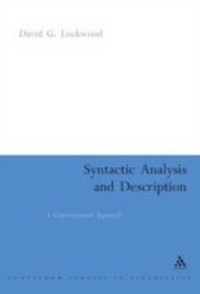
Syntactic Analysis and Description
A Constructional Approach
1st Edition
Published on 1. May 2005
386 pages
978-1-4411-6256-4 (ISBN)
Description

This book is designed to teach undergraduate and beginning graduate students how to understand, analyse and describe syntactic phenomena in different languages. The book covers every aspect of syntax from the basics to more specialised topics, such as clitics which have grammatical importance but cannot be used in isolation, and negation, in which a construction contradicts the meaning of a sentence.
The approach taken combines concepts from different theoretical schools, which view syntax differently. These include M. A. K. Halliday's systemic functional linguistics, the stratificational school advocated by Sydney Lamb, and Kenneth L. Pike's tagmemic model. The emphasis of the book is on syntactic structures rather than linguistic meaning, and the book stresses the difference between a well-formed sentence and a meaningful one. The final chapter brings these two aspects together, to show the connections between syntax and semology.
Each chapter concludes with exercises from a diverse range of languages and a list of major technical terms. The book also includes a glossary as an essential resource for students approaching this difficult subject for the first time.
The approach taken combines concepts from different theoretical schools, which view syntax differently. These include M. A. K. Halliday's systemic functional linguistics, the stratificational school advocated by Sydney Lamb, and Kenneth L. Pike's tagmemic model. The emphasis of the book is on syntactic structures rather than linguistic meaning, and the book stresses the difference between a well-formed sentence and a meaningful one. The final chapter brings these two aspects together, to show the connections between syntax and semology.
Each chapter concludes with exercises from a diverse range of languages and a list of major technical terms. The book also includes a glossary as an essential resource for students approaching this difficult subject for the first time.
More details
Edition
1. Auflage
Language
English
Place of publication
New York
United States
ISBN-13
978-1-4411-6256-4 (9781441162564)
Copyright in bibliographic data and cover images is held by Nielsen Book Services Limited or by the publishers or by their respective licensors: all rights reserved.
Schweitzer Classification
Other editions
Additional editions
Book
05/2005
Continuum International Publishing Group Ltd.
€114.90
Shipment within 15-20 days
Person
David G. Lockwood is Professor of Linguistics at Michigan State University, USA. He is co-editor, with Michael Cummings, Peter H. Fries and William Spruiell, of Relations and Functions within and around Language (Continuum, 2001).
Content
- Cover
- Contents
- Preface
- 1 Constructions, functions, and classes
- What is syntax?
- The construction: an essential element in syntax
- Functions within constructions
- The manifestation of functions
- Application to basic clausal data
- Orders of functions in transitive clauses
- Summary of notations introduced
- Exercises
- Terminology
- 2 Syntax and morphology: pre-editing syntactic data
- Inflection in English
- Abstracting out morphological details
- Patterns of pre-editing
- Summary of inflectional categories
- Summary of new notations
- Exercises
- Terminology
- 3 Types of phrase constructions
- The noun phrase: a typical endocentric phrase
- Other endocentric phrases
- The problem of the verb phrase
- Exocentric phrases
- Summary of phrasal constituents and symbols
- Exercises
- Terminology
- 4 Concord and government in the phrase
- Simple concord
- Gender concord
- Grammatical government
- Types of phrasal congruence
- Notations for concord and government
- Exercises
- Terminology
- 5 Phrase coordination
- Basic varieties of coordination
- Position of conjunctions
- Formalization of coordination
- Structural types of coordination
- General patterns of coordination
- Exercises
- Terminology
- 6 Types of basic clause constructions
- Verbal clauses and their elements
- Basic clause types in English
- Expressing "being" in different languages
- Non-verbal clauses
- Summary of clausal constituents and symbols
- Exercises
- Terminology
- 7 Congruence and determination in the clause
- Congruence between Subject and Predicator
- Congruence between Predicator and Objects
- Government in the clause
- Determination
- Summary of new notations
- Exercises
- Terminology
- 8 Identification and description of clitics
- What is a clitic?
- Identification by separability
- Identification by comembership
- Identification by differential linkage
- Classification of clitics
- Fitting clitics into syntactic description
- Exercises
- Terminology
- 9 Negation in the clause
- Inflectional negation
- Negation by simple particles
- Discontinuous negation
- Special constituent orders in the negative
- Special relations of government in the negative
- Special auxiliary uses in the negative
- Negative concord and anti-concord
- Exercises
- Terminology
- 10 Varieties of clausal organization: accusative, ergative, and others
- Accusative and ergative perspectives illustrated
- Split ergativity
- Further varieties of organization
- Summary
- Exercises
- Terminology
- 11 Voice and other forms of highlighting in the clause
- Active and passive voices
- Varieties of the passive
- The antipassive
- Highlighting in general
- Exercises
- Terminology
- 12 Sentence constructions
- The rank hierarchy
- A traditional classification
- An alternative traditional classification
- Special sentence types of English
- Summary of sentence structures
- Exercises
- Terminology
- 13 Interrogation in clause and sentence structures
- Basic classification of interrogatives
- Expression of polarity questions
- Varieties of supplement questions
- Confirmatory questions
- Summary
- Exercises
- Terminology
- 14 Subordinate clauses and clausoidal phrases
- English subordinate clauses
- Clausoids in English: infinitive, participial, and gerund phrases
- Clausoids in other European languages
- The non-universality of clausoids
- Exercises
- Terminology
- 15 Syntax and semology
- Examples of semological effects on syntax
- Agnation and semology
- Markedness and semology
- Semological control of syntax
- Classifying semo-syntactic relations
- Exercises
- Terminology
- Appendix: adaptations of the boxed notation
- Glossary
- A
- B
- C
- D
- E
- F
- G
- H
- I
- L
- M
- N
- O
- P
- Q
- R
- S
- T
- U
- V
- W
- Z
- References
- Textbooks and other works on syntax
- Sources consulted for language data
- Index of languages
- A
- B
- C
- D
- E
- F
- G
- H
- I
- J
- K
- L
- M
- O
- P
- R
- S
- T
- V
- W
- Y
- Index of names and terms
- A
- B
- C
- D
- E
- F
- G
- H
- I
- L
- M
- N
- O
- P
- Q
- R
- S
- T
- U
- V
- W
- X
- Z
