

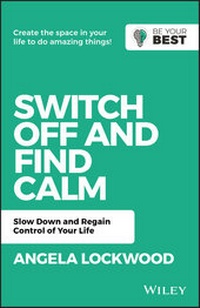
Switch Off and Find Calm
Description

Slowing down is not a luxury, it is a necessity
Have you ever felt as though everyone wants too much from you? Does your life feel so full there is no room to do the things you enjoy? Do you feel as though life at full throttle is consuming you?
Occupational therapist Angela Lockwood shows you how to recognise overwhelm and overstimulation, build habits that help you flick the switch, and re-energise both your mind and body.
With Switch Off and Find Calm, you will learn to recognise when it's time to switch off and discover practical ways to make that happen.
Angela Lockwood is an occupational therapist and the founder of The Place for Health-a health education company helping people to prioritise their own health and wellbeing.
More details
Other editions
Additional editions
Content
The challenge of being overconnected and unable to switch off from technology transcends age, race, education and geography, and it doesn't stop with technology. Many of us feel the effects of living life in the fast lane. Our frenetic pace, racing from one meeting to the next and one activity to the next, is affecting our ability to take time out, slow down, switch off and refuel. With our bodies and minds constantly 'switched on', our health and wellbeing are increasingly paying the price. We are in a state of chronic overconnection, overwhelm and overstimulation. This is a growing global problem.
Searching for slow
In 2004 Canadian journalist and best-selling author Carl Honoré published In Praise of Slow, in which he outlines the sociological and psychological implications of a speed-obsessed culture and warns of the potential negative consequences of our obsession with speed. Honoré traces the history of our relationship with time and asks, 'Why are we always in such a rush?' and 'When are we going to slow down?' Arguing that 'Evolution works on survival of the fittest, not the fastest,' he proposes an alternative way of thinking and living, which he calls 'the slow revolution'.
To achieve more we do not have to keep pushing ourselves to do more; in fact we are capable of achieving more through doing less. Most people reading this will want to jump immediately to the 'how to' section. It is a modern-day conundrum: how can we do more by doing less?
To achieve more we do not have to keep pushing ourselves to do more; in fact we are capable of achieving more through doing less.
In Praise of Slow was written more than fifteen years ago. This way of thinking seemed then to be espoused only by hippies living in the mountains who were rarely in touch with the 'real world'. How times have changed! Roll forward ten years and it seems the slow revolution has started to find its way into the consciousness of people you would least expect to have time for it. Executives in boardrooms are searching for ways to integrate slow living into their fast-paced, demand-driven lives, and as suggested in the Korean news report, parents are embracing the slow revolution for their children.
We want to have it all - a fat pay packet, a successful business, prestige during the week, and the weekend spent stand-up paddle boarding, sipping lattes and coaching the soccer team. To have it all, though, we need to make some changes to how we are living. Back in 1948, in his best-seller How to Stop Worrying and Start Living, Dale Carnegie spoke of the importance of living a life free of worry about the constraints of time and other pressures. His message evidently remains compelling, as the book continues to be one of the most recommended business self-help books almost seventy years later.
If we have known for a long time, having been warned by such authoritative voices as these, that living life constantly 'switched on' is negatively affecting our physical and psychological wellbeing, then why haven't we taken notice?
Part of the answer lies in the context of the rapid pace of change in our world. The changes that have resulted from the growth in population, communications and technology over the past hundred years are quite astonishing. Here are some examples taken from the years my grandmother has been alive:
-
» As many people live in Sydney today as lived in the whole of Australia in 1915.
-
» Traditionally school children relied on paper and ink. Today's students learn using personal tablets, computers, interactive boards and live video linkups, starting as early as preschool.
-
» A handwritten letter to a friend could take weeks to get to London from Australia; now it takes milliseconds to send a message via instant messaging to the other side of the world.
-
» The most influential people were once politicians; now we look to business leaders, bloggers and celebrities for guidance.
-
» People would send a letter or walk to a friend's house for a cup of tea and a catch-up; now there are social media platforms with millions (sorry, billions) of users, allowing you to connect instantly with your friends (and with people you don't even know!) all over the world.
-
» According to the Australian Bureau of Statistics, in 1915 just 498 divorces were recorded in Australia; today's annual figure exceeds 47 000.
-
» Television, computers, phones, cars, air travel, the pop-up toaster, disposable nappies, ballpoint pens, batteries, aerosol cans, stereos and the internet, all now taken for granted in our society, were invented during the lifetime of my grandmother. It is mind-blowing to think that none of these things we so take for granted even existed when she was young. Now we cannot imagine life without them. (Think about the changes you might yet see in your own lifetime or 100 years from now.)
We cannot deny these changes have benefited us in so many ways. It is our ability to keep up with the speed of change that is taking its toll on our health and wellbeing. So why haven't we learned how to switch off when we need to? It comes down to two factors: expectations and priorities.
Life role evolution
Life roles evolve. If we roll back a few thousand years, the chief expectations of our early ancestors were to eat and to stay alive. Life was based on survival, so daily actions focused on finding adequate shelter, gathering enough food and making sure you were not eaten - with social roles distinguishing, for example, hunters from gatherers. Not complicated perhaps, but life had its risks and stressors, like being taken by a lion or dying of starvation.
Roll forward a few thousand years to the 19th century and expectations had changed significantly. By common practice men worked for pay to provide for their family while women were expected to run the household, raise children, and keep the family fed, clothes washed and needs satisfied. Days were spent working to provide a roof over the family's heads and put food on the table - not so very different from our early ancestors, albeit a little more complicated, and with the danger from lions much reduced. It was still a lot simpler than the complexity of life roles we know today.
Move into the 20th century and life roles started to shift much faster. Women were speaking up, demanding equal rights, insisting there was more to life than putting a hot meal on the table, and looking for options beyond running the household. Men, in turn, started to resent how their long hours at work meant less time with their families. They were looking for ways they could both be the provider and take a more active part in family life.
Part-time work was typically taken on by men nearing retirement age as a way to gradually step out of full-time work into retirement. How times have changed! According to a report released in 2018 by the Australian Industry Group titled 'Casual work and part-time work in Australia 2018', an estimated 18.5 per cent of Australian men are now working part-time employment compared to 5.2 per cent in 1980. As national interest in gender diversity has grown, life roles and community expectations have significantly shifted for both women and men.
People are looking for and creating opportunities that will allow them to work and have a life. Both men and women are making different choices about family, work and relationships. Purpose and passion have become greater motivators than pay, and success is measured as much by a person's ability to balance work and family as by financial reward.
The challenge is to pursue a financially successful career while also carving out the time and energy needed to maintain a fulfilling life outside of work. In the early nineties the term work-life balance entered our vocabulary. Over the past ten years it has been a perennial topic of discussion in many forums. How can we achieve the ideal work-life balance? It seems as though, in acknowledging that finding the perfect balance is harder than we had initially thought, we have now moved towards a new concept: work-life integration.
Work-life integration recognises that life cannot always be in balance, that sometimes we have to focus on work while at other times our family takes priority, and that at times these will merge into each other, as one affects the other.
The nine-to-five, five-day work week most of us knew a couple of decades ago is now just one of a suite of work options that includes shift work, part-time, casual or contract work, and self-employment. The physical workplace has changed too, as more of us work from a home-based office or from a laptop in a car or aeroplane or even the local cafe. There is no longer one employment structure or type of workplace. Flexible work conditions and an ever-changing work environment present their own challenges for how we manage our time, our attention and ourselves. Whether written down formally or understood through unspoken agreement, whether we like it or not, we are now expected to make our work-life integration work. Technology allows us to work from anywhere and to be contactable at any time, making it hard to ever switch off.
Switching off is hard when the boundary between work and life is...
