

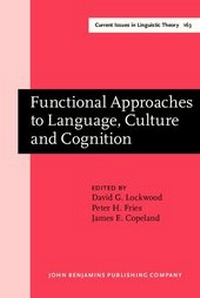
Functional Approaches to Language, Culture and Cognition
Papers in honor of Sydney M. Lamb
1st Edition
Published on 15. March 2000
XXXIV, 656 pages
978-90-272-9968-0 (ISBN)
Description

This volume contains functional approaches to the description of language and culture, and language and cultural change. The approaches taken by the authors range from cognitive approaches including Stratificational grammar to more socially oriented ones including Systemic Functional linguistics. The volume is organized into two sections.
The first section 'Functional Approaches to the Structure of Language: Theory and Practice' starts with contributions developing a Stratificational model; these are followed by contributions focusing on some related functional model of language; and by articles describing some particular set of language phenomena.
In the second section 'Functional Approaches to the History of Language and Linguistics' general studies of language change are addressed first; a second group of contributions examines language change, lexicon and culture; and the last cluster of contributions treats the history of linguistics and culture.
The first section 'Functional Approaches to the Structure of Language: Theory and Practice' starts with contributions developing a Stratificational model; these are followed by contributions focusing on some related functional model of language; and by articles describing some particular set of language phenomena.
In the second section 'Functional Approaches to the History of Language and Linguistics' general studies of language change are addressed first; a second group of contributions examines language change, lexicon and culture; and the last cluster of contributions treats the history of linguistics and culture.
More details
Other editions
Additional editions
David G. Lockwood | Peter H. Fries | James E. Copeland
Functional Approaches to Language, Culture and Cognition
Papers in honor of Sydney M. Lamb
Book
03/2000
John Benjamins Publishing Co
€171.72
Shipment within 10-15 days
Persons
Content
- FUNCTIONAL APPROACHES TO LANGUAGE, CULTURE AND COGNITION
- Editorial page
- Title page
- LCC data
- Picture: Sidney M. Lamb at home
- Acknowledgments
- Table of Contents
- Introduction
- Biographical Sketch of Sydney MacDonald Lamb
- Published Works of Sydney M. Lamb
- PART I: Functional Approaches to the Structure of Language: Theory and Practice
- A. Cognitive Approaches: Theory
- Chapter 1. Valence and Phraseology in Stratificational Linguistics
- Chapter 2. A Neural Network Model of Language Production
- Chapter 3. From Reticula to Trees: A Computerizable Model of Transduction from Semology to Lexology
- Chapter 4. Neurological Evidence for the Existence of an Autonomous Lexicon
- Chapter 5. Luminous Loci in Lex-Eco-Memory
- Chapter 6. The Logic of Anataxis
- Chapter 7. The Dilemma of the Welsh Sentence Particle: Empiricism in Stratificational Linguistics
- B. Related Approaches: Theory
- Chapter 8. The Development Of Adequate Formalism In Linguistics
- Chapter 9. Parsing with a Chart and its Efficiency
- Chapter 10. Language as Human Action
- Chapter 11. Some Hermeneutic Observations on Textlinguistics and Text Theory in the Humanities
- Chapter 12. The Schemata for Motion and Action: A Typological Consideration
- Chapter 13. The Iconicity of Consonant Alternation
- C. Functional Language Description
- Chapter 14. Grammar and Daily Life: Concurrence and Complementarity
- Chapter 15. Translation and Text-Analysis
- Chapter 16. Cognitive Networks in Conversation
- Chapter 16. Some Stratificational Insights Concerning the English Noun Phrase
- Chapter 17. Some Peculiar Adjectives in the English Nominal Group
- Chapter 19. The ist- Prefix in Alabama
- Chapter 20. Attention to Microspace: Plotting the Connections of a Cultural Theme
- Chapter 21. Toward Kawaiisu Poetics
- Chapter 22. The Effect of Rate of Speech on Laryngeal Timing in Medial Stops in Mongolian
- PART II: Functional Approaches to the History of Language and Linguistics
- A. Language Change: General Studies
- Chapter 23. Change - Linguistic and Societal
- Chapter 24. From First to Second Person: The History of Amerind *k(i)
- Chapter 25. The Grammaticalization of Lexicalized Manual Gesture in Tarahumara
- Chapter 26. Investigating Syntactic Change through Synchronic Textual Comparison: A Case Study
- Chapter 27. The Ablauts of l
- B. Language Change: Lexicon and Culture
- Chapter 28. Notes on Hispanisms: California
- Chapter 29. Slang and Lexicography
- Chapter 30. On Sugar, Sumac and Sewers
- Chapter 31. Why Kaka and Aya?
- C. History of Linguistics and Culture
- Chapter 32. Medieval Views on the World and Nature
- Chapter 33. Linguistics in India: Past and Future
- Chapter 34. Some Reflections of Vico in Semiotics
- Chapter 35. The Forerunners of Scientific Phonology: Diacritical Marks and Other Reforms in Orthography
- Chapter 36. Early MT Research at M.I.T.: The Search for Context
- Index
- Current Issues in Linguistic Theory
