

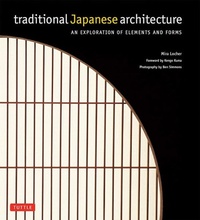
Traditional Japanese Architecture
An Exploration of Elements and Forms
Published on 1. January 2012
225 pages
978-1-4629-0606-2 (ISBN)
Description

By examining the Japanese history of buildings and building designs from prehistory to modern day, lovers of Japan will develop a deeper understanding and appreciation of this island country.
Simplicity, sensitivity to the natural environment, and the use of natural materials are the hallmarks of Japanese architecture. The Art of Japanese Architecture provides a broad overview of traditional Japanese architecture in its historical and cultural context. It begins with a discussion of prehistoric dwellings and concludes with a description of modern Japanese buildings. Important historical influences and trends--notably the introduction of Buddhist culture from Korea and China, the development of feudalism, and the influence of modern Western styles of building--are all discussed in detail as facets of Japanese design.
Through all of these changes, a restrained architectural tradition developed in marked contrast to an exuberant tradition characterized by monumentality and the use of bold colors. The book provides tremendous insights into the dynamic nature of Japanese architecture and how it reflects an underlying diversity within Japanese culture.
The book is profusely illustrated with over 370 color photographs, woodblock prints, maps, diagrams, and specially commissioned watercolors.
Simplicity, sensitivity to the natural environment, and the use of natural materials are the hallmarks of Japanese architecture. The Art of Japanese Architecture provides a broad overview of traditional Japanese architecture in its historical and cultural context. It begins with a discussion of prehistoric dwellings and concludes with a description of modern Japanese buildings. Important historical influences and trends--notably the introduction of Buddhist culture from Korea and China, the development of feudalism, and the influence of modern Western styles of building--are all discussed in detail as facets of Japanese design.
Through all of these changes, a restrained architectural tradition developed in marked contrast to an exuberant tradition characterized by monumentality and the use of bold colors. The book provides tremendous insights into the dynamic nature of Japanese architecture and how it reflects an underlying diversity within Japanese culture.
The book is profusely illustrated with over 370 color photographs, woodblock prints, maps, diagrams, and specially commissioned watercolors.
More details
Language
English
Place of publication
La Vergne
United States
Product notice
Reflowable
Illustrations
over 400 color photos
ISBN-13
978-1-4629-0606-2 (9781462906062)
Copyright in bibliographic data and cover images is held by Nielsen Book Services Limited or by the publishers or by their respective licensors: all rights reserved.
Schweitzer Classification
Other editions
Additional editions

Book
03/2015
2nd Edition
Tuttle Publishing
€28.50
Available (delivery time upon request)

Book
12/2010
Tuttle Shokai Inc
€59.62
Article exhausted; check for reprint
Persons
Content
- Intro
- Contents
- Foreward by Kengo Kuma
- Preface
- PART 1: Context
- 1. Environment and Culture
- 2. The Evolution of Japanese Architecture
- 3. The Role of Tradition
- PART 2: Forms and Materials
- 4. Basic Principles
- 5. Regional Variations
- 6. Tools and Techniques
- 7. Materials
- PART 3: Architecture
- 8. Roofs
- 9. Foundations
- 10. Walls
- 11. Floors
- 12. Ceilings
- 13. Built-Ins
- 14. Furniture
- 15. Decorative Objects
- 16. Interior Ornamentation
- 17. Exterior Ornamentation
- PART 4: Gardens and Courtyards
- 18. Shaping the Land
- 19. Entrance Gates
- 20. Garden Walls
- 21. Fences
- 22. Paths
- 23. Bridges
- 24. Gravel Courtyards
- 25. Raked Gravel Beds and Mounds
- 26. Stone Borders
- 27. Rocks and Stones
- 28. Plants
- 29. Water
- 30. Garden Objects
- 31. Temporary and Seasonal Elements
- Endnotes
- Glossary
- Bibliography
- Index
- Acknowledgments
