

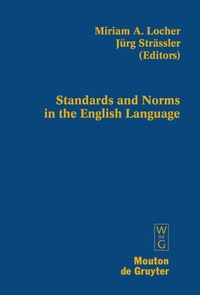
Standards and Norms in the English Language
Description

The theme of this collection is a discussion of the notions of 'norms' and 'standards', which are studied from various different angles, but always in relation to the English language. These terms are to be understood in a very wide sense, allowing discussions of topics such as the norms we orient to in social interaction, the benchmark employed in teaching, or the development of English dialects and varieties over time and space and their relation to the standard language. The collection is organized into three parts, each of which covers an important research field for the study of norms and standards. Part 1 is entitled "English over time and space" and is further divided into three thematic subgroups: standard and non-standard features in English varieties and dialects; research on English standardization processes; and issues of standards and norms in oral production. Part 2 deals with "English usage in non-native contexts," and Part 3 is dedicated to "Issues on politeness and impoliteness." The notions of standards and norms are equally important concepts for historical linguists, sociolinguists with a variationist background, applied linguists, pragmaticians, and discourse analysts.
More details
Other editions
Additional editions
Persons
Content
2 - Table of contents [Seite 23]
3 - Chapter 1 Introduction: Standards and norms [Seite 27]
4 - Chapter 2 Swiss English, German English and American English: In grammatical alliance against traditional British English? [Seite 49]
5 - Chapter 3 Regional variation in English in the new millennium: Looking to the future [Seite 73]
6 - Chapter 4 The role of dialect contact in the formation of Englishes [Seite 95]
7 - Chapter 5 Non-standardisation [Seite 111]
8 - Chapter 6 From 'standard' to 'nonstandard' grammar. New England in the days of Salem Witchcraft and the Civil War [Seite 131]
9 - Chapter 7 The rise of prescriptive grammars on English in the 18th century [Seite 153]
10 - Chapter 8 Lest the situation deteriorates - A study of lest as trigger of the inflectional subjunctive [Seite 175]
11 - Chapter 9 The BBC Advisory Committee on Spoken English or How (not) to construct a 'standard' pronunciation [Seite 201]
12 - Chapter 10 Liverpool to Louisiana in one lyrical line: Style choice in British rock, pop and folk singing [Seite 221]
13 - Chapter 11 'Standard' English, discourse grammars and English language teaching [Seite 247]
14 - Chapter 12 Towards a new English as a Foreign Language curriculum for Continental Europe [Seite 265]
15 - Chapter 13 Language learning and medium of instruction: Understanding contemporary discourses and practices in Swiss schools and classrooms [Seite 281]
16 - Chapter 14 Can academic writing style be taught? [Seite 307]
17 - Chapter 15 Linguascaping Switzerland: Language ideologies in tourism [Seite 327]
18 - Chapter 16 The rules of "Denglish" [Seite 349]
19 - Chapter 17 (Im)politeness in English as Lingua Franca discourse [Seite 377]
20 - Chapter 18 How to be impolite: Rating offensive strategies [Seite 393]
21 - Backmatter [Seite 419]
