

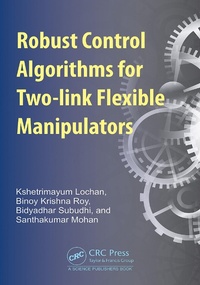
Robust Control Algorithms for Flexible Manipulators
1st Edition
Published on 18. October 2024
256 pages
978-1-040-15220-1 (ISBN)
Description

Various modelling and control of two-link flexible manipulators are presented in this book. The lumped parameter modelling method and the assumed modes method modelling are comprehensively reviewed. The book also reviews the trajectory tracking problem and tip trajectory tracking problem along with the suppression of tip deflection of the links. An exponential time varying signal and a chaotic signal are considered as the desired trajectories. The identical/ non-identical slave manipulator is synchronised with the controlled master manipulator so that the slave manipulator indirectly follows the desired manipulator.
More details
Edition
1. Auflage
Language
English
Place of publication
London
United Kingdom
Publishing group
Taylor & Francis Ltd
Target group
Professional and scholarly
Illustrations
17 Illustrations, color; 115 Illustrations, black and white
ISBN-13
978-1-040-15220-1 (9781040152201)
Copyright in bibliographic data and cover images is held by Nielsen Book Services Limited or by the publishers or by their respective licensors: all rights reserved.
Schweitzer Classification
Other editions
Additional editions
Kshetrimayum Lochan | Binoy Krishna Roy | Bidyadhar Subudhi
Robust Control Algorithms for Two-link Flexible Manipulators
Book
05/2026
1st Edition
CRC Press
€66.00
Shipment within 10-20 days
Kshetrimayum Lochan | Binoy Krishna Roy | Bidyadhar Subudhi
Robust Control Algorithms for Flexible Manipulators
Book
10/2024
1st Edition
CRC Press
€202.20
Shipment within 10-20 days
Persons
Kshetrimayum Lochan is a research fellow and robotics lead for the ASPIRE Research Institute for Food Security in Drylands (ARIFSID) under the Department of Mechanical and Nuclear Engineering, Khalifa University Center for Robotics and Autonomous Systems (KUCARS), UAE. She has a bachelor's degree in Electronics and Communication Engineering from Anna University, India in 2009 and Master's degree in Electronics and Communication Technology from Gauhati University, India in 2012. She joined as an assistant professor in the Department of Electronics and Communication Engineering at Royal Global University, India in 2012-2013. She obtained a PhD degree in Robotics and Control specialization from National Institute of Technology Silchar (NITS) in 2018. She was initially with NITS Silchar in 2018, as a contractual faculty. Later on, she joined as an assistant professor in the Mechatronics Department at Manipal Institute of Technology, Manipal Academy of Higher Education, India until September 2021. She was also a postdoctoral research fellow in Indian Institute of Technology (IIT) Palakkad Technology IHub Foundation (IPTIF) in 2022. She has also received Mentor-Mentee Fellowship Award from the Indian National Academy of Engineering (INAE) in the year 2021-2022. She has also received merit scholarship from North Eastern council (NEC), India for her Masters and Bachelor's degrees. She has published several papers in reputed journals and conferences. Her research interest is in controlling for flexible manipulators, nonlinear control, autonomous robots in complex environments of underwater and drylands.
Binoy Krishna Roy is a Professor in the Department of Electrical Engineering and Dean (Academics) at the National Institute of Technology, Silchar. He served as the Head of the Department and discharged many other academic and administrative responsibilities for the institute. He was the general chair of the international conference, Advances in Control and Optimization of Dynamical Systems (ACODS), India, in February 2022. He did pre-university at Dibrugarh H.S. Konoi College, Dibrugarh, from 1977 to 1979. After completing his bachelor's in Electrical Engineering from REC Silchar, he joined as a lecturer in the Electrical Engineering Department, Regional Engineering College (REC), presently NIT, Silchar, in 1986. Subsequently, he completed his Master of Technology degree in 1989 with Control Systems specialization and PhD in 1998, both from IIT Kharagpur, India. He has guided many PhD students and has more than 130 articles in reputed journals, 85 international conferences, 17 book chapters and many projects.
Prof. Roy is a Fellow of the Institution of Engineers (India), The Institution of Electronics and Telecommunication Engineers, Senior Member of IEEE and ISA. He was a resource person in various conferences and short-term courses, and delivered expert lectures.
Bidyadhar Subudhi is the Director of National Institute of Technology Warangal (NITW), India on deputation from Indian Institute of Technology (IIT) Goa. He is a Professor in School of Electrical Sciences at IIT Goa. Prof. Subudhi received a Bachelor of Electrical Engineering from the National Institute of Technology (NIT), Rourkela in 1988, a Master of Technology degree in Control and Instrumentation from IIT Delhi in 1994 and PhD degree in Control System Engineering from the University of Sheffield, United Kingdom in 2002. He served as a Postdoctoral Research Fellow in the NUS Singapore in 2005. He was a Professor in the Department of Electrical Engineering in NIT Rourkela. He also served as a Visiting Professor at the University of Saskatchewan, Canada and in Asian Institute of Technology, Bangkok in 2011 and 2013 respectively.
Prof. Subudhi has been appointed as Distinguished Speaker by ACM. He received the Prestigious Samanta Chandra Sekhar Award of the Odisha Bigyan Academy, Government of Odisha for his contribution to science and technology in the 2013. He was awarded NITRAA Research Excellence Award in Electrical Sciences in 2019. He has been elected as a Fellow of the Indian National Academy of Engineering for his distinguished contribution in Electrical Engineering. He is a Fellow of IET (UK), Institution of Engineers (India), Institution of Electronics & Telecommunication Engineers (India) and Senior Member, IEEE. He serves as a Technical Committee Member of the IEEE Intelligent Control Group. He has supervised 41 PhD students. He has published his research work in 160 reputed journals and 75 conference papers. He has edited 8 books and contributed 14 book chapters. His research interests include Flexible Manipulators, Machine Learning and Adaptive Systems, Marine Robotics and Microgrid Systems.
Santhakumar Mohan got a PhD (Robotics and Control) from the Indian Institute of Technology Madras, Chennai (India) in 2010. From June 2010 to March 2011, he worked as an assistant professor in the Department of Mechanical Engineering at the National Institute of Technology Calicut (NITC), Kerala (India). He then worked as a postdoctoral fellow at the Korean Advanced Institute of Science and Technology (KAIST), Daejeon, Republic of Korea. In 2012, he joined the faculty of Mechanical Engineering at the Indian Institute of Technology Indore. Currently, he has visiting faculty positions at IISc Bangalore, India, BSTU, Belgorod, Russia, KAIST, Daejeon, Republic of Korea, RWTH Aachen, Germany, and ECN, France. His active research areas include Service and Field Robots (specifically, the design & motion control of underwater and wheeled mobile robots), Parallel Robotic Platforms, and Assistive and Rehabilitation Robots.
Furthermore, he has received the outstanding young Scientist for the year 2014 from the Korea Robotics Society, European Master on Advanced Robotics Plus (EMARO+) fellowship (2018-2019), Alexander von Humboldt (AvH) Fellowship (2016-2017), Satellite across virtual institutes (SAVI) fellowship (2013-2014), World-class university fellowship (2011- 2012) and Brian Korean 21 (BK2) fellowship (2011). He has published more than 120 articles in various journals and conference proceedings. He has edited three books and completed eleven sponsored projects. Currently, he is serving as Technical Editor, of IEEE/ASME Transactions on Mechatronics, Associate Editor, of IEEE Robotics and Automation Letters, ASME Letters in Dynamic Systems and Control, and Robotica. He is also an adjunct professor at the Department of Engineering Design, at IIT Madras and a Faculty Fellow at the IIT Palakkad Technology Ihub Foundation (IPTIF).
Binoy Krishna Roy is a Professor in the Department of Electrical Engineering and Dean (Academics) at the National Institute of Technology, Silchar. He served as the Head of the Department and discharged many other academic and administrative responsibilities for the institute. He was the general chair of the international conference, Advances in Control and Optimization of Dynamical Systems (ACODS), India, in February 2022. He did pre-university at Dibrugarh H.S. Konoi College, Dibrugarh, from 1977 to 1979. After completing his bachelor's in Electrical Engineering from REC Silchar, he joined as a lecturer in the Electrical Engineering Department, Regional Engineering College (REC), presently NIT, Silchar, in 1986. Subsequently, he completed his Master of Technology degree in 1989 with Control Systems specialization and PhD in 1998, both from IIT Kharagpur, India. He has guided many PhD students and has more than 130 articles in reputed journals, 85 international conferences, 17 book chapters and many projects.
Prof. Roy is a Fellow of the Institution of Engineers (India), The Institution of Electronics and Telecommunication Engineers, Senior Member of IEEE and ISA. He was a resource person in various conferences and short-term courses, and delivered expert lectures.
Bidyadhar Subudhi is the Director of National Institute of Technology Warangal (NITW), India on deputation from Indian Institute of Technology (IIT) Goa. He is a Professor in School of Electrical Sciences at IIT Goa. Prof. Subudhi received a Bachelor of Electrical Engineering from the National Institute of Technology (NIT), Rourkela in 1988, a Master of Technology degree in Control and Instrumentation from IIT Delhi in 1994 and PhD degree in Control System Engineering from the University of Sheffield, United Kingdom in 2002. He served as a Postdoctoral Research Fellow in the NUS Singapore in 2005. He was a Professor in the Department of Electrical Engineering in NIT Rourkela. He also served as a Visiting Professor at the University of Saskatchewan, Canada and in Asian Institute of Technology, Bangkok in 2011 and 2013 respectively.
Prof. Subudhi has been appointed as Distinguished Speaker by ACM. He received the Prestigious Samanta Chandra Sekhar Award of the Odisha Bigyan Academy, Government of Odisha for his contribution to science and technology in the 2013. He was awarded NITRAA Research Excellence Award in Electrical Sciences in 2019. He has been elected as a Fellow of the Indian National Academy of Engineering for his distinguished contribution in Electrical Engineering. He is a Fellow of IET (UK), Institution of Engineers (India), Institution of Electronics & Telecommunication Engineers (India) and Senior Member, IEEE. He serves as a Technical Committee Member of the IEEE Intelligent Control Group. He has supervised 41 PhD students. He has published his research work in 160 reputed journals and 75 conference papers. He has edited 8 books and contributed 14 book chapters. His research interests include Flexible Manipulators, Machine Learning and Adaptive Systems, Marine Robotics and Microgrid Systems.
Santhakumar Mohan got a PhD (Robotics and Control) from the Indian Institute of Technology Madras, Chennai (India) in 2010. From June 2010 to March 2011, he worked as an assistant professor in the Department of Mechanical Engineering at the National Institute of Technology Calicut (NITC), Kerala (India). He then worked as a postdoctoral fellow at the Korean Advanced Institute of Science and Technology (KAIST), Daejeon, Republic of Korea. In 2012, he joined the faculty of Mechanical Engineering at the Indian Institute of Technology Indore. Currently, he has visiting faculty positions at IISc Bangalore, India, BSTU, Belgorod, Russia, KAIST, Daejeon, Republic of Korea, RWTH Aachen, Germany, and ECN, France. His active research areas include Service and Field Robots (specifically, the design & motion control of underwater and wheeled mobile robots), Parallel Robotic Platforms, and Assistive and Rehabilitation Robots.
Furthermore, he has received the outstanding young Scientist for the year 2014 from the Korea Robotics Society, European Master on Advanced Robotics Plus (EMARO+) fellowship (2018-2019), Alexander von Humboldt (AvH) Fellowship (2016-2017), Satellite across virtual institutes (SAVI) fellowship (2013-2014), World-class university fellowship (2011- 2012) and Brian Korean 21 (BK2) fellowship (2011). He has published more than 120 articles in various journals and conference proceedings. He has edited three books and completed eleven sponsored projects. Currently, he is serving as Technical Editor, of IEEE/ASME Transactions on Mechatronics, Associate Editor, of IEEE Robotics and Automation Letters, ASME Letters in Dynamic Systems and Control, and Robotica. He is also an adjunct professor at the Department of Engineering Design, at IIT Madras and a Faculty Fellow at the IIT Palakkad Technology Ihub Foundation (IPTIF).
Content
Introduction. Survey on a Two-link Flexible Manipulator. Dynamic Modelling of a Two-link Flexible Manipulator. Design of Sliding Mode Controllers for a TLFM. Design of Controllers for a TLFM using the Singular Perturbation Technique. Generalised Projective Synchronisation between Lumped Parameter Modelled TLFMs. Synchronisation between Assumed Modes Modelled TLFMs. Projective Synchronisation between Assumed Modes and Lumped Parameter Modelled TLFMs. Conclusions and Future Work. Index.
