

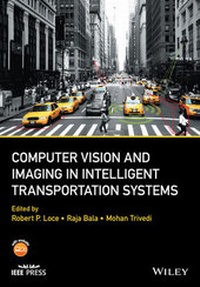
Computer Vision and Imaging in Intelligent Transportation Systems
Description

More details
Other editions
Additional editions
Persons
Content
List of Contributors xiii
Preface xvii
Acknowledgments xxi
About the Companion Website xxiii
1 Introduction 1
Raja Bala and Robert P. Loce
1.1 Law Enforcement and Security 1
1.2 Efficiency 4
1.3 Driver Safety and Comfort 5
1.4 A Computer Vision Framework for Transportation Applications 7
1.4.1 Image and Video Capture 8
1.4.2 Data Preprocessing 8
1.4.3 Feature Extraction 9
1.4.4 Inference Engine 10
1.4.5 Data Presentation and Feedback 11
Part I Imaging from the Roadway Infrastructure 15
2 Automated License Plate Recognition 17
Aaron Burry and Vladimir Kozitsky
2.1 Introduction 17
2.2 Core ALPR Technologies 18
2.2.1 License Plate Localization 19
2.2.2 Character Segmentation 24
2.2.3 Character Recognition 28
2.2.4 State Identification 38
3 Vehicle Classification 47
Shashank Deshpande, Wiktor Muron and Yang Cai
3.1 Introduction 47
3.2 Overview of the Algorithms 48
3.3 Existing AVC Methods 48
3.4 LiDAR Imaging-Based 49
3.4.1 LiDAR Sensors 49
3.4.2 Fusion of LiDAR and Vision Sensors 50
3.5 Thermal Imaging?-Based 53
3.5.1 Thermal Signatures 53
3.5.2 Intensity Shape?-Based 56
3.6 Shape?- and Profile?-Based 58
3.6.1 Silhouette Measurements 60
3.6.2 Edge?-Based Classification 65
3.6.3 Histogram of Oriented Gradients 67
3.6.4 Haar Features 68
3.6.5 Principal Component Analysis 69
3.7 Intrinsic Proportion Model 72
3.8 3D Model?-Based Classification 74
3.9 SIFT?-Based Classification 74
3.10 Summary 75
4 Detection of Passenger Compartment Violations 81
Orhan Bulan, Beilei Xu, Robert P. Loce and Peter Paul
4.1 Introduction 81
4.2 Sensing within the Passenger Compartment 82
4.2.1 Seat Belt Usage Detection 82
4.2.2 Cell Phone Usage Detection 83
4.2.3 Occupancy Detection 83
4.3 Roadside Imaging 84
4.3.1 Image Acquisition Setup 84
4.3.2 Image Classification Methods 85
4.3.3 Detection?-Based Methods 94
5 Detection of Moving Violations 101
Wencheng Wu, Orhan Bulan, Edgar A. Bernal and Robert P. Loce
5.1 Introduction 101
5.2 Detection of Speed Violations 101
5.2.1 Speed Estimation from Monocular Cameras 102
5.2.2 Speed Estimation from Stereo Cameras 108
5.2.3 Discussion 115
5.3 Stop Violations 115
5.3.1 Red Light Cameras 115
5.4 Other Violations 125
5.4.1 Wrong?-Way Driver Detection 125
5.4.2 Crossing Solid Lines 126
6 Traffic Flow Analysis 131
Rodrigo Fernandez, Muhammad Haroon Yousaf, Timothy J. Ellis, Zezhi Chen and Sergio A. Velastin
6.1 What is Traffic Flow Analysis? 131
6.1.1 Traffic Conflicts and Traffic Analysis 131
6.1.2 Time Observation 132
6.1.3 Space Observation 133
6.1.4 The Fundamental Equation 133
6.1.5 The Fundamental Diagram 133
6.1.6 Measuring Traffic Variables 134
6.1.7 Road Counts 135
6.1.8 Junction Counts 135
6.1.9 Passenger Counts 136
6.1.10 Pedestrian Counts 136
6.1.11 Speed Measurement 136
6.2 The Use of Video Analysis in Intelligent Transportation Systems 137
6.2.1 Introduction 137
6.2.2 General Framework for Traffic Flow Analysis 137
6.2.3 Application Domains 143
6.3 Measuring Traffic Flow from Roadside CCTV Video 144
6.3.1 Video Analysis Framework 144
6.3.2 Vehicle Detection 146
6.3.3 Background Model 146
6.3.4 Counting Vehicles 149
6.3.5 Tracking 150
6.3.6 Camera Calibration 150
6.3.7 Feature Extraction and Vehicle Classification 152
6.3.8 Lane Detection 153
6.3.9 Results 155
6.4 Some Challenges 156
7 Intersection Monitoring Using Computer Vision Techniques for Capacity, Delay, and Safety Analysis 163
Brendan Tran Morris and Mohammad Shokrolah Shirazi
7.1 Vision?-Based Intersection Analysis: Capacity, Delay, and Safety 163
7.1.1 Intersection Monitoring 163
7.1.2 Computer Vision Application 164
7.2 System Overview 165
7.2.1 Tracking Road Users 166
7.2.2 Camera Calibration 169
7.3 Count Analysis 171
7.3.1 Vehicular Counts 171
7.3.2 Nonvehicular Counts 173
7.4 Queue Length Estimation 173
7.4.1 Detection?-Based Methods 174
7.4.2 Tracking?-Based Methods 175
7.5 Safety Analysis 177
7.5.1 Behaviors 178
7.5.2 Accidents 182
7.5.3 Conflicts 185
7.6 Challenging Problems and Perspectives 187
7.6.1 Robust Detection and Tracking 187
7.6.2 Validity of Prediction Models for Conflict and Collisions 188
7.6.3 Cooperating Sensing Modalities 189
7.6.4 Networked Traffic Monitoring Systems 189
7.7 Conclusion 189
8 Video?-Based Parking Management 195
Oliver Sidla and Yuriy Lipetski
8.1 Introduction 195
8.2 Overview of Parking Sensors 197
8.3 Introduction to Vehicle Occupancy Detection Methods 200
8.4 Monocular Vehicle Detection 200
8.4.1 Advantages of Simple 2D Vehicle Detection 200
8.4.2 Background Model-Based Approaches 200
8.4.3 Vehicle Detection Using Local Feature Descriptors 202
8.4.4 Appearance?-Based Vehicle Detection 203
8.4.5 Histograms of Oriented Gradients 204
8.4.6 LBP Features and LBP Histograms 207
8.4.7 Combining Detectors into Cascades and Complex Descriptors 208
8.4.8 Case Study: Parking Space Monitoring Using a Combined Feature Detector 208
8.4.9 Detection Using Artificial Neural Networks 211
8.5 Introduction to Vehicle Detection with 3D Methods 213
8.6 Stereo Vision Methods 215
8.6.1 Introduction to Stereo Methods 215
8.6.2 Limits on the Accuracy of Stereo Reconstruction 216
8.6.3 Computing the Stereo Correspondence 217
8.6.4 Simple Stereo for Volume Occupation Measurement 218
8.6.5 A Practical System for Parking Space Monitoring Using a Stereo System 218
8.6.6 Detection Methods Using Sparse 3D Reconstruction 220
9 Video Anomaly Detection 227
Raja Bala and Vishal Monga
9.1 Introduction 227
9.2 Event Encoding 228
9.2.1 Trajectory Descriptors 229
9.2.2 Spatiotemporal Descriptors 231
9.3 Anomaly Detection Models 233
9.3.1 Classification Methods 233
9.3.2 Hidden Markov Models 234
9.3.3 Contextual Methods 234
9.4 Sparse Representation Methods for Robust Video Anomaly Detection 236
9.4.1 Structured Anomaly Detection 237
9.4.2 Unstructured Video Anomaly Detection 243
9.4.3 Experimental Setup and Results 245
9.5 Conclusion and Future Research 253
Part II Imaging from and within the Vehicle 257
10 Pedestrian Detection 259
Shashank Deshpande and Yang Cai
10.1 Introduction 259
10.2 Overview of the Algorithms 259
10.3 Thermal Imaging 260
10.4 Background Subtraction Methods 261
10.4.1 Frame Subtraction 261
10.4.2 Approximate Median 262
10.4.3 Gaussian Mixture Model 263
10.5 Polar Coordinate Profile 263
10.6 Image?-Based Features 265
10.6.1 Histogram of Oriented Gradients 265
10.6.2 Deformable Parts Model 266
10.6.3 LiDAR and Camera Fusion-Based Detection 266
10.7 LiDAR Features 268
10.7.1 Preprocessing Module 268
10.7.2 Feature Extraction Module 268
10.7.3 Fusion Module 268
10.7.4 LIPD Dataset 270
10.7.5 Overview of the Algorithm 270
10.7.6 LiDAR Module 272
10.7.7 Vision Module 275
10.7.8 Results and Discussion 276
10.7.8.1 LiDAR Module 276
10.7.8.2 Vision Module 276
10.8 Summary 280
11 Lane Detection and Tracking Problems in Lane Departure Warning Systems 283
Gianni Cario, Alessandro Casavola and Marco Lupia
11.1 Introduction 283
11.2 LD: Algorithms for a Single Frame 285
11.2.1 Image Preprocessing 285
11.2.2 Edge Extraction 287
11.2.3 Stripe Identification 291
11.2.4 Line Fitting 294
11.3 LT Algorithms 297
11.3.1 Recursive Filters on Subsequent N frames 298
11.3.2 Kalman Filter 298
11.4 Implementation of an LD and LT Algorithm 299
11.4.1 Simulations 300
11.4.2 Test Driving Scenario 300
11.4.3 Driving Scenario: Lane Departures at Increasing Longitudinal Speed 300
11.4.4 The Proposed Algorithm 302
11.4.5 Conclusions 303
12 Vision?-Based Integrated Techniques for Collision Avoidance Systems 305
Ravi Satzoda and Mohan Trivedi
12.1 Introduction 305
12.2 Related Work 307
12.3 Context Definition for Integrated Approach 307
12.4 ELVIS: Proposed Integrated Approach 308
12.4.1 Vehicle Detection Using Lane Information 309
12.4.2 Improving Lane Detection using On?-Road Vehicle Information 312
12.5 Performance Evaluation 313
12.5.1 Vehicle Detection in ELVIS 313
12.5.2 Lane Detection in ELVIS 316
12.6 Concluding Remarks 319
13 Driver Monitoring 321
Raja Bala and Edgar A. Bernal
13.1 Introduction 321
13.2 Video Acquisition 322
13.3 Face Detection and Alignment 323
13.4 Eye Detection and Analysis 325
13.5 Head Pose and Gaze Estimation 326
13.5.1 Head Pose Estimation 326
13.5.2 Gaze Estimation 328
13.6 Facial Expression Analysis 332
13.7 Multimodal Sensing and Fusion 334
13.8 Conclusions and Future Directions 336
14 Traffic Sign Detection and Recognition 343
Hasan Fleyeh
14.1 Introduction 343
14.2 Traffic Signs 344
14.2.1 The European Road and Traffic Signs 344
14.2.2 The American Road and Traffic Signs 347
14.3 Traffic Sign Recognition 347
14.4 Traffic Sign Recognition Applications 348
14.5 Potential Challenges 349
14.6 Traffic Sign Recognition System Design 349
14.6.1 Traffic Signs Datasets 352
14.6.2 Colour Segmentation 354
14.6.3 Traffic Sign's Rim Analysis 359
14.6.4 Pictogram Extraction 364
14.6.5 Pictogram Classification Using Features 365
14.7 Working Systems 369
15 Road Condition Monitoring 375
Matti Kutila, Pasi Pyykonen, Johan Casselgren and Patrik Jonsson
15.1 Introduction 375
15.2 Measurement Principles 376
15.3 Sensor Solutions 377
15.3.1 Camera?-Based Friction Estimation Systems 377
15.3.2 Pavement Sensors 379
15.3.3 Spectroscopy 380
15.3.4 Roadside Fog Sensing 382
15.3.5 In?-Vehicle Sensors 383
15.4 Classification and Sensor Fusion 386
15.5 Field Studies 390
15.6 Cooperative Road Weather Services 394
15.7 Discussion and Future Work 395
Index 399
Preface
There is a worldwide effort to develop smart transportation networks that can provide travelers with enhanced safety and comfort, reduced travel time and cost, energy savings, and effective traffic law enforcement. Computer vision and imaging is playing a pivotal role in this transportation evolution. The forefront of this technological evolution can be seen in the growth of scientific publications and conferences produced through substantial university and corporate research laboratory projects. The editors of this book have assembled topics and authors that are representative of the core technologies coming out of these research projects. This text offers the reader with a broad comprehensive exposition of computer vision technologies addressing important roadway transportation problems. Each chapter is authored by world-renowned authorities discussing a specific transportation application, the practical challenges involved, a broad survey of state-of-the-art approaches, an in-depth treatment of a few exemplary techniques, and a perspective on future directions. The material is presented in a lucid tutorial style, balancing fundamental theoretical concepts and pragmatic real-world considerations. Each chapter ends with an abundant collection of references for the reader requiring additional depth.
The book is intended to benefit researchers, engineers, and practitioners of computer vision, digital imaging, automotive, and civil engineering working on intelligent transportation systems. Urban planners, government agencies, and other decision- and policy-making bodies will also benefit from an enhanced awareness of the opportunities and challenges afforded by computer vision in the transportation domain. While each chapter provides the requisite background required to learn a given problem and application, it is helpful for the reader to have some familiarity with the fundamental concepts in image processing and computer vision. For those who are entirely new to this field, appropriate background reading is recommended in Chapter 1. It is hoped that the material presented in the book will not only enhance the reader's knowledge of today's state of the art but also prompt new and yet-unconceived applications and solutions for transportation networks of the future.
The text is organized into Chapter 1 that provides a brief overview of the field and Chapters 2-15 divided into two parts. In Part I, Chapters 2-9 present applications relying upon the infrastructure, that is, cameras that are installed on roadway structures such as bridges, poles and gantries. In Part II, Chapters 10-15 discuss techniques to monitor driver and vehicle behavior from cameras and sensors placed within the vehicle.
In Chapter 2, Burry and Kozitsky present the problem of license plate recognition-a fundamental technology that underpins many transportation applications, notably ones pertaining to law enforcement. The basic computer vision pipeline and state-of-the-art solutions for plate recognition are described. Muron, Deshpande, and Cai present automatic vehicle classification (AVC) in Chapter 3. AVC is a method for automatically categorizing types of motor vehicles based on the predominant characteristics of their features such as length, height, axle count, existence of a trailer, and specific contours. AVC is also an important part of intelligent transportation system (ITS) in applications such as automatic toll collection, management of traffic density, and estimation of road usage and wear.
Chapters 2, 4, 5, and 8 present aspects of law enforcement based on imaging from the infrastructure. Detection of passenger compartment violations is presented in Chapter 4 by Bulan, Xu, Loce, and Paul. The chapter presents imaging systems capable of gathering passenger compartment images and computer vision methods of extracting the desired information from the images. The applications it presents are detection of seat belt usage, detection of mobile phone usage, and occupancy detection for high-occupancy lane tolling and violation detection. The chapter also covers several approaches, while providing depth on a classification-based method that is yielding very good results. Detection of moving violations is presented in Chapter 5 by Wu, Bulan, Bernal, and Loce. Two prominent applications-speed detection and stop light/sign enforcement-are covered in detail, while several other violations are briefly reviewed.
A major concern for urban planners is traffic flow analysis and optimization. In Chapter 6, Fernandez, Yousaf, Ellis, Chen, and Velastin present a model for traffic flow from a transportation engineer's perspective. They consider flow analysis using computer vision techniques, with emphasis given to specific challenges encountered in developing countries. Intersection modeling is taught by Morris and Shirazi in Chapter 7 for the applications of understanding capacity, delay, and safety. Intersections are planned conflict points with complex interactions of vehicles, pedestrians, and bicycles. Vision-based sensing and computer vision analysis bring a level of depth of understanding that other sensing modalities alone cannot provide. In Chapter 8, Sidla and Lipetski examine the state of the art in visual parking space monitoring. The task of the automatic parking management is becoming increasingly essential. The number of annually produced cars has grown by 55% in the past 7 years. Most large cities have a problem of insufficient availability of parking space. Automatic determination of available parking space coupled with a communication network holds great promise in alleviating this urban burden.
While computer vision algorithms can be trained to recognize common patterns in traffic, vehicle, and pedestrian behavior, it is often an unusual event such as an accident or traffic violation that warrants special attention and action. Chapter 9 by Bala and Monga is devoted to the problem of detecting anomalous traffic events from video. A broad survey of state-of-the-art anomaly detection models is followed by an in-depth treatment of a robust method based on sparse signal representations.
In Part II of the text, attention is turned to in-vehicle imaging and analysis. The focus of Chapters 10-12 are technologies that are being applied to driver assistance systems. Chapter 10 by Deshpande and Cai deals with the problem of detecting pedestrians from road-facing cameras installed on the vehicle. Pedestrian detection is critical to intelligent transportation systems, ranging from autonomous driving to infrastructure surveillance, traffic management, and transit safety and efficiency, as well as law enforcement. In Chapter 11, Casavola, Cario, and Lupia present lane detection (LD) and lane tracking (LT) problems arising in lane departure warning systems (LDWSs). LWDSs refer to specific forms of advanced driver assistant systems (ADAS) designed to help the driver to stay into the lane, by warning her/him with a sufficient advance that an imminent and possibly unintentional lane departure is going to take place so that she/he can take the necessary corrective measures. Chapter 12 by Satzoda and Trivedi teaches the technologies associated with vision-based integrated techniques for collision avoidance systems. The chapter surveys related technologies and focuses on an integrated approach called efficient lane and vehicle detection using integrated synergies (ELVIS) that incorporates the lane information to detect vehicles more efficiently in an informed manner using a novel two part-based vehicle detection technique.
Driver inattention is a major cause of traffic fatalities worldwide. Chapter 13 by Bala and Bernal presents an overview of in-vehicle technologies to proactively monitor driver behavior and provide appropriate feedback and intervention to enhance safety and comfort. A broad survey of the state of the art is complemented with a detailed treatment of a few selected driver monitoring techniques including methods to fuse video with nonvisual data such as motion and bio-signals.
Traffic sign recognition is present in Chapter 14 by Fleyeh. Sign recognition is a field-concerned detection and recognition of traffic signs in traffic scenes as acquired by a vehicle-mounted camera. Computer vision and artificial intelligence are used to extract the traffic signs from outdoor images taken in uncontrolled lighting conditions. The signs may be occluded by other objects and may suffer from various problems such as color fading, disorientation, and variations in shape and size. It is the field of study that can be used either to aid the development of an inventory system (for which real-time recognition is not required), or to aid the development of an in-car advisory system (when real-time recognition is necessary). Road condition monitoring is presented in Chapter 15 by Kutila, Pyykönen, Casselgren, and Jonsson. The chapter reviews proposed measurement principles in the road traction monitoring area and provides examples of sensor solutions that are feasible for vehicle on-board and road sensing. The chapter also reviews opportunities to improve performance with the use of sensor data fusion and discusses future opportunities. We do have an enhanced eBook available with integrated video demonstrations to further explain the concepts discussed in the book.
Robert P....
