

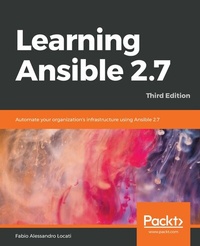
Learning Ansible 2.7
Automate your organization's infrastructure using Ansible 2.7
3rd Edition
Published on 23. September 2024
266 pages
978-1-78995-000-7 (ISBN)
Description

Use Ansible to configure your systems, deploy software, and orchestrate advanced IT tasks
Key Features
Get familiar with the fundamentals of Ansible 2.7
Understand how to use Ansible Tower to scale your IT automation
Gain insights into how to develop and test Ansible playbooks
Book DescriptionAnsible is an open source automation platform that assists organizations with tasks such as application deployment, orchestration, and task automation. With the release of Ansible 2.7, even complex tasks can be handled much more easily than before. Learning Ansible 2.7 will help you take your first steps toward understanding the fundamentals and practical aspects of Ansible by introducing you to topics such as playbooks, modules, and the installation of Linux, Berkeley Software Distribution (BSD), and Windows support. In addition to this, you will focus on various testing strategies, deployment, and orchestration to build on your knowledge. The book will then help you get accustomed to features including cleaner architecture, task blocks, and playbook parsing, which can help you to streamline automation processes. Next, you will learn how to integrate Ansible with cloud platforms such as Amazon Web Services (AWS) before gaining insights into the enterprise versions of Ansible, Ansible Tower and Ansible Galaxy. This will help you to use Ansible to interact with different operating systems and improve your working efficiency. By the end of this book, you will be equipped with the Ansible skills you need to automate complex tasks for your organization. What you will learn
Create a web server using Ansible
Write a custom module and test it
Deploy playbooks in the production environment
Troubleshoot networks using Ansible
Use Ansible Galaxy and Ansible Tower during deployment
Deploy an application with Ansible on AWS, Azure and DigitalOcean
Who this book is forThis beginner-level book is for system administrators who want to automate their organization's infrastructure using Ansible 2.7. No prior knowledge of Ansible is required
Key Features
Get familiar with the fundamentals of Ansible 2.7
Understand how to use Ansible Tower to scale your IT automation
Gain insights into how to develop and test Ansible playbooks
Book DescriptionAnsible is an open source automation platform that assists organizations with tasks such as application deployment, orchestration, and task automation. With the release of Ansible 2.7, even complex tasks can be handled much more easily than before. Learning Ansible 2.7 will help you take your first steps toward understanding the fundamentals and practical aspects of Ansible by introducing you to topics such as playbooks, modules, and the installation of Linux, Berkeley Software Distribution (BSD), and Windows support. In addition to this, you will focus on various testing strategies, deployment, and orchestration to build on your knowledge. The book will then help you get accustomed to features including cleaner architecture, task blocks, and playbook parsing, which can help you to streamline automation processes. Next, you will learn how to integrate Ansible with cloud platforms such as Amazon Web Services (AWS) before gaining insights into the enterprise versions of Ansible, Ansible Tower and Ansible Galaxy. This will help you to use Ansible to interact with different operating systems and improve your working efficiency. By the end of this book, you will be equipped with the Ansible skills you need to automate complex tasks for your organization. What you will learn
Create a web server using Ansible
Write a custom module and test it
Deploy playbooks in the production environment
Troubleshoot networks using Ansible
Use Ansible Galaxy and Ansible Tower during deployment
Deploy an application with Ansible on AWS, Azure and DigitalOcean
Who this book is forThis beginner-level book is for system administrators who want to automate their organization's infrastructure using Ansible 2.7. No prior knowledge of Ansible is required
More details
Edition
3rd Revised edition
Language
English
Place of publication
Birmingham
United Kingdom
Target group
Professional and scholarly
US School Grade: College Graduate Student
Edition type
Revised edition
File size
2,28 MB
ISBN-13
978-1-78995-000-7 (9781789950007)
Copyright in bibliographic data and cover images is held by Nielsen Book Services Limited or by the publishers or by their respective licensors: all rights reserved.
Schweitzer Classification
Other editions
Additional editions
Fabio Alessandro Locati
Learning Ansible 2.7
Automate your organization's infrastructure using Ansible 2.7
Book
04/2019
3rd Edition
Packt Publishing
€45.90
Shipment within 3-4 weeks
Person
Locati Fabio Alessandro :
Fabio Alessandro Locati - commonly known as Fale - is an EMEA associate principal solutions architect at Red Hat, a public speaker, an author, and an open source contributor. His primary areas of expertise are Linux, automation, security, and cloud technologies. Fale has more than 15 years of working experience in IT, with many of them spent consulting for various organizations, including dozens of Fortune 500 companies. Fale has written Learning Ansible 2.7, Learning Ansible 2, and OpenStack Cloud Security, and has been part of the review process of multiple books.
Fabio Alessandro Locati - commonly known as Fale - is an EMEA associate principal solutions architect at Red Hat, a public speaker, an author, and an open source contributor. His primary areas of expertise are Linux, automation, security, and cloud technologies. Fale has more than 15 years of working experience in IT, with many of them spent consulting for various organizations, including dozens of Fortune 500 companies. Fale has written Learning Ansible 2.7, Learning Ansible 2, and OpenStack Cloud Security, and has been part of the review process of multiple books.
Content
Table of Contents
Getting started with Ansible
Automating Simple Tasks
Scaling to multiple hosts
Handling complex deployment
Going cloud
Getting notification from Ansible
Creating a custom module
Debugging and error handling
Complex Environments
Introducing Ansible for Enterprises
Getting started with AWX
Working with AWX Users, Permissions, and Organizations
Getting started with Ansible
Automating Simple Tasks
Scaling to multiple hosts
Handling complex deployment
Going cloud
Getting notification from Ansible
Creating a custom module
Debugging and error handling
Complex Environments
Introducing Ansible for Enterprises
Getting started with AWX
Working with AWX Users, Permissions, and Organizations
