

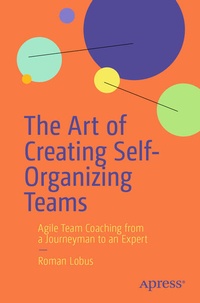
The Art of Creating Self-Organizing Teams
Description

The book centers on the art of team coaching specifically for Scrum Masters or Agile practitioners leading teams. This topic remains largely unexamined by the literature as there is a lack of contemporary guidance about coaching Agile teams on acquiring qualities paramount for an adaptive organization - being self-organized and assuming ownership over their ways of working and its results. An Agile practitioner has to either study books on professional coaching that don't provide much information on working in the Agile context or try to implement Agile methodologies and frameworks with fragmented and limited guidance on dealing with teams and group dynamics.
By integrating coaching principles with the realities of an Agile environment, this book provides enough information and relevant case studies to equip a reader with the skills needed to organize coaching, confidently deal with emerging dynamics, and achieve the intended goals. It also connects Agile team coaching with the ICF (International Coaching Federation) Team Coaching competencies, professionalizing the practice.
In Agile ways of working, the team's strength significantly impacts the success of the products they work on. While Agile practitioners are adept at understanding methodologies, frameworks, tools, complementary practices and techniques, many lack coaching skills that address the human aspects of teamwork. This book fills that gap by empowering to effectively coach teams, leading to improved communication and cohesion, increased adaptability, and a culture of continuous improvement.
This book is practical, insightful, and it aims to support not only beginners but also seasoned professionals aspiring to elevate their practice.
What You Will Learn
Practical team coaching techniques for Agile contexts
Understanding and navigating complex dynamics
Systemic awareness and interventions
Who This Book is For
The primary audience for the book includes Scrum Masters and Agile practitioners aiming to improve their team's performance. These professionals typically hold roles such as Scrum Master, Agile Coach, or Team Lead.
More details
Other editions
Additional editions
Person
Roman Lobus leads Agile practice at Singapore Airlines as Vice President of Agile Product and Portfolio Management. Throughout the past 10 years, he's coached more than 120 teams across Europe, Asia and Australia in adopting Agile Ways of Working.
He's a Professional Certified Coach and hold Advanced Certification in Team Coaching with the International Coaching Federation. In his coaching practice, heI leverage systems-informed and solution-focused coaching methods. He runs a community and meet-up 'Scrum Patterns' in Singapore and mentor executives, Agile coaches and Scrum Masters; one of his passions is to speak at Agile conferences like XP202x and Regional Scrum Gatherings on coaching topics.
Content
Part 1: Team Coaching for Agility.- 1: Why team coaching?.- 2: Mastering the fundamentals.- Part 2: Coaching Techniques and Processes.- 3: Sealing the deal: effective contracting.- 4: Navigating team dynamics and development.- 5: Power plays and hidden agendas revealed.- 6: Accelerating success.- 7: Leading leaders.- 8: Seeing the whole picture: systemic awareness.- Part 3: Navigating Challenging Situations.- 9: Clearing the roadblocks: overcoming issues with contracting.-10: Turning resistance into resilience.- 11: Staying true.- 12: Going Virtual.- Part 4: Enhancing the Coaching Craft.- 13: What if we don't need another tool to be impactful?.- 14: Pause, Reflect, Act - cultivating reflective practices for Agile team coaches.- 15: The power of supervision and deliberate practice.- 16: Reflective writing for deeper understanding.Chapter 17: The Team coach's first-aid kit.
