

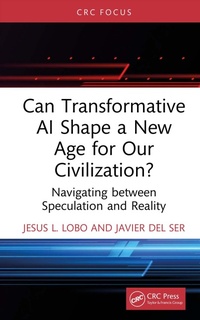
Can Transformative AI Shape a New Age for Our Civilization?
Description

Artificial Intelligence is moving beyond incremental innovation toward a threshold of transformative potential, where its capabilities may surpass human performance in critical cognitive, creative, and strategic domains. This shift could mark the beginning of a new epoch, reshaping economies, scientific discovery, and the very fabric of human society. "Can Transformative AI Shape a New Age for Our Civilization? Navigating between Speculation and Reality" offers a concise yet comprehensive guide to understanding this pivotal technological frontier. It clearly defines what makes AI transformative, distinguishing it from current-generation systems, and examines how such capabilities could accelerate breakthroughs in science, medicine, climate action, and global problem-solving. At the same time, it addresses the unprecedented risks, from economic disruption and systemic misuse to existential threats, that demand urgent governance, ethical foresight, and robust safety measures. Drawing from the latest research, cross-disciplinary perspectives, and real-world case studies, the authors provide readers with a structured framework for recognizing emerging transformative AI capabilities, assessing their likely societal impacts, and designing responsible adoption strategies. They explore both the technical foundations and the philosophical questions at the heart of this shift, offering actionable insights for policymakers, innovators, researchers, and informed citizens.
Whether your interest lies in guiding policy, advancing research, or simply making sense of AI's rapidly evolving landscape, this book equips you with the clarity, context, and critical tools to navigate one of the most consequential transitions in human history.
More details
Other editions
Additional editions
Persons
Dr. Jesus L. Lobo is currently Head of AI at FAES FARMA. He is passionate about AI and the possibility it offers to change everything. Drawing from many years of experience as an engineer and researcher, but also as a reader of science fiction and philosophy, he has a holistic vision that allows him to share a complete perspective.
Dr Javier Del Ser is currently Research Professor at TECNALIA Research & Innovation and Distinguished Researcher at University of the Basque Country. He has extensive practical and research experience in many branches of AI, assessing its impact on human and industrial activity, and anticipating changes that will occur in the future.
Content
1 Introduction
2 Understanding and Perceiving AI
2.1. A Few Brushstrokes of History
Information Classification: General
o 2.1.1. The Early Turning Points
o 2.1.2. The Modern Turning Points
o 2.1.3. The AI's Turn: the Great Hope
2.2. The Relevance of Ethical Perspectives in AI
o 2.2.1. Challenges in Translating Ethical Perspectives to AI
o 2.2.2. Reconciliation between Ethical Perspectives
o 2.2.3. Unpacking the Ethical Perspectives of the EU AI Act
3 From AI Today to the Challenges of TAI (page 26)
3.1. The Omnipresence of AI Today
o 3.1.1. A Time in the Shadows
o 3.1.2. AI Until Now
o 3.1.3. The AI Role in Our Civilization
3.2. Human Potholes in the Road to TAI
o 3.2.1. Cognitive and Data Biases
o 3.2.2. The Information Overload
o 3.2.3. Misalignment and The Enforcement of Human Oversight
o 3.2.4. Risk Aversion and Inertia
o 3.2.5. Overreliance on Human Expertise
o 3.2.6. The Perception of Futility of AI Ethics
o 3.2.7. Socio-Technical Disparities and Digital Divide
o 3.2.8. The Loss of Trust and Resistance
o 3.2.9. Diluted AI
o 3.2.10. Overregulation
o 3.2.11. Human Obsolescence
o 3.2.12. The AI-tocracy
3.3. Technical Potholes in the Road to TAI
o 3.3.1. The Capacity to Detect New Emerging Abilities
o 3.3.2. The Data Paradox
o 3.3.3. World Modeling
o 3.3.4. Sustainability, Physical Constraints, and Alternatives
o 3.3.5. A Stronghold for a Few
o 3.3.6. The Duality of Theoretical Foundations of Computation and AI
4 Opportunities and Perspectives (page 65)
4.1. Opportunities to Facilitate TAI
o 4.1.1. Some Technical Green Shoots
o 4.1.2. Some Non-Technical Green Shoots
4.2. A Great Hope for TAI: the "Science Explosion"
4.3. Would We Need a New Ethical and Philosophical Perspective for TAI?
5 Reflections and Conclusions (page 76)
5.1. Discussion and Open Thoughts from the Community
5.2. Conclusion
