

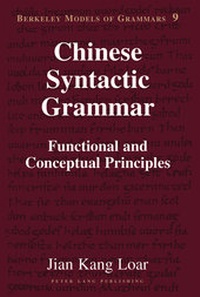
Chinese Syntactic Grammar
Functional and Conceptual Principles
300th Edition
Published on 12. April 2012
XXIV, 493 pages
978-1-4539-0514-2 (ISBN)
Description

Chinese Syntactic Grammar: Functional and Conceptual Principles is unique in that it discusses the organizational principles of Chinese syntactic structures in terms of conceptual and functional principles, which are iconic and hence are easy to understand and apply. The organizational principles mainly comprise the three Chinese conceptual principles of Temporal Sequence, Temporal Scope, and Whole-Before-Part (Tai, 1985) and the two functional principles of Communicative Dynamism and the Principle of Topic-End Focus. By analyzing the semantic roles of each clause element, Chinese Syntactic Grammar reveals that the conceptual principles play a crucial role in organizing ideas and bringing units (such as subject, verb, and object) together to form grammatical sequences, which manifest S (A) V O (C), which is the basic Chinese word order. The functional principles control and govern variations of the basic sentence structure, which are motivated to facilitate effective communication and achieve specific communicative goals, thus generating several special structures, including the Bá/Bèi/null Bèi sentences, etc. The variant forms are motivated to achieve special communicative goals, and to facilitate effective communication.
Another feature of the book is that it focuses on reasons, rather than merely on a description of rules. The language is lucid, and the arguments are cogent. The scope and depth of the investigation make the volume one of the most thorough and relatively complete pedagogical reference books. Chinese Syntactic Grammar can serve as a textbook for training professional CFL teachers. It is a must-read book for Mandarin Chinese teachers as a handy manual, also for intermediate and advanced Chinese learners if they want to have deeper insight into the nature of the Chinese language. Linguists who are interested in cognitive grammar and specialists across many fields including education, psychology, communication, and information science will find the book enlightening and interesting.
Another feature of the book is that it focuses on reasons, rather than merely on a description of rules. The language is lucid, and the arguments are cogent. The scope and depth of the investigation make the volume one of the most thorough and relatively complete pedagogical reference books. Chinese Syntactic Grammar can serve as a textbook for training professional CFL teachers. It is a must-read book for Mandarin Chinese teachers as a handy manual, also for intermediate and advanced Chinese learners if they want to have deeper insight into the nature of the Chinese language. Linguists who are interested in cognitive grammar and specialists across many fields including education, psychology, communication, and information science will find the book enlightening and interesting.
More details
Other editions
Additional editions
Book
01/2011
Peter Lang Verlag
€114.05
Article not available at the moment
Person
Jian Kang Loar received her BA in English and MA in English and linguistics at Huazhong University in Wuhan, China, where she also became an English lecturer. She came to Boston University on a presidential scholarship, and, subsequently, received her PhD in applied linguistics. Dr. Loar is Associate Professor of Chinese at the Defense Language Institute in Monterey, California. She has been engaged in foreign language teaching her whole life, and she is conversant with foreign language learning and teaching theories and methodology. Her specialty is Chinese grammar and linguistics, primarily in the verbal aspectual system, the sentence information structure, and word order in Chinese. Dr. Loar is the author of several articles that have been published in the Journal of Chinese Linguistics and the Journal of Chinese Language Teachers Association.
Content
- Intro
- Table of Contents
- List of Diagrams and Tables xv
- Preface xvii
- Acknowledgments xxi
- List of Abbreviations xxiii
- Chapter One - Organizational Principles of Chinese Syntactic Structures and Essential Notions 1
- 1.1. Organizational Principles of Syntactic Structures 1
- 1.1.1. The Principle of Temporal Sequence (PTS) 2
- 1.1.2. Process vs. Result 5
- 1.1.3. Functional Principles 7
- 1.1.4. Interplay between Conceptual and Functional Principles 12
- 1.1.5. Other Principles the Analysis Is Based On 13
- 1.2. Basic Clause Structures in Chinese 14
- 1.2.1. The Basic Word Order of SVO 14
- 1.2.2. The Simple Sentence 15
- 1.2.3. Central Verb Element and Chinese Fixed Word Order 16
- 1.2.4. Clause Patterns in Chinese: SV, SVO, SAV, SVOO, SV(O)C 18
- 1.2.5. Semantic, Pragmatic and Grammatical Relations 20
- 1.3. Semantic Roles of the Clause Elements 23
- 1.3.1. Predicate, Argument, and Predication 23
- 1.3.2. Semantic Roles of the Clause Element Subject 24
- 1.3.3. Semantic Roles of the Clause Element Object 29
- 1.3.4. Semantic Roles of the Clause Element Complement 31
- 1.3.5. Semantic Roles of the Clause Element Adverbial 32
- Chapter Two - Adverbials and Their Positions With Respect to the VP 35
- 2.1. The Conceptual Principle of Temporal Sequence 35
- 2.2. Outline of Semantic Roles of Adverbials 36
- 2.2.1. The Adverbial of Position 'zài + NP ' and Its Order 37
- 2.2.2. 'zài + NP loc ' Phrase Acts as a Sentential Adverbial 39
- 2.2.3. Adverbials of Direction and Source 41
- 2.2.4. Process Adverbials 44
- 2.2.4.1. Adverbials of Manner 45
- 2.2.4.2. Adverbials of Means and Instrument 46
- 2.2.5. Subject-Oriented Adverbials 47
- 2.2.5.1. Subject-Oriented Adverbials Depicting Subject Referent 47
- 2.2.5.2. Subject-Oriented Adverbials Expressing Volition 49
- 2.3. Time Adverbials and the Principle of Temporal Scope 50
- 2.3.1. Time-position Adverbials 50
- 2.3.2. Time Expressions of Span and Duration 54
- 2.3.3. Expressions of Time Frequency 60
- 2.4. Attitudinal Adverbials 63
- 2.4.1. Modality 63
- 2.4.2. Semantic Scope and Focus 65
- 2.4.3. Common Emphasizing Adverbials 70
- 2.4.4. Focusing Adverbials 72
- 2.4.5. Viewpoint Adverbials 74
- 2.4.6. Common Intensifying Adverbials 75
- 2.4.7. Other Adverbials of Modality 79
- 2.4.8. Summary of Adverbials of Modality 83
- 2.5. Relative Positions of Multiple Adverbials 84
- 2.6. Semantic Blend 92
- 2.7. Location and its Expression 98
- 2.7.1. The Relational Nature of Location 98
- 2.7.2. The Principle 'Whole-Before-Part' and Position Words 99
- 2.7.3. Spatial Relations Encoded by Compound Position Words 101
- 2.7.4. Constant and Projected Locations 107
- 2.8. Sentence Patterns Expressing Location 109
- 2.8.1. The Existential You Sentence 109
- 2.8.2. The Locative Zài Sentence 110
- 2.8.3. The Identifying Shì Sentence 112
- Chapter Three - The Verbal Complement and Clause Element of Complement 115
- 3.1. Background Knowledge 115
- 3.1.1. Situation Types 115
- 3.1.2. Aspect 118
- 3.1.3. Aspectual Features of Chinese Activity Verbs 121
- 3.2. Resultative Verb Compounds (RVC) 122
- 3.2.1. The Definition of the RVC 122
- 3.2.2. The Lexical Properties of the RVC 122
- 3.2.2.1. V2 Is a Property Adjective Used as an Inchoative 123
- 3.2.2.2. V2 Is an Achievement 125
- 3.2.2.3. V1 is an Activity 127
- 3.2.2.4. V1 is an Inchoative Verb 127
- 3.2.2.5. Verbs that Cannot Act as V1 128
- 3.2.3. Resultative Verb Compounds Are Accomplishments 130
- 3.2.4. The Head of the RVC 130
- 3.2.5. The Perfective Aspect Induced by the RVC 132
- 3.2.6. The RVC Is Incompatible with the Progressive 'zhèng zài' 135
- 3.2.7. Often Used Resultative Complements 137
- 3.3. Directional Verb Compounds (DVC) 141
- 3.3.1. Brief Introduction to Directional Complements 141
- 3.3.2. Syntactic Features of Directional Verb Compounds 143
- 3.3.3. The Aspectual Properties and Function of the DCC 146
- 3.3.3.1. The Semantic Components of Direction Verbs 146
- 3.3.3.2. Direction Verbs are Achievement Verbs 147
- 3.3.3.3. The Aspectual Function of the DCC 149
- 3.3.4. Lexical Properties of the Directional Verb Compound 150
- 3.3.4.1. Activity Verbs Acting as V1 150
- 3.3.4.2. Inchoative Verbs Acting as V1 151
- 3.3.4.3. Adjective Stative Verbs Acting as V1 153
- 3.3.5. Formal Tests for the DVC as Accomplishments 155
- 3.4. The Clause Element of Complements 160
- 3.4.1. The Action Measure Complement (AMC) 161
- 3.4.1.1. AMC Denoting Frequency 'X biàn' or 'Y cì' 161
- 3.4.1.2. AMC Denoting the Quantity of an Action 167
- 3.4.1.3. 'yixiàr' Used as an AMC 168
- 3.4.2. The Time Measure Complement (TMC) 170
- 3.4.3. The Conceptual Structure Underlying AMCs/TMCs 175
- 3.4.4. Complements Expressed by Prepositional Phrases 177
- 3.4.4.1. The Prepositional Phrase of 'zài + NP loc ' 177
- 3.4.4.2. The Prepositional Phrase of 'dào + NP loc ' 183
- 3.4.4.3. Complements Expressed by 'xiàng/wang + NP loc ' 185
- 3.5. The Potential Complement 187
- 3.5.1. The Definition of the Potential Complement 187
- 3.5.2. Differences Between Potential Complement and 'néng/keyi' 188
- 3.5.3. The Potential Form of RVCs and the De Complement 192
- 3.5.4. Three Idiomatic Potential Complement Expressions 196
- 3.6. The Complement of Degree 198
- 3.6.1. Definition of The Complement of Degree 198
- 3.6.2. Types of Verb Taking a Complement of Degree 198
- 3.6.3. Commonly Used Complements of Degree 200
- 3.6.4. Differences Between Degree and Resultative Complements 202
- Chapter Four - The Order of Clauses in the Compound and Complex Sentence 209
- 4.1. Compound and Complex Sentences 209
- 4.2. Semantic Roles of Adverbial Clauses 213
- 4.2.1. Clauses of Reason or Cause 213
- 4.2.2. Clauses of Concession 215
- 4.2.3. Clauses of Condition 217
- 4.2.3.1. Direct Conditional Clauses 217
- 4.2.3.2. Necessary Conditional Clauses 219
- 4.2.4. Conditional-Concessive Clauses 221
- 4.2.4.1. Alternative Conditional-Concessive Clauses 221
- 4.2.4.2. Universal Conditional-Concessive Clauses 222
- 4.2.5. Clauses of Purpose 223
- 4.2.6. Clauses of Result 226
- 4.2.7. Clauses of Preference 228
- 4.3. The Compound Sentence 230
- 4.3.1. The Coordinated Compound Sentence 231
- 4.3.2. The Sequential Compound Sentence 233
- 4.3.3. The Alternative Compound Sentence 235
- 4.3.4. The Additive Compound Sentence 235
- 4.4. Often Used Coordinators 236
- 4.4.1. The Coordinator 'ér' 236
- 4.4.2. The Coordinator 'yijí' 241
- 4.4.3. The Coordinator 'hé' 242
- 4.4.4. The Coordinator 'jì.yòu' 243
- 4.4.5. The Coordinator 'bìng/bìngqie' 244
- Chapter Five - Attributives and the Principle for Ordering Multiple Premodifiers 247
- 5.1. The Pattern of the Basic Internal Order in Chinese NPs 247
- 5.1.1. Semantic and Pragmatic Functions of D, Q and A 248
- 5.1.2. Interaction of SP and RP in the Ordering of DQAN 250
- 5.2. More Fronted Positions of De-Modifiers 251
- 5.2.1. Flexible Positions of De-Modifiers 251
- 5.2.2. The Refined Principle of Referential Precedence 251
- 5.2.3. Referentiality of Adjectives and R-A Ratio 252
- 5.3. A De-modifier Occurring in Pre-Q or Post-Q position 254
- 5.4. De-Modifiers Occurring in Pre-D Positions 3 & 4 256
- 5.5. General Guideline for Ordering Multiple Adjectives 259
- 5.6. The Principle for Ordering Cross-Categorical Premodifiers 261
- 5.6.1. Modifiers and Temporal Stability 261
- 5.6.2. The General Principle of Permanent/Temporary Polarity 263
- 5.7. Supplementary Knowledge about Modifiers D, A and VP 270
- 5.7.1. Lexical Items That Have Definite Referential Force 270
- 5.7.2. Adjective Modifiers 275
- 5.7.2.1. Classification of Adjectives 275
- 5.7.2.2. Adjectives Used Attributively 278
- 5.7.2.3. Adjectives Used as the Predicate 280
- 5.7.3. Noun Phrase Modifiers 281
- 5.7.4. Verb Phrases as Modifiers 283
- Chapter Six - Four Resultative Sentence Structures in Chinese 289
- 6.1. Background Knowledge 289
- 6.2. The Causative Ba Sentence 293
- 6.2.1. The Ba Construction as a Causative Structure 293
- 6.2.2. Differences between Ba and Non-Ba Sentences 295
- 6.2.3. The VP in the Ba Sentence Must Express a Result 296
- 6.2.3.1. Resultative VPs Acting as the Predicate 297
- 6.2.3.2. Restrictions on Activity Verbs Acting as the Predicate 300
- 6.2.3.3. Activity Verbs with Resultant Object as the Predicate 303
- 6.2.3.4. A Psyche or Cognitive Verb as the Predicate 304
- 6.2.4. The Agentivity of the Subject NP 306
- 6.2.5. The Communicative Function of the Ba Sentence 310
- 6.3. The Null Bèi and Bèi Sentence 312
- 6.3.1. Background Knowledge 312
- 6.3.2. The Null Bèi Construction 314
- 6.3.3. The Predicate of the Null Bèi Expresses Result 315
- 6.4. The Bèi Construction 317
- 6.4.1. The Nature of the Bèi Construction 317
- 6.4.2. VPs Acting as the Predicate of the Bèi Sentence 320
- 6.4.3. Positions of Adverbials in the Bèi Sentence 324
- 6.4.4. Differences Between the Bèi and Yóu sentence 328
- 6.4.5. Organizational Principles for Ba/Bèi/Null Bèi Sentences 330
- 6.5. The De Complement Construction 331
- 6.5.1. Traditional Analysis of the De Complement 331
- 6.5.2. The Nature of the De Complement Construction 332
- 6.5.3. Comparison Between the De Complement and RVC 333
- 6.5.4. The Notion of Goal or Result 334
- 6.5.5. Types of Verb Acting as the Matrix Verb 336
- 6.5.5.1. Activity Verbs Act as the Matrix Verb 337
- 6.5.5.2. Property Adjectives Act as the Matrix Verb 339
- 6.5.5.3. Stative Adjectives Cannot Act as the Matrix Verb 340
- 6.5.5.4. Psyche Verbs Act as the Matrix Verb 342
- 6.5.6. Arguments Predicated of by the De Resultative 343
- 6.5.6.1. Is Simpson's Law Observed in the De complement? 343
- 6.5.6.2. Affected Arguments Predicated of by De Complements 344
- 6.5.6.3. Turn to the Theory of Macroroles 345
- 6.5.6.4. Subjects with the Semantic Role of Experiencer 348
- 6.5.6.5. Subjects with the Semantic Role of External Causer 349
- 6.5.6.6. Arguments of Psyche Verbs 350
- 6.5.6.7. The Object Argument in the De Complement Sentence 352
- 6.5.7. The Predicate-focused De Complement Sentence 353
- 6.5.7.1. Different Foci on the Event and its Participants 354
- 6.5.7.2. The Essence of an (Active) Event Is Change 355
- 6.5.7.3. Interpreted Shifts of Situation Types 358
- 6.5.7.4. De Complements Used as Derived Stative Sentences 361
- 6.5.8. Co-occurrence of Ba and De complement Sentences 364
- 6.5.9. Co-occurrence of Bèi/Null Bèi/De Complement Sentences 366
- Chapter Seven - The Topic-Comment Structure of the Chinese Language 369
- 7.1. Background Knowledge 369
- 7.1.1. The Definitions of Topic 370
- 7.1.2. End-Focus and Marked-Focus 372
- 7.1.3. Subject as a Marked Focus 374
- 7.2. Characteristics of Chinese Topic-Comment Structures 376
- 7.2.1. Topic Expressions and Their References 376
- 7.2.2. Relationships between Topic and Comment 386
- 7.2.2.1. Topic Co-Refers to an Argument in the Comment 387
- 7.2.2.2. Pragmatic Relations between Topic and Comment 390
- 7.2.2.3. The Subject-Predicate Sentence 392
- 7.2.3. Topic May Not Be Confined to One Referent 393
- 7.2.4. Grammatical Forms Functioning as Topics 395
- 7.2.5. Omission of Subject in Topic-Comment Sentences 400
- 7.2.6. The Object NP Functions As Topic 402
- 7.3. The Topic Acceptability Scale 408
- 7.4. Topic Promotion Constructions 409
- 7.4.1. The Presentative Construction 410
- 7.4.1.1. The Structure of the Presentative Sentence 410
- 7.4.1.2. The Communicative Function of the Presentative 412
- 7.4.2. The Existential You Construction 414
- 7.4.2.1. The Communicative Function of the You Sentence 414
- 7.4.2.2. Existential Sentences with Stative Verbs 416
- 7.5. Topic-Comment Constructions in Chinese 419
- 7.5.1. Sentences with Nominal Predicates 420
- 7.5.2. The S-P Predicate Construction 424
- 7.5.2.1. The Structure of the S-P Predicate Sentence 424
- 7.5.2.2. Communicative Functions of S-P Predicate Sentences 425
- 7.5.2.3. The Relation between NP1 and NP2 426
- 7.5.2.4. S-P/Nominal Predicate Sentence Transformation 429
- 7.5.3. Comparative Constructions 429
- 7.5.3.1. Comparison of Superiority: The Bi Construction 430
- 7.5.3.2. The Item Being Compared Must Be Topic 431
- 7.5.3.3. The Predicate Is Stative and Gradable 433
- 7.5.3.4. Comparison of Inferiority: The 'Méiyou' Sentence 436
- 7.5.3.5. Comparison of Equality: The 'Gen.Yíyàng' Sentence 437
- 7.6. The Left-Detachment Sentence 438
- 7.6.1. Definition of the Left-Detachment Sentence 438
- 7.6.2. Communicative Function of Left-Detachment Sentences 439
- 7.6.3. The Left-Detachment and the Topic Sentence 441
- 7.6.4. Pragmatic Motivation for Left-Detachment Sentences 444
- 7.7. The Right-Detachment Sentence 446
- 7.8. The Contrastive Topic Constructions 447
- 7.8.1. The 'lián.ye/dou' Construction 447
- 7.8.1.1. The 'lián' Element Is Topic or Subtopic 447
- 7.8.1.2. The Function of the Adverb 'ye/dou' 451
- 7.8.1.3. Semantic Relations between 'lián' Item and the VP 453
- 7.8.2. Contrastive Topic 'an Interrogative + ye/dou' 456
- 7.8.3. Topic 'Reduplicated Measure Word + dou' 458
- 7.8.4. 'yi + Classifier + NP.ye/dou' Construction 459
- 7.9. The Topic Copying Construction 459
- 7.10. The Information Focus Constructions in Chinese 464
- 7.10.1. Chinese Has a Strong Preference for End Focus 464
- 7.10.2. S Adjective Predicate Construction 465
- 7.10.3. The Information Focus Construction 'shì.de' Sentence 468
- 7.10.3.1. 'shì.de' Construction Emphasizing Adverbials 468
- 7.10.3.2. 'shì.de' Sentence Emphasizing the Agent 471
- 7.10.3.3. 'shì.de' Construction Emphasizing a Proposition 472
- 7.10.3.4. Communicative Function of 'shì.de' Construction 475
- 7.10.3.5. Difference between 'shì.de' and Copula 'shì' Sentences 476
- Bibliography 483
- Index 489
