

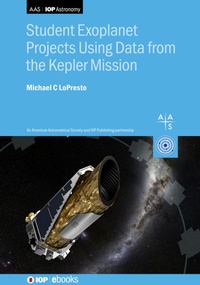
Student Exoplanet Projects Using Data from the Kepler Mission
Description

The first exoplanets were discovered over 25 years ago. Since then, the Kepler Mission has discovered smaller, Earth-sized exoplanets and types of planets not found in our solar system. By using Kepler data, it is possible to assess some of the key parameters indicating planetary habitability, including density, and also to determine the various types of planets that exist beyond our solar system. Ongoing missions continuing the research begun by the Kepler Mission are now attempting to determine the composition of the atmospheres of possibly habitable planets to see if the chemical signatures of substances necessary to support life and maybe even life itself are present.
The book describes the Kepler Mission and its detection methods, providing the reader with a fundamental background to explore Kepler datasets independently. The book then outlines student research projects using the mission's data that can conducted independently or guided by a course leader. These projects cover various aspects of Kepler data, including habitable zones, planetary temperatures, and the densities of different planetary types, Super-Earths, and Mini-Neptunes. Excel templates for each project are accessible alongside the book with selected data for students to analyse, and detailed instruction is provided to ensure self-sufficiency and independence. The projects are designed to teach students to consider the caveats of their findings throughout the work, placing their findings in a greater context. Guidance is also provided for lecturers leading these classes. The book ends with a summary of the findings of the Kepler mission and provides a discussion of ongoing and possible future research of other missions picking up where Kepler left off.
More details
Other editions
Additional editions

Person
Dr. Michael LoPresto is based at the University of Michigan, USA. He has taught Astronomy for 34 years, is the author of a textbook and several laboratory manuals for introductory astronomy and has published many journal articles on innovations and methods for the teaching of Astronomy as well as astronomy education research.
Content
- Introduction to the Kepler mission and its methods.
- Discovery of exoplanets in Habitable Zones
- Temperatures of exoplanets
- The Densities of different exoplanet types
- Super Earths & Mini Neptunes
- Conclusions & Future Research
