

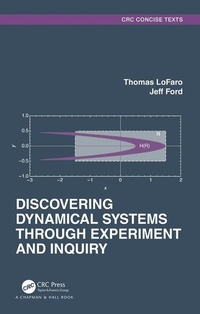
Discovering Dynamical Systems Through Experiment and Inquiry
1st Edition
Published on 22. March 2021
216 pages
978-1-000-35895-7 (ISBN)
Description

Discovering Dynamical Systems Through Experiment and Inquiry differs from most texts on dynamical systems by blending the use of computer simulations with inquiry-based learning (IBL). IBL is an excellent tool to move students from merely remembering the material to deeper understanding and analysis. This method relies on asking students questions first, rather than presenting the material in a lecture.
Another unique feature of this book is the use of computer simulations. Students can discover examples and counterexamples through manipulations built into the software. These tools have long been used in the study of dynamical systems to visualize chaotic behavior.
We refer to this unique approach to teaching mathematics as ECAP-Explore, Conjecture, Apply, and Prove. ECAP was developed to mimic the actual practice of mathematics in an effort to provide students with a more holistic mathematical experience. In general, each section begins with exercises guiding students through explorations of the featured concept and concludes with exercises that help the students formally prove the results.
While symbolic dynamics is a standard topic in an undergraduate dynamics text, we have tried to emphasize it in a way that is more detailed and inclusive than is typically the case. Finally, we have chosen to include multiple sections on important ideas from analysis and topology independent from their application to dynamics.
Another unique feature of this book is the use of computer simulations. Students can discover examples and counterexamples through manipulations built into the software. These tools have long been used in the study of dynamical systems to visualize chaotic behavior.
We refer to this unique approach to teaching mathematics as ECAP-Explore, Conjecture, Apply, and Prove. ECAP was developed to mimic the actual practice of mathematics in an effort to provide students with a more holistic mathematical experience. In general, each section begins with exercises guiding students through explorations of the featured concept and concludes with exercises that help the students formally prove the results.
While symbolic dynamics is a standard topic in an undergraduate dynamics text, we have tried to emphasize it in a way that is more detailed and inclusive than is typically the case. Finally, we have chosen to include multiple sections on important ideas from analysis and topology independent from their application to dynamics.
More details
Series
Edition
1. Auflage
Language
English
Place of publication
London
United Kingdom
Publishing group
Taylor & Francis Ltd
Target group
College/higher education
Product notice
Reflowable
Illustrations
40 Illustrations, black and white
ISBN-13
978-1-000-35895-7 (9781000358957)
Copyright in bibliographic data and cover images is held by Nielsen Book Services Limited or by the publishers or by their respective licensors: all rights reserved.
Schweitzer Classification
Other editions
Additional editions
Thomas LoFaro | Jeff Ford
Discovering Dynamical Systems Through Experiment and Inquiry
Book
08/2024
1st Edition
Chapman & Hall/CRC
€85.40
Shipment within 15-20 days
Thomas LoFaro | Jeff Ford
Discovering Dynamical Systems Through Experiment and Inquiry
Book
03/2021
1st Edition
Chapman & Hall/CRC
€132.30
Shipment within 15-20 days
Persons
Tom LoFaro: Tom LoFaro is the Clifford M. Swanson Professor of Mathematics at Gustavus Adolphus College. He earned his Bachelor's and Master's degrees in mathematics from the University of Missouri. He then earned his Ph.D. from Boston University in mathematics under the direction of Nancy Kopell. Tom's research interests are in the applications of dynamical systems to mathematical biology in general and neuroscience in particular and is an Affiliated Faculty Member of the Institute for the Study of Decision Making at New York University.
Tom has been active in the differential equations and dynamical systems education community and in the past worked closely with the Community for Ordinary Differential Equations Educators where he has published several articles their journal.
Jeff Ford: Jeff Ford is a Visiting Assistant Professor of Mathematics at Gustavus Adolphus College. He earned his Bachelor's degree from Gustavus Adolphus College, his Master's degree in mathematics from Minnesota State University - Mankato, and his Ph.D. in mathematics from Auburn University, studying under Dr. Krystyna Kuperberg. Jeff is interested in the existence volume-preserving dynamical systems with unique properties.
Jeff uses and assesses a variety of active learning techniques in his class including inquiry-based learning and team-based learning. His scholarship in this area centers on understanding how active learning techniques improve confidence and reduce anxiety in undergraduate students.
Tom has been active in the differential equations and dynamical systems education community and in the past worked closely with the Community for Ordinary Differential Equations Educators where he has published several articles their journal.
Jeff Ford: Jeff Ford is a Visiting Assistant Professor of Mathematics at Gustavus Adolphus College. He earned his Bachelor's degree from Gustavus Adolphus College, his Master's degree in mathematics from Minnesota State University - Mankato, and his Ph.D. in mathematics from Auburn University, studying under Dr. Krystyna Kuperberg. Jeff is interested in the existence volume-preserving dynamical systems with unique properties.
Jeff uses and assesses a variety of active learning techniques in his class including inquiry-based learning and team-based learning. His scholarship in this area centers on understanding how active learning techniques improve confidence and reduce anxiety in undergraduate students.
Content
Table of Contents
Chapter 1: An Introduction to Dynamical Systems
Chapter 2: Sequences
Chapter 3: Fixed Points & Periodic Points
Chapter 4: Analysis of Fixed Points
Chapter 5: Bifurcations
Chapter 6: Examples of Global Dynamics
Chapter 7: The Tools of Global Dynamics
Chapter 8: Examples of Chaos
Chapter 9: From Fixed Points to Chaos
Chapter 10: Sarkovskii's Theorem
Chapter 11: Dynamical Systems on the Plane
Chapter 12: The Smale Horseshoe
Chapter 13: Generalized Symbolic Dynamics
Chapter 1: An Introduction to Dynamical Systems
Chapter 2: Sequences
Chapter 3: Fixed Points & Periodic Points
Chapter 4: Analysis of Fixed Points
Chapter 5: Bifurcations
Chapter 6: Examples of Global Dynamics
Chapter 7: The Tools of Global Dynamics
Chapter 8: Examples of Chaos
Chapter 9: From Fixed Points to Chaos
Chapter 10: Sarkovskii's Theorem
Chapter 11: Dynamical Systems on the Plane
Chapter 12: The Smale Horseshoe
Chapter 13: Generalized Symbolic Dynamics
