

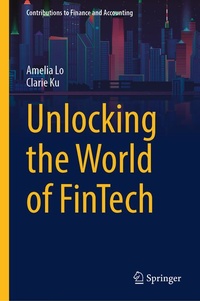
Unlocking the World of FinTech
Description

This book offers a clear, comparative perspective on how leading jurisdictions are responding to the rapid rise of financial technologies. Through jurisdiction-specific chapters, it highlights practical regulatory strategies, emerging legal trends, and the balance between innovation and financial stability across 11 key markets.
What sets this work apart is its focus on real-world applications and collaborative regulatory approaches, providing insights that are both globally informed and locally grounded. Covering developments in digital assets, cross-border payments, CBDCs, and data governance, the volume brings together perspectives from experts embedded in each legal system.
Written for policymakers, legal practitioners, scholars, and advanced students, the content is accessible yet analytically rigorous.
Key benefits include:
· A unique, side-by-side comparison of global FinTech regulatory ecosystems
· Forward-looking analysis that supports international dialogue and policy alignment
More details
Other editions
Additional editions
Persons
Amelia Lo is a cross-border legal practitioner with law degrees from the University of Hong Kong, CUHK Business School, and Harvard University. She is a partner at an international law firm, with legal practice credentials across Hong Kong, Mainland China, the UK, and the US. Amelia was seconded by the Hong Kong SAR Government to UNIDROIT in Rome and recognized as a LexisNexis 40 Under 40 (Asia) lawyer in 2023. She serves as a founding committee member of the Harvard Alumni Entrepreneurs (HK) and advises startups under Hong Kong Cyberport's Incubation Scheme. Her research interests include FinTech law, cross-border regulation, and legal innovation in public health and finance.
Clarie Ku is the former Deputy Secretary for Financial Services and the Treasury of the Hong Kong SAR Government and served as global President of the FATF in 2001. She led international responses to counter-terrorism financing post-9/11, and co-founded the China-US Exchange Foundation as its inaugural CEO. A recipient of the Chief Executive's Commendation for Public Service, she has held leadership roles across the public, financial, and tech sectors. Clarie holds degrees from Stanford, University of London, CUHK, and completed executive programs at Oxford and Harvard. Her expertise spans anti-money laundering, policy innovation, and financial diplomacy.
Content
Part I: Basic Essentials.- Chapter 1. Introduction.- Chapter 2. Regulatory Frameworks in FinTech.- Chapter 3. Contracts & Commercial Agreements: Legal Foundations for FinTech.- Chapter 4. Mastering Anti-Money Laundering (AML) in FinTech.- Chapter 5. The Future of Digital Finance: What Is Next?.- Part II: Specific Issues.- Chapter 6. Venture Capital & Private Equity in FinTech.- Chapter 7. Investment Funds in FinTech.- Chapter 8. IPOs Exit Strategies: Making Your Mark in FinTech.- Chapter 9. Litigation & Dispute Resolution in FinTech.- Chapter 10. Exploring Specialized FinTech Topics.- Chapter 11. Navigating the Dark Side: Scams in FinTech.- Chapter 12. Art and Fintech.- Chapter 13. Fintech in Entertainment.- Chapter 14. FinTech and Internet Law and Business.- Chapter 15. FinTech and Longevity Finance in Healthcare PEVC Investments - Law, Business, and Cross-Jurisdictional Dynamics.- Chapter 16. Overall Conclusion.
