

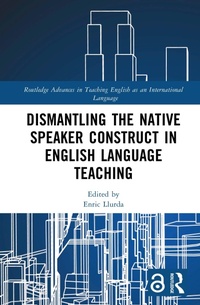
Dismantling the Native Speaker Construct in English Language Teaching
1st Edition
Published on 15. September 2025
274 pages
978-1-040-42488-9 (ISBN)
Description

This edited volume provides a set of cutting-edge research on native-speakerism and how the concept of the native speaker is still present in the teaching of English as a global language.
The chapters each take a critical stance on the concept of 'native speaker' and thus deconstruct it so that the reader can construct their own vision of language use, language acquisition, and language teaching in an unbiased way, detached from myths and fallacies that have permeated in language education up until today. Though this book is contextualized within the teaching of English as an International Language, its contributions and argumentations are also illuminating for any other language teaching context. Research included in this volume is empirical, thus providing rich data to support critical argumentation, and ensuring a global overview of studies conducted in Asia, Europe, and the Americas.
A unique reference for students, scholars, and practitioners interested in the native speaker construct and its effect on language teachers' identities, general language teaching practices, and advancing the field of Applied Linguistics.
Chapter 1 of this book is freely available as a downloadable Open Access PDF at http://www.taylorfrancis.com under a Creative Commons [Attribution-Non Commercial-No Derivatives (CC-BY-NC-ND)] 4.0 license.
The chapters each take a critical stance on the concept of 'native speaker' and thus deconstruct it so that the reader can construct their own vision of language use, language acquisition, and language teaching in an unbiased way, detached from myths and fallacies that have permeated in language education up until today. Though this book is contextualized within the teaching of English as an International Language, its contributions and argumentations are also illuminating for any other language teaching context. Research included in this volume is empirical, thus providing rich data to support critical argumentation, and ensuring a global overview of studies conducted in Asia, Europe, and the Americas.
A unique reference for students, scholars, and practitioners interested in the native speaker construct and its effect on language teachers' identities, general language teaching practices, and advancing the field of Applied Linguistics.
Chapter 1 of this book is freely available as a downloadable Open Access PDF at http://www.taylorfrancis.com under a Creative Commons [Attribution-Non Commercial-No Derivatives (CC-BY-NC-ND)] 4.0 license.
More details
Series
Edition
1. Auflage
Language
English
Place of publication
London
United Kingdom
Publishing group
Taylor & Francis Ltd
Target group
College/higher education
Professional and scholarly
ELT/ESL
Illustrations
12 Tables, black and white; 10 Line drawings, black and white; 10 Illustrations, black and white
File size
4,59 MB
ISBN-13
978-1-040-42488-9 (9781040424889)
Copyright in bibliographic data and cover images is held by Nielsen Book Services Limited or by the publishers or by their respective licensors: all rights reserved.
Schweitzer Classification
Other editions
Additional editions

Book
10/2025
Routledge
Unfortunately, price unknown
Available (delivery time upon request)
Book
09/2025
1st Edition
Routledge
€206.60
Shipment within 10-20 days
Person
Enric Llurda is a Professor of Applied Linguistics at Universitat de Lleida in Catalonia (Spain). His interests include native-speakerism, global Englishes, internationalization, language attitudes, and ideologies. He is the editor of the 2005 volume Non-native Language Teachers: Perceptions, Challenges and Contributions to the Profession, and has published extensively in journals and edited volumes on native-speakerism, non-native teachers, and language teacher identity.
Content
Contents
List Contributors
Series Foreword
Chapter 1. Bringing down the wall of native-speakerism in English language teaching
Enric Llurda
Part I: The pervasiveness of the native-speaker construct in the expanding circle
Chapter 2. Native-speakerism in Catalan private language schools: recruiters' perspectives
Julia Calvet-Terre & Enric Llurda
Chapter 3. Between tradition and globalization: native-speakerism in Poland
Tomasz Paciorkowski
Chapter 4. Social media English teaching and native-speakerism in Japan
Yuzuko Nagashima & Luke Lawrence
Chapter 5. English language education policies in Latin America and the perpetuation of native-speakerism
Adriana Gonzalez
Part II: The emergence of new identities beyond the native-speaker construct
Chapter 6. Understanding the mechanisms of the ghost of native-speakerism through unpacking my silent moments: An autoethnography
Nugrahenny T. Zacharias (Henny)
Chapter 7. The impact of native-speakerism on culture teaching practices of secondary ELT teachers in Thailand
Nattida Pattaraworathum & Will Baker
Chapter 8. Translingual English teachers and students' desires for the concept of 'native speaker' in Japan
Ryo Mizukura
Chapter 9. The hybridity of English as an international language in Asia
Jette G. Hansen Edwards
Part III: Teacher-training initiatives dismantling the native-speaker construct
Chapter 10. Re-assessing nativeness for a Global Englishes-informed language teacher education
Martin Dewey
Chapter 11. English as lingua franca, native-speakerism, ideology, and framing: an investigation of the beliefs of teacher trainees in Japan
Robert J. Lowe
Chapter 12. Decolonizing teacher education: digitally unveiling native-speakerism in ELT through ELF Pedagogy
Inmaculada Pineda
Index
List Contributors
Series Foreword
Chapter 1. Bringing down the wall of native-speakerism in English language teaching
Enric Llurda
Part I: The pervasiveness of the native-speaker construct in the expanding circle
Chapter 2. Native-speakerism in Catalan private language schools: recruiters' perspectives
Julia Calvet-Terre & Enric Llurda
Chapter 3. Between tradition and globalization: native-speakerism in Poland
Tomasz Paciorkowski
Chapter 4. Social media English teaching and native-speakerism in Japan
Yuzuko Nagashima & Luke Lawrence
Chapter 5. English language education policies in Latin America and the perpetuation of native-speakerism
Adriana Gonzalez
Part II: The emergence of new identities beyond the native-speaker construct
Chapter 6. Understanding the mechanisms of the ghost of native-speakerism through unpacking my silent moments: An autoethnography
Nugrahenny T. Zacharias (Henny)
Chapter 7. The impact of native-speakerism on culture teaching practices of secondary ELT teachers in Thailand
Nattida Pattaraworathum & Will Baker
Chapter 8. Translingual English teachers and students' desires for the concept of 'native speaker' in Japan
Ryo Mizukura
Chapter 9. The hybridity of English as an international language in Asia
Jette G. Hansen Edwards
Part III: Teacher-training initiatives dismantling the native-speaker construct
Chapter 10. Re-assessing nativeness for a Global Englishes-informed language teacher education
Martin Dewey
Chapter 11. English as lingua franca, native-speakerism, ideology, and framing: an investigation of the beliefs of teacher trainees in Japan
Robert J. Lowe
Chapter 12. Decolonizing teacher education: digitally unveiling native-speakerism in ELT through ELF Pedagogy
Inmaculada Pineda
Index
