

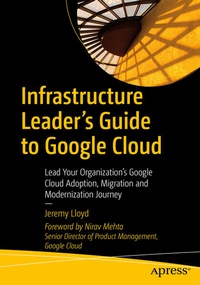
Infrastructure Leader's Guide to Google Cloud
Description

Making fast and accurate technology decisions is critical to staying relevant to your customers. And technology needs to add value back to your organization quicker than ever. Google Cloud offers IT leaders the answer to today's technology challenges. However, to realize its benefits you must navigate your journey without hitting common pitfalls that lead to stalled and unsuccessful cloud adoption.
This book distills the lessons learned from guiding and working with hundreds of organizations on their journey to the cloud. Its goal is to give aspiring and current IT leaders the knowledge required to be an infrastructure leader. That is the term author Jeremy Lloyd uses for the person who can lead your organization's Google Cloud adoption strategy.
Of course, cloud adoption isn't a solo endeavor. Jeremy covers the different generations of IT leaders, the team structure, and the skills required for a successful migration to Google Cloud. This book also covers why you should choose Google Cloud, how to build a business case for the cloud, and defining your adoption/migration/modernization strategies and cloud operating model. Finally, the book covers how to empower your developers to deploy cloud-native applications and how to support day two operations once you have moved to Google Cloud.
What You Will Learn- Use Google Cloud to add value to your organization
- Define and lead your Google Cloud adoption strategy
- Migrate and modernize your workloads
- Operate workloads once in Google Cloud and avoid antipatterns
- Understand how the infrastructure team can be enablers for cloud-native development
More details
Other editions
Additional editions
Person
Content
PART 1: Understanding Why Google Cloud Is Used.- Chapter 1: Introduction.- Chapter 2: About Google and Google Cloud.-Chapter 3: The Future of IT.- PART 2: Business & Cloud Strategies.- Chapter 4: The Four Approaches To Google Cloud Adoption.- Chapter 5: Business Case.- Chapter 6: The Cloud Strategy.- Chapter 7: Cloud Operating Model Strategy.- Chapter 8: Migration Strategies.- Chapter 9: Modernisation Strategies.- Chapter 10: Accelerate with Google and Partners.- PART 3: Organisational Readiness And Change.- Chapter 11: Cloud Adoption & Cultural Change.- Chapter 12: Cloud Operating Model Readiness.- Chapter 13: Skills.- Chapter 14: Cloud Adoption Teams.- PART 4: Migration Journey.- Chapter 15: Assess.- Chapter 16: Plan.- Chapter 17: Migrate.- Chapter 18: Optimise.- PART 5: Cloud-Native.- Chapter19: Cloud-Native Development.- Chapter 20: Containers.- Chapter 21: Serverless.- PART 6: Day Two Operations.- Chapter 22: Day Two Operations Explained.- Chapter 23: Cloud Foundations & Landing Zones.- Chapter 24: Compute.- Chapter 25: Containers & Serverless.- Chapter 26: Networking.- Chapter 27: Additional Workload Architectural Considerations.- Chapter 28: Other Key Day Two Products & Services.- PART 7: Productivity and Collaboration.- Chapter 29: BeyondCorp.- Chapter 30: Other Google Services.
