

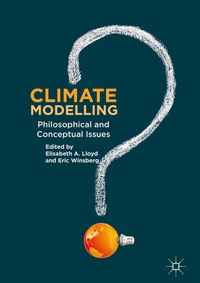
Climate Modelling
Description

This edited collection of works by leading climate scientists and philosophers introduces readers to issues in the foundations, evaluation, confirmation, and application of climate models. It engages with important topics directly affecting public policy, including the role of doubt, the use of satellite data, and the robustness of models.
Climate Modelling provides an early and significant contribution to the burgeoning Philosophy of Climate Science field that will help to shape our understanding of these topics in both philosophy and the wider scientific context. It offers insight into the reasons we should believe what climate models say about the world but addresses the issues that inform how reliable and well-confirmed these models are.
This book will be of interest to students of climate science, philosophy of science, and of particular relevance to policy makers who depend on the models that forecast future states of the climate and ocean in order to make public policy decisions.
More details
Other editions
Additional editions
Persons
Elisabeth A. Lloyd is Arnold and Maxine Tanis Chair of History and Philosophy of Science at Indiana University, USA. She specializes in the philosophy of climate science and the philosophy of evolutionary biology.
Eric Winsberg is Professor of Philosophy at the University of South Florida. His research interests include models and simulations, the philosophy of climate science, and the philosophy of physics, as well as general philosophy of science.
Content
1. Introduction; Elisabeth A. Lloyd and Eric Winsberg .- Section 1: Confirmation and Evidence .- 2. The Scientific Consensus on Climate Change: How Do We Know We're Not Wrong?; Naomi Oreskes .- 3. Satellite Data and Climate Models Redux .- 3a. Introduction to Chapter 3: Satellite Data and Climate Models; Elisabeth A. Lloyd .- Ch. 3b Fact Sheet to "Consistency of Modelled and Observed Temperature Trends in the Tropical Troposphere"; Benjamin D. Santer et al. .- Ch. 3c Reprint of "Consistency of Modelled and Observed Temperature Trends in the Tropical Troposphere"; Benjamin D. Santer et al. .- 4. The Role of 'Complex' Empiricism in the Debates about Satellite Data and Climate Models; Elisabeth A. Lloyd .- 5. Reconciling Climate Model/Data Discrepancies: The Case of the Trees That Didn't Bark; Michael Mann .- 6. Downscaling of Climate Information; Linda O. Mearns et al. .- Section 2: Uncertainties and Robustness .- 7. The Significance of Robust Model Projections; Wendy S. Parker .- 8.Building Trust, Removing Doubt? Robustness Analysis and Climate Modeling; Jay Odenbaugh .- Section 3: Climate Models as Guides to Policy .- 9. Climate Model Confirmation: From Philosophy to Predicting Climate in the Real World; Reto Knutti .- 10. Uncertainty in Climate Science and Climate Policy; Jonathan Rougier and Michel Crucifix .- 11. Communicating Uncertainty to Policy Makers: The Ineliminable Role of Values; Eric Winsberg .- 12. Modeling Climate Policies: A Critical Look at Integrated Assessment Models; Mathias Frisch .- 13. Modelling Mitigation and Adaptation Policies to Predict their Effectiveness: The Limits of Randomized Controlled Trials; Alexandre Marcellesi and Nancy D. Cartwright.
