

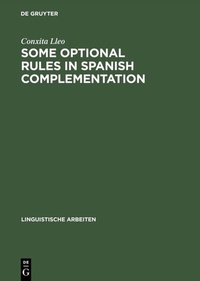
Some optional rules in Spanish complementation
Towards a study of the speaker's intent
1st Edition
Published on 17. August 2015
VI, 201 pages
978-3-11-134604-5 (ISBN)
Description

No detailed description available for "Some optional rules in Spanish complementation".
More details
Series
Edition
Reprint 2015
Language
English
Place of publication
Tübingen
Germany
Publishing group
de Gruyter Mouton
Target group
Professional and scholarly
US School Grade: College Graduate Student
Illustrations
Zahlr. Abb.
Num. figs.
File size
16,07 MB
ISBN-13
978-3-11-134604-5 (9783111346045)
Schweitzer Classification
Other editions
Additional editions
Book
04/1979
1st Edition
De Gruyter
€119.95
Shipment within 7-9 days
Book
01/1979
De Gruyter Mouton
€169.95
Article exhausted; check different version
Content
- Intro
- PREFACE
- INTRODUCTION
- Chapter I. PROBLEMS OF MOOD IN SPANISH COMPLEMENTATION
- 1. Data
- 1.1. Difference of Meaning
- 1.2. Differences of Syntactic Behavior: Root Transformations
- 1.3. More Differences of Syntactic Behavior
- 2. Analyses of the Data
- 2.1. Different Underlying Structures
- 2.11. Different Matrix Verbs
- 2.12. Different Complementizers
- 2.13. Different Complement Clauses
- 2.14. Different Overall Sentential Structures
- 2.2. Identical Underlying Structures
- 2.21. Conditions on Rules
- 2.22. Rules of Complementization
- 3. Further Data
- 3.1. Unexpected Indicatives
- 3.2. Unexpected Subjunctives
- Chapter II. THE RULE OF SUBJECT-RAISING
- 1. Data
- 2. Analyses of the Data
- 2.1. The Raising Analysis
- 2.2. The Equi-NP Deletion Analysis
- 2.3. The Subjectless Infinitive Analysis
- 2.4. Chomsky's Latest Analysis
- 2.5. The Simple Clause Analysis
- 3. Arguments in favor of Subject-raising
- 3.1. Subject-raising into Object
- 3.11. Some Remarks about Equi-NP Deletion
- 3.12. The Inclusion Constraint
- 3.13. Negation of Quantifiers
- 3.14. Pronominalization Constraint
- 3.15. Pseudo-clefts
- 3.16. Speaker-oriented Adverbs
- 3.2. Subject-raising into Subject
- 3.21. Nouns without Determiner
- 3.22. Selectional Restrictions
- 3.23. Non-referential NP's
- 3.24. Haber
- 3.25. Idioms
- 3.26. Duality of Structures
- 4. The Problem of Meaning
- Chapter III. THE RULE OF NEGATIVE-RAISING
- 1. Data
- 2. Analyses of the Data
- 2.1. Syntactic Accounts
- 2.2. (Interpretive) Semantic Account
- 2.3. Lexical Account
- 3. Status of the Arguments for the Spanish Data
- 3.1. Negative Polarity Items
- 3.2. Multiple Negation
- 3.3. Pronominalization
- 3.4. A Classical Argument against Interpretivism
- 4. Meaning and the Rule of Neg-raising
- 4.1. Classes of Neg-raising Verbs
- 4.2. Unexpected Neg-raisers
- Chapter IV. OPTIONAL RULES, PRAGMATICS AND MOOD
- 1. Pragmatic Differences are also Semantic Differences
- 2. The Problem of Meaning-preservingness of Transformations
- 3. Towards Explaining the Relationship among the Optional Transformations
- 3.1. Assertion and Complementation
- 3.2. The Negation of Assertion and Indicative Mood
- 3.3. The Problem of Semi-factives
- 3.4. A Possible Solution to the Problem of Mood
- 3.5. Indicative vs. Non-Indicative
- 3.6. Resistance to Transformations
- Chapter V. EPILOGUE AND PROLOGUE
- 1. Mental Status of the Rules
- 2. Some Examples
- 2.1. Indicative vs. Subjunctive Insertion
- 2.2. Subject-raising
- 3. Towards Developing a "Recognition" Mechanism
- BIBLIOGRAPHY
