

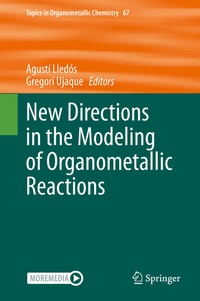
New Directions in the Modeling of Organometallic Reactions
Published on 5. November 2020
IX, 269 pages
978-3-030-56996-9 (ISBN)
Description

This book focuses on the computational modeling of organometallic reactivity. In recent years, computational methods, particularly those based on Density Functional Theory (DFT) have been fully incorporated into the toolbox of organometallic chemists' methods. Nowadays, energy profiles of multistep processes are routinely calculated, and detailed mechanistic pictures of the reactions arise from these calculations. This type of analysis is increasingly performed even by experimentalists themselves. The volume aims to connect established computational organometallics with the more recent theoretical and methodological developments applied to this field. This would allow broadening of the simulation scope toward emergent organometallic areas (as ligand design or photoactivated processes), to narrow the gap between calculations and experiments (microkinetic models) and even to discover new reactions (automated methods).
Given the broad interest and extensiveapplication that computational methods have reached within the organometallic community, this new volume will attract the interest of both experimental and computational organometallic chemists.
Given the broad interest and extensiveapplication that computational methods have reached within the organometallic community, this new volume will attract the interest of both experimental and computational organometallic chemists.
More details
Other editions
Additional editions
Agustí Lledós | Gregori Ujaque
New Directions in the Modeling of Organometallic Reactions
Book
11/2020
Springer
€320.99
Shipment within 7-9 days
Persons
Prof. Agustí Lledós (Barcelona, 1955) obtained a Ph. D. in Chemistry from the Universitat Autònoma de Barcelona (UAB) in 1984. He entered into the field of organometallic chemistry during a postdoctoral stay at the "Laboratoire de ChimieThèorique" of the "Université de Paris-Sud" (1985-86). In 1987 he started at UAB a research group devoted to the computational study of organometallic reactivity and homogeneous catalysis. He was appointed Full Professor of Physical Chemistry at UAB in 1994. The UAB group has pioneered the collaborative experimental-theoretical research in organometallic chemistry. A significant part of Dr. Lledós' scientific production (more than 350 articles) has been published in collaboration with experimental groups. He has also contributed to the formation of researchers in computational organometallic chemistry (25 supervised PhD Thesis) and to the training in computational techniques of experimental researchers (more than 30). He has served asVice-president of the Spanish Chemical Society (RSEQ) between 2012 and 2017. In 2008 he was awarded with the RSEQ-Bruker Award for Physical Chemistry, in 2018 with the Gold Medal of the Organometallic Group of the RSEQ and in 2019 he received the Narcís Monturiol Medal for the Scientific Merit from the Generalitat de Catalunya.
Dr. Gregori Ujaque was born in Torres de Segre (Lleida, Catalonia) in 1971. He obtained his Ph.D. in Chemistry from the Universitat Autònoma de Barcelona (UAB) in 1999 on the field of computational homogeneous catalysis under supervision of Profs. A. Lledós and F. Maseras. He then spent a couple of years at the University of California, Los Angeles (UCLA) with Prof. K.N. Houk working on rational design of catalytic antibodies and organic reactivity using computational chemistry. He returned to UAB contracted by the "Ramon y Cajal" program, obtaining a permanent position in 2007. His main interests are the application ofcomputational methods to the understanding of catalysis, using QM and QM/MM methods and more recently AIMD and QM/MM-MD methods. He enjoys working in several topics as C-C or C-N cross-coupling, hydrogenation, hydroamination, or any type of addition reactions, etc. Several metal catalysts have been objective of his studies, with gold occupying a prominent position; he is also focusing on first row transition metals and main group elements. His interests have recently broadened to modeling Supramolecular Catalysis. He served as associated editor of "Anales de Química" (2018-2020), the journal of the Spanish Chemical Society. Nowadays he is the President of the Catalan Chemical Society (SCQ).
Dr. Gregori Ujaque was born in Torres de Segre (Lleida, Catalonia) in 1971. He obtained his Ph.D. in Chemistry from the Universitat Autònoma de Barcelona (UAB) in 1999 on the field of computational homogeneous catalysis under supervision of Profs. A. Lledós and F. Maseras. He then spent a couple of years at the University of California, Los Angeles (UCLA) with Prof. K.N. Houk working on rational design of catalytic antibodies and organic reactivity using computational chemistry. He returned to UAB contracted by the "Ramon y Cajal" program, obtaining a permanent position in 2007. His main interests are the application ofcomputational methods to the understanding of catalysis, using QM and QM/MM methods and more recently AIMD and QM/MM-MD methods. He enjoys working in several topics as C-C or C-N cross-coupling, hydrogenation, hydroamination, or any type of addition reactions, etc. Several metal catalysts have been objective of his studies, with gold occupying a prominent position; he is also focusing on first row transition metals and main group elements. His interests have recently broadened to modeling Supramolecular Catalysis. He served as associated editor of "Anales de Química" (2018-2020), the journal of the Spanish Chemical Society. Nowadays he is the President of the Catalan Chemical Society (SCQ).
Content
What Makes a Good (Computed) Energy Profile?- Mechanisms of Metal-Catalyzed Electrophilic F/CF3/SCF3 Transfer Reactions from Quantum Chemical Calculations.- Artificial Force Induced Reaction Method for Systematic Elucidation of Mechanism and Selectivity in Organometallic Reactions.- DFT-Based Microkinetic Simulations: A Bridge Between Experiment and Theory in Synthetic Chemistry.- A Quantitative Approach to Understanding Reactivity in Organometallic Chemistry.- Computational Modeling of Selected Photoactivated Processes.- Ligand Design for Asymmetric Catalysis: Combining Mechanistic and Chemoinformatics Approaches.- Dealing with Spin States in Computational Organometallic Catalysis.- Characterizing the Metal Ligand Bond Strength via Vibrational Spectroscopy: The Metal Ligand Electronic Parameter MLEP.
