

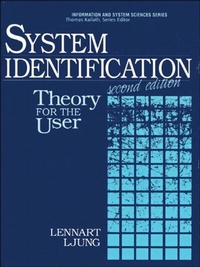
System Identification
Theory for the User
2nd Edition
Published on 29. December 1998
640 pages
978-0-13-244053-0 (ISBN)
Description

The field's leading text, now completely updated.
Modeling dynamical systems - theory, methodology, and applications.
Lennart Ljung's System Identification: Theory for the User is a complete, coherent description of the theory, methodology, and practice of System Identification. This completely revised Second Edition introduces subspace methods, methods that utilize frequency domain data, and general non-linear black box methods, including neural networks and neuro-fuzzy modeling. The book contains many new computer-based examples designed for Ljung's market-leading software, System Identification Toolbox for MATLAB.
Ljung combines careful mathematics, a practical understanding of real-world applications, and extensive exercises. He introduces both black-box and tailor-made models of linear as well as non-linear systems, and he describes principles, properties, and algorithms for a variety of identification techniques:
Nonparametric time-domain and frequency-domain methods.
Parameter estimation methods in a general prediction error setting.
Frequency domain data and frequency domain interpretations.
Asymptotic analysis of parameter estimates.
Linear regressions, iterative search methods, and other ways to compute estimates.
Recursive (adaptive) estimation techniques.
Ljung also presents detailed coverage of the key issues that can make or break system identification projects, such as defining objectives, designing experiments, controlling the bias distribution of transfer-function estimates, and carefully validating the resulting models.
The first edition of System Identification has been the field's most widely cited reference for over a decade. This new edition will be the new text of choice for anyone concerned with system identification theory and practice.
Modeling dynamical systems - theory, methodology, and applications.
Lennart Ljung's System Identification: Theory for the User is a complete, coherent description of the theory, methodology, and practice of System Identification. This completely revised Second Edition introduces subspace methods, methods that utilize frequency domain data, and general non-linear black box methods, including neural networks and neuro-fuzzy modeling. The book contains many new computer-based examples designed for Ljung's market-leading software, System Identification Toolbox for MATLAB.
Ljung combines careful mathematics, a practical understanding of real-world applications, and extensive exercises. He introduces both black-box and tailor-made models of linear as well as non-linear systems, and he describes principles, properties, and algorithms for a variety of identification techniques:
Nonparametric time-domain and frequency-domain methods.
Parameter estimation methods in a general prediction error setting.
Frequency domain data and frequency domain interpretations.
Asymptotic analysis of parameter estimates.
Linear regressions, iterative search methods, and other ways to compute estimates.
Recursive (adaptive) estimation techniques.
Ljung also presents detailed coverage of the key issues that can make or break system identification projects, such as defining objectives, designing experiments, controlling the bias distribution of transfer-function estimates, and carefully validating the resulting models.
The first edition of System Identification has been the field's most widely cited reference for over a decade. This new edition will be the new text of choice for anyone concerned with system identification theory and practice.
All prices
More details
Edition
2nd edition
Language
English
Place of publication
United States
Publishing group
Pearson Education (US)
Target group
College/higher education
File size
25,54 MB
ISBN-13
978-0-13-244053-0 (9780132440530)
Copyright in bibliographic data and cover images is held by Nielsen Book Services Limited or by the publishers or by their respective licensors: all rights reserved.
Schweitzer Classification
Other editions
Additional editions
Book
01/1999
2nd Edition
Pearson
€212.99
Shipment within 15-20 days
Content
1. Introduction.
PART I. SYSTEMS AND MODELS.
2. Time-Invariant Linear Systems.
3. Simulation, Prediction, and Control.
4. Models of Linear Time-Invariant Systems.
5. Models for Time-Varying and Nonlinear Systems.
PART II. METHODS.
6. Nonparametric Time- and Frequency-Domain Methods.
7.Parameter Estimation Methods.
8.Covergence and Consistency.
9. Asymptotic Distribution of Parameter Estimates.
10. Computing the Estimate.
11. Recursive Estimation Methods.
PART III. USER'S CHOICES.
12. Options and Objectives.
13. Affecting the Bias Distribution of Transfer-Function Estimates.
14. Experiment Design.
15. Choice of Identification Criterion.
16. Model Structure Selection and Model Validation.
17. System Identification in Practice.
Appendix I. Some Concepts from Probability Theory.
Appendix II. Some Statistical Techniques for Linear Regressions.
PART I. SYSTEMS AND MODELS.
2. Time-Invariant Linear Systems.
3. Simulation, Prediction, and Control.
4. Models of Linear Time-Invariant Systems.
5. Models for Time-Varying and Nonlinear Systems.
PART II. METHODS.
6. Nonparametric Time- and Frequency-Domain Methods.
7.Parameter Estimation Methods.
8.Covergence and Consistency.
9. Asymptotic Distribution of Parameter Estimates.
10. Computing the Estimate.
11. Recursive Estimation Methods.
PART III. USER'S CHOICES.
12. Options and Objectives.
13. Affecting the Bias Distribution of Transfer-Function Estimates.
14. Experiment Design.
15. Choice of Identification Criterion.
16. Model Structure Selection and Model Validation.
17. System Identification in Practice.
Appendix I. Some Concepts from Probability Theory.
Appendix II. Some Statistical Techniques for Linear Regressions.
