

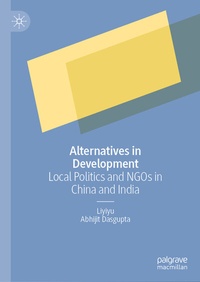
Alternatives in Development
Description

This book deals with the dynamics of local-level politics in China and India. China introduced new policies to restructure local politics in 1978. In place of communes, civil society organizations and cooperatives were introduced in villages. More changes came about with the introduction of the Organic Law of the Villagers' Committees of the People's Republic of China in 1998. The new local power structure includes state-sponsored institutions like Villagers Committees and the traditional civil society organizations (CSOs) and non-government organizations (NGOs). As in China, local politics in India undergoes considerable changes during the last few decades. Panchayati Raj Institutions (PRIs) were reformed in 1992 with a constitutional amendment act. CSOs and NGOs were allowed to function. Against this background, the present book is undertaken with the objectives first, to present two different models of local politics and second, to compare the two, finally to focus on the two different models of development. This book will interest scholars of rural governance, rural transformation, and the role of the grassroots CSOs and NGOs in shaping development program and growth in the two large countries in Asia.
More details
Other editions
Additional editions
Persons
Liyiyu is Professor of Public Administration and currently Director, Comparative Research Centre, School of Law and Politics, Zhejiang Sci-Tech University, China. She has published several books and articles including Rural Civil Society and Rural Development in China: Case Studies (2006), A Comparative Study on Chinese Traditional Administrative Culture Models (2010), and A Comparative Study of Social Governance in China and India (2016).
Abhijit Dasgupta formerly a Professor of Sociology at the Delhi School of Economics, University of Delhi. He has published several papers on agrarian relations in West Bengal and Bangladesh, population displacement, and affirmative action with reference to the minorities in South Asia. He is Author of Growth with Equity: the New Technology and Agrarian Change in Bengal (1998); Displacement and Exile: The State-Refugee Relations in India (2016) and Co-editor of the following books: Minorities and the State: Changing Social and Political Landscape of Bengal (2011) and Family and Kinship among Muslims in Bengal ( 2021).
Content
