

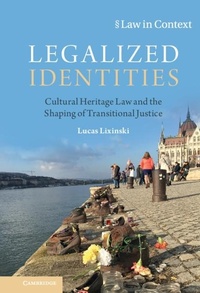
Legalized Identities
Cultural Heritage Law and the Shaping of Transitional Justice
Published on 19. May 2021
252 pages
978-1-108-85487-0 (ISBN)
Description

Cultural heritage is a feature of transitioning societies, from museums commemorating the end of a dictatorship to adding places like the Auschwitz-Birkenau concentration camp to the World Heritage List. These processes are governed by specific laws, and yet transitional justice discourses tend to ignore law's role, assuming that memory in transition emerges organically. This book debunks this assumption, showing how cultural heritage law is integral to what memory and cultural identity is possible in transition. Lixinski attempts to reengage with the original promise of transitional justice: to pragmatically advance societies towards a future where atrocities will no longer happen. The promise in the UNESCO Constitution of lasting peace through cultural understanding is possible through focusing on the intersection of cultural heritage law and transitional justice, as Lixinski shows in this ground-breaking book.
Reviews / Votes
'Bold, imaginative and presented with the author's usual flair and writing skill, this work takes the topic on addressing difficult pasts in transition beyond the strictures of traditional legal mechanisms of transitional justice (TJ) and provides a nuanced and engaging analysis of expansive and creative uses of heritage law as a conduit for the fulfilment of TJ goals. Aside from the intellectual rigor and the clear flow of the arguments, the interdisciplinary approach is the book's strongest suit and it has certainly allowed for a creative and original engagement with the topic. Given the ever-expanding scope and, at the same time, increased specialization of broadly comprehended heritage studies, it is rare for a legal scholar to engage across these specialized fields with such depth and dedication.' Berenika Drazewska, International Law Agendas Brazil Symposium 'In summary, the book Legalized Identities: Cultural Heritage Law and the Shaping of Transitional Justice by Professor Lucas Lixinski addresses fundamental questions related to the role of cultural heritage in transitional justice. By analyzing several case studies, the book highlights the challenges and advantages of instrumentalizing cultural heritage in the process of building a peaceful society after a conflict. Moreover, it proposes a new manner to think the use of memory and cultural heritage in this context. It is an important and comprehensive piece of legal literature on the subject.' Alice Lopes Fabris, International Law Agendas Brazil Symposium 'Legalized Identities is a creative and though-provoking piece of work. Its arguments allow us to reflect not only on legal norms and practices that shape memory and culture in transitional contexts, but also on the political projects involved in these fields.' Joao Roriz, International Law Agendas Brazil Symposium 'This book is well written and is a fairly unique addition to the extant scholarship on cultural heritage and transitional justice ... This text would be an invaluable addition to the collections of academic and law school libraries, particularly those offering courses in human rights, intellectual property, and traditional knowledge, as well as to any researchers or policy makers who focus on UNESCO, cultural heritage, and the cultural and social aspects of post-conflict transitioning societies.' Julie A. Lavigne, Canadian Law Library ReviewMore details
Series
Language
English
Place of publication
Cambridge
United Kingdom
Target group
Professional and scholarly
Illustrations
Worked examples or Exercises
File size
5,78 MB
ISBN-13
978-1-108-85487-0 (9781108854870)
Copyright in bibliographic data and cover images is held by Nielsen Book Services Limited or by the publishers or by their respective licensors: all rights reserved.
Schweitzer Classification
Other editions
Additional editions
Book
04/2021
Cambridge University Press
€140.30
Shipment within 15-20 days
Person
Content
1. Introduction; 2. Identity, Memory, and Transitional Justice; 3. Conservation and Reinvention: Remaking Symbols; 4. Erasing or Replacing Symbols; 5. Creating New Symbols; 6. Cultural Heritage as Pragmatism; 7. Conclusions.
