

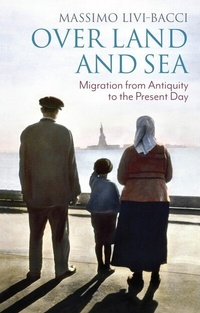
Over Land and Sea
Description

Human history has always been marked by the mobility of people and populations, from the earliest movement of human beings out of Africa to the flows of migrants and refugees today. While mobility is intrinsic to human nature, migration is not always voluntary: it can be the result of free choice, but it can also be forced, in different ways and to varying degrees.
In this book, Massimo Livi-Bacci examines migrations past and present with reference to the degree of free choice behind them. The degree can be minimal, as when migration is compelled by war, natural disaster or the actions of a tyrant, but in other cases the decision to migrate can be fully voluntary and deliberate, as when individuals and groups weigh up their options and decide whether to move. Between these two poles there is a continuum of different situations, with gradually increasing or decreasing degrees of freedom and choice. Livi-Bacci explores these variations by focusing on fifteen stories of migration from Antiquity to the present day, ranging from the Greek colonization of the Eastern Mediterranean in the Ancient world to the great migration of millions of people from Europe to the Americas in the nineteenth and twentieth centuries. Taken together, these stories of human movement shed fresh light on the millennia-long history of migration and its motivations, causes and consequences.
More details
Other editions
Additional editions
Persons
Content
Introduction
I. Antiquity
1.1. Seneca, two thousand years ago
1.2. Settlers and founders: ápoikoi and oikistés
1.3 Augustus's Res gestae
1.4. Peoples on the march
II. In the Hands of the State
2.1. Forced migration
2.2. Peru: up and down the Andes
2.3. The end of an empire
2.4. The Soviet Union and its internal enemies
III. Misdeeds of Nature
3.1. Unkind nature
3.2. Drought
3.3. A Caribbean odyssey
3.4. Ireland: the blight of diaspora
IV. Organised Migration
4.1. On the road, not alone
4.2. The filles du roi in the laboratory of Nouvelle France
4.3. The Drang nach Osten and the Germanisation of Eastern Europe
4.4. From the Rhine to the Volga with Catherine the Great
V. Free Migration
5.1. A Rare Phenomenon
5.2. Moving freely
5.3. The Great Transoceanic Migration
5.4. America: the "advancing wave" of migration
Reconsiderations
Notes
Index
II
In the Hands of the State
2.1. Forced migration
Moving and shifting across territory are human prerogatives. Inscribed in the biology and sociality of individuals, these practices are functional to the pursuit of well-being and survival. Migration, when it is voluntary, represents a concrete exercise of these prerogatives. But its voluntariness is never absolute, and stands as the positive pole of a spectrum that has its opposite, negative pole in forced migration, including cases of expulsion, displacement or deportation. These take different forms, depending on the context and the historical era; here, we are referring to settled populations that are uprooted from their homes and forcibly transplanted elsewhere.
The examples presented here do not include the most imposing case of forced movement in the modern history of the Western world: namely, the deportation of slaves from Africa, which has profoundly affected the ethnic and human geography of the American continent. Its exclusion may be justified, in a formal sense, by the fact that these pages are dedicated to Europe and the Americas, and not to the other continents. But that is a very weak justification. Indeed, the traffic in slaves has had enormously important effects on the Americas; suffice to mention that some two hundred million people, out of their one billion inhabitants, today call themselves either 'Blacks', north of the Rio Grande, or 'Afrodescendientes' south of it. However, the real reason for excluding this example is that the slave trade is a historical fact of such scope, duration and dimension, and of such tremendous cruelty, that it requires an exclusive treatment that finds no fitting space here. Two centuries ago, Alexander von Humboldt wrote that 'Slavery is possibly the greatest evil ever to have afflicted humanity', having observed many aspects of it during his five-year exploration of South America.1
A few quick reminders of some aspects of trafficking. Careful studies of archival material have concluded that between 1500 and the latter part of the nineteenth century - when trafficking, which had become illegal earlier that century, ran out of illegal arrivals -between ten and eleven million Africans were disembarked in American ports. But these were only the ones who survived the terrible conditions of travel on the slave ships, and in fact the number of slaves embarked in Africa was considerably higher.2 About two-thirds of the slaves were young adult men (piezas de India),3 and the remaining one-third women and children. The slaves came from the west coast of Africa, from Senegal to Angola, and a small minority also from the east. About half were taken to the Caribbean islands owned by the Spanish, French, British and Dutch; a good third to Brazil; and the remainder to the southern part of the present-day United States and the South American colonies, later ex-colonies, of Spain. About two-thirds of the slaves were brought to America between 1750 and 1850.
The transatlantic slave trade was not undertaken for the purposes of populating the American continent, but rather to provide a cheap, mostly male, workforce for production and services, which could supplement or replace a native workforce that was too scarce and in sharp decline after contact with Europeans. It is almost as if this were a raw material, forcibly extracted from the African continent to feed the New World, according to the needs of the market. The enslaved population had a very high mortality rate and - given the hindrances placed on family formation and reproduction - a very low birth rate; it had to be fed by new arrivals to prevent its numbers from declining. On the large sugar-cane plantations in the Caribbean and Brazil, it was widely believed that it was cheaper to buy slaves on the market to fill gaps, rather than to invest in the welfare of the enslaved people and sustain their reproduction.
The three cases of forced migration narrated here are very different. The first, concerning the Inca Empire, is the least traumatic: it is about forced transplants of entire communities made to consolidate the new territories acquired in the process of imperial expansion in the fifteenth and sixteenth centuries, and to dilute and integrate the populations inhabiting them. These displacements were not undertaken for punitive purposes: indeed, the communities forced to migrate retained many of their prerogatives and also acquired new ones. But they were still forced displacements. The Spanish also subjected Peruvian populations to a radical process of displacement in order to alter settlement patterns in the colony and thus achieve a better social control of the population. The second case concerns the Ottoman Empire, in its twilight years, before, during and after its end. This twilight was characterized by the internal displacement of minorities and population exchanges with neighbouring states. In these tumultuous years, forced migrations resulted in the genocide of the Armenian minority, actions to exterminate the Greek minority, and the forcible exchanges of large communities: Greeks from Anatolia to Greece, and Turks from Greece to their homeland. Religious factors weighed heavily in the Ottoman case, and through Europe's history they would also prompt other forced migrations: conspicuous examples include the expulsion of the Jews and then the Moriscos from Spain and the exodus of the Huguenots from France. In the third case, concerning the Soviet Union during the Second World War, these were 'internal' forced migrations, or rather outright deportations, of minorities suspected of consorting with the enemy or otherwise deemed politically unreliable. The ethnic groups of Koreans, Germans, Finns, Tatars, Chechens, Ingush, and many others, were relocated to distant and peripheral areas of this country's boundless territories. More generally, the two world wars, with the redrawing of the map of Europe, population exchanges aimed at ethnic homogeneity, forced migrations and waves of refugees generated massive population displacements which escaped individual willingness or choice.
In modern times, population removals are relatively rare; more frequent are the expulsions and flight caused by conflicts and violence involving millions of people, officially considered 'refugees' by international institutions. In 2021, the number of refugees forced to leave their homelands, according to the United Nations' special agency (UNHCR), amounted to 27 million, plus 48 million people forcibly displaced within their own countries. This is a kind of pathology of mobility, which increased conflict has turned into a mass phenomenon. If we consider that according to UN assessments, the total inventory of migrants in the world (people living in a country other than their land of birth) counts not far from three hundred million people, we can say that for every ten migrants there is one who is forcibly displaced outside their own country. In the past, the partition of the British Raj (Anglo-Indian Empire) between India and Pakistan in 1947 resulted in a number of refugees variously estimated at between ten and twenty million; in 1983, the expulsions of Ghanaians and other irregular West African migrants from Nigeria affected more than two million people; the wars in Yugoslavia in the decade between 1991 and 2001 generated more than four million refugees and internally displaced persons. In the last decade, the expulsion and deportation of a million Rohingya from Myanmar to Bangladesh is still an open wound, as is that generated by the countless refugees from the civil war in Syria and Russia's attack on Ukraine.
History is replete with examples of forced migration. While the great variety of situations precludes any real counting of the numbers, there is no doubt that the passing of time has been unable to alleviate the pathologies that cause it.
2.2. Peru: up and down the Andes
The Inca took Indians from Nanasca to transplant them to the banks of the river Apurímac, because that river, from the royal road that passes from Cuzco to Rimac, flows through such a hot region that the Indians of the sierra, from a cold or temperate climate, cannot live in such heat, but fall ill and die. So, as already mentioned, the Incas stipulated that, when they transplanted Indians from one province to another in this way, what they called mítmac, they would always draw a comparison between the regions, making sure that the climate there was the same, so that the difference in conditions was not harmful, such that moving them from a hot region to a cold one, and vice versa would not cause them to die. For this reason, it was forbidden to bring Indians from the sierras to the plains because, with all certainty, they would perish within a few days. (Garcilaso de la Vega)4
In ancient Peru, despite the ruggedness of the terrain, mobility was not a problem: it is said that the Inca in Cuzco could every day enjoy fresh fish caught in the ocean more than three thousand metres below. This is probably a myth, but the ingenuity of the Inca people and the ever-expanding size of the empire, as well as the need to govern it, had endowed the country with a road network second only to that of the Roman Empire, from sea level to the highlands over 4,000 metres above sea level. To consolidate such an extensive empire, formed in a relatively short period (essentially in the fifteenth century), the Incas often resorted to the practice of forced migration of the populations there. Pedro Cieza de León, who had headed to...
