

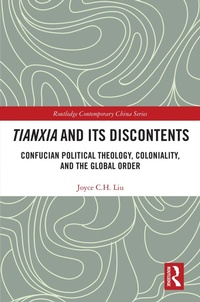
Tianxia and Its Discontents
Confucian Political Theology, Coloniality, and the Global Order
Published on 10. June 2026
312 pages
978-1-040-60726-8 (ISBN)
Description

Across imperial histories and contemporary digital infrastructures, Tianxia and Its Discontents challenges the enduring assumption that the Chinese notion of tianxia-"all under heaven"-offers a benign or alternative vision of world order.
It argues instead that Tianxia operates as a colonial dispositif: a mode of power that organises space, hierarchy, and subjectivity while masking domination in the language of moral inclusion.
Rather than countering Western imperialism, Tianxia constitutes a parallel-and increasingly entangled-formation of global domination. In its contemporary mutations, it extends through biopolitics, the economisation of psyche, and regimes of algorithmic governance, where data infrastructures and predictive systems restructure life at a planetary scale. Beneath the rhetoric of harmony, connectivity, and development, the book exposes the emergence of a Digital Tianxia: an infrastructural empire sustained by extraction, illegality, and carceral control
across transnational zones.
Combining theoretical innovation with historically grounded analysis, the book makes a distinctive contribution by developing the concept of surplus (yu ?) as a method of immanent critique, opening new pathways for rethinking coloniality, governance, and resistance. It will appeal to scholars and advanced students in global studies, political philosophy, Asian history, and media and technology studies, and is well suited for courses on geopolitics, digital governance, and postcolonial theory.
It argues instead that Tianxia operates as a colonial dispositif: a mode of power that organises space, hierarchy, and subjectivity while masking domination in the language of moral inclusion.
Rather than countering Western imperialism, Tianxia constitutes a parallel-and increasingly entangled-formation of global domination. In its contemporary mutations, it extends through biopolitics, the economisation of psyche, and regimes of algorithmic governance, where data infrastructures and predictive systems restructure life at a planetary scale. Beneath the rhetoric of harmony, connectivity, and development, the book exposes the emergence of a Digital Tianxia: an infrastructural empire sustained by extraction, illegality, and carceral control
across transnational zones.
Combining theoretical innovation with historically grounded analysis, the book makes a distinctive contribution by developing the concept of surplus (yu ?) as a method of immanent critique, opening new pathways for rethinking coloniality, governance, and resistance. It will appeal to scholars and advanced students in global studies, political philosophy, Asian history, and media and technology studies, and is well suited for courses on geopolitics, digital governance, and postcolonial theory.
Reviews / Votes
'This remarkable and groundbreaking work rethinks Chinese history and thought through the lens of the imperial logic of tianxia. Few scholars possess Joyce Liu's breadth of cross-disciplinary knowledge. Drawing on intellectual history, global studies of colonialism, and critical theory, she maps geographies of domination while working within and against them to open new horizons for a politics of liberation in East Asia and beyond. Tianxia and Its Discontents is both a major scholarly achievement and a committed political intervention, urgently needed in our turbulent present.'Sandro Mezzadra, Professor, Department of the Arts, University of Bologna, Italy
'With such boldness and force, few scholars have ever bridged this diversity of disciplinary fields: the history of ideas, colonial studies, and digital governance. Liu's study not only reinterprets Confucian political theology but also illuminates its contemporary dynamics in the Sinocentric world. A major contribution to our understanding of the politics of knowledge production in the twentieth-first century.'
Naoki Sakai, Distinguished Professor of Arts and Sciences in Asian Studies Emeritus at Cornell University, USA
'With extraordinary skill and theoretical prescience, Liu combines her deep understanding of Confucian political theology, colonial logics, and the twenty-first century development of capitalism to present possibilities of thinking of the postcolonial age in a new way. A seminal contribution to a long duree historical understanding of the Asian world.'
Ranabir Samaddar, Distinguished Chair in Migration and Forced Migration Studies, Calcutta Research Group, Kolkata, India.
'A perspicacious reading of political Confucianism wedded to a nuanced analysis of China's Belt and Road Initiatives as a colonial cartographic project in material and digital worlds, Liu's work exposes the imperial unconscious in China's Tianxia discourse to advance a critique of empire for the present and a theorization of the remainder as the hope for the future. It's a field changing work that researchers on China, past and present, cannot miss.'
Andy Chih-Ming Wang, Research Fellow (Professor) and Deputy Director, Institute of European and American Culture Studies, Academia Sinica, Taiwan
'Tianxia and Its Discontents is a groundbreaking work that examines the issue of decolonization from the perspective of East Asia. Engaging critically with postcolonial theory, Professor Liu situates the discussion within the specific historical and cultural contexts of East Asia. The work not only enriches global discourses in critical theory but also addresses the formidable challenges of pursuing decolonization amid East Asia's intricate political thought and cultural configurations, thereby offering a significant intervention from the perspective of the humanities.'
Masahisa Suzuki, Professor, Graduate School of Humanities and Sociology, The University of Tokyo, Japan
'More than just critically analyzing Chinese visions of world order, Liu turns them inside out. Reading the history of Confucian thought against its official formulations, Tianxia and its Discontents recovers what was always there: not hierarchy dressed as harmony, but resources for living side by side.'
Brett Neilson, Professor and Deputy Director at the Institute for Culture and Society at Western Sydney University, Australia.
'This groundbreaking book, besides giving an insight into centuries of China's governance thought and politics, and its overlooked colonial appetites, also allows unexpected questions on the reshuffling of contemporary imperialisms. They are now mainly two, China's and the USA's, reconstructing a new worldwide binary, instead of 'capitalism' and 'socialism' of the historic cold war in the 20th century. But where is now the tertium datur, the Non-aligned movement of the 21st century, one wonders? Is there an alternative, a 'third way'? It is still to come. Europe is not it, neither is it - yet - the Global South nor, of course, the BRICS countries. Few scholars bridge intellectual history, coloniality studies, and digital governance with such clarity and force. Liu's study not only reinterprets Confucian political theology but also illuminates its transformations in contemporary geopolitics. A major contribution to our understanding of imperial power(s) and their dynamics in the 21st century. This book will encourage scholars to search further.'
Rada Ivekovic, philosopher, former Research director at the College international de philosophie, Paris, full professor at universities in Yugoslavia and France.
More details
Series
Language
English
Place of publication
London
United Kingdom
Publishing group
Taylor & Francis Ltd
Target group
College/higher education
Professional and scholarly
Product notice
Reflowable
Illustrations
9 Halftones, color; 27 Halftones, black and white; 9 Illustrations, color; 27 Illustrations, black and white
File size
10,52 MB
ISBN-13
978-1-040-60726-8 (9781040607268)
Copyright in bibliographic data and cover images is held by Nielsen Book Services Limited or by the publishers or by their respective licensors: all rights reserved.
Schweitzer Classification
Other editions
Additional editions
Joyce C. H. Liu
Tianxia and Its Discontents
Confucian Political Theology, Coloniality, and the Global Order
Book
06/2026
1st Edition
Routledge
€204.50
Shipment within 15-20 days
Person
Joyce C.H. Liu is Professor Emerita and Director of the International Center for Cultural Studies at National Yang Ming Chiao Tung University, Taiwan. A leading scholar in critical theory and global cultural studies, her research spans geopolitics, biopolitics, internal coloniality, and Chinese political thought. Her work examines the intersections of political theology, subjectivity, and infrastructural power in both imperial and contemporary contexts. She is the author of One Divides into Two, The Topology of Psyche, and numerous books and articles on culture, power,
and decolonisation.
and decolonisation.
Content
Acknowledgement
Note on Earlier Versions
List of Figures
Introduction: Inside the Shadow of Tianxia
Part I - The Order of Tianxia
1. What is Tianxia?
2. Tianxia versus Nomos of the Earth: The Material Apparatus of Tianxia's Colonial Character
Part II - Beyond Empire: The Persistence of Tianxia Structures in the Modern Nation-State
3. When Enlightenment Mutates: The Great Transformation of Tianxia and the Semiotic Syncretism of Knowledge
4. The Economisation of Psyche: Mental Force between Enlightenment, Political Economy, and Confucian Political Theology
5. Waves upon Waves: Confucian Revivals and the Authoritarian Desire for Legitimacy
6. Heaven and Humanity as One: Civilisational Fallacies and the Afterlife of Tianxia
Part III - Digital Tianxia: The Algorithmic Empire and the Return of Harmony
7. The Rise of China in the Twenty-First Century and the Transformation of the Tianxia Order
8. The Digital Tianxia and the Upgrading of Colonial Despotic Techniques
9. The Darker Side of Tianxia and Its Underground Rhizomes
Part IV - Outside of Tianxia? Cracks, Surplus, Beginnings
10. The Struggle between Confucianism and Legalism: Rethinking the Limits of Confucian Theology and the Possibility of Internal Critique
11. The Antinomy of Tianxia and Coexistence: Fang Yi-Zhi's Continuous Critique from Within
12. Artistic Decolonization: Xu Bing, Wu Tien-Chang, Chen Chieh-Jen
Epilogue - Coexistence Without Capture
References
Index
Note on Earlier Versions
List of Figures
Introduction: Inside the Shadow of Tianxia
Part I - The Order of Tianxia
1. What is Tianxia?
2. Tianxia versus Nomos of the Earth: The Material Apparatus of Tianxia's Colonial Character
Part II - Beyond Empire: The Persistence of Tianxia Structures in the Modern Nation-State
3. When Enlightenment Mutates: The Great Transformation of Tianxia and the Semiotic Syncretism of Knowledge
4. The Economisation of Psyche: Mental Force between Enlightenment, Political Economy, and Confucian Political Theology
5. Waves upon Waves: Confucian Revivals and the Authoritarian Desire for Legitimacy
6. Heaven and Humanity as One: Civilisational Fallacies and the Afterlife of Tianxia
Part III - Digital Tianxia: The Algorithmic Empire and the Return of Harmony
7. The Rise of China in the Twenty-First Century and the Transformation of the Tianxia Order
8. The Digital Tianxia and the Upgrading of Colonial Despotic Techniques
9. The Darker Side of Tianxia and Its Underground Rhizomes
Part IV - Outside of Tianxia? Cracks, Surplus, Beginnings
10. The Struggle between Confucianism and Legalism: Rethinking the Limits of Confucian Theology and the Possibility of Internal Critique
11. The Antinomy of Tianxia and Coexistence: Fang Yi-Zhi's Continuous Critique from Within
12. Artistic Decolonization: Xu Bing, Wu Tien-Chang, Chen Chieh-Jen
Epilogue - Coexistence Without Capture
References
Index
